
Variants most common in DNA damage repair genes including BRCA2, ATM, TP53, CHEK2 and BRCA1; prevalence rises to 32.3% in high-risk groups
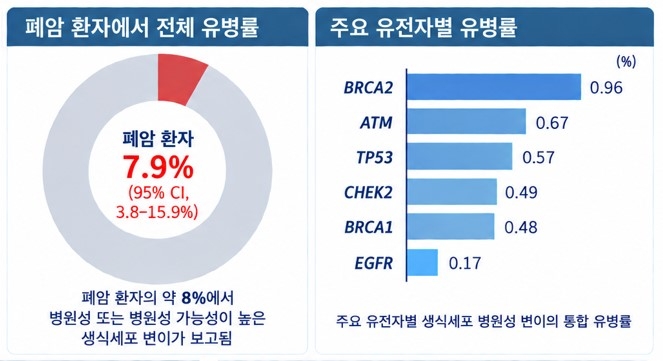
A team of Korean researchers has published a meta-analysis finding that 7.9% of lung cancer patients carry germline pathogenic or likely pathogenic variants that may contribute to cancer development. The prevalence climbed to about 32% among high-risk patients selected on the basis of a family history of lung cancer, young age at onset or multiple primary lung cancers.
Lung cancer is one of the leading causes of cancer death worldwide, with smoking widely recognized as the primary risk factor. Yet cases arising in non-smokers or younger patients are difficult to explain through environmental factors alone, fueling growing interest in genetic predisposition. Previous studies have been limited in their ability to map the distribution of germline pathogenic variants comprehensively, owing to differences in study populations and the scope of genetic testing.
A joint research team — comprising Lee Ji-young of the Department of Radiology, Kim Si-hyun of the Department of Clinical Genomic Medicine, Na Kwon-joong of the Department of Thoracic and Cardiovascular Surgery, and Koo Jin-mo of the Department of Radiology at Seoul National University Hospital, along with Yoon Soon-ho of the Department of Radiology at National Jewish Health — pooled data from 28 lung cancer studies to analyze the overall and gene-specific prevalence of germline pathogenic or likely pathogenic variants and the factors associated with them.
The overall prevalence of such variants among lung cancer patients was 7.9%, with the highest rates found in genes involved in DNA damage repair. By gene, the prevalence ranked as follows: BRCA2 (0.96%), ATM (0.67%), TP53 (0.57%), CHEK2 (0.49%) and BRCA1 (0.48%).
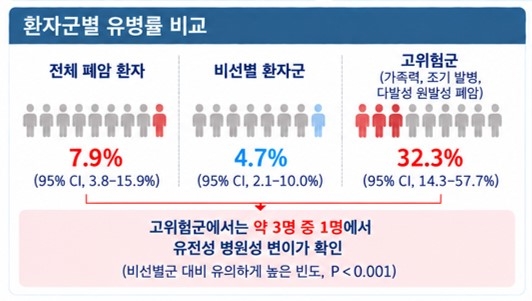
The study also found significant differences in prevalence based on patients' clinical characteristics. The high-risk group — selected on the basis of family history, young age at onset and multiple primary lung cancers — had a prevalence of 32.3%, significantly higher than the 4.7% seen in unselected patients.
Analysis by genetic background showed no significant difference in overall prevalence, but variants in major DNA damage repair genes were more common in non-Asian and mixed-race populations than in East Asians. Studies with a lower mean patient age and a larger number of genes tested also tended to show higher prevalence of pathogenic variants.
"This study found a high prevalence of germline pathogenic variants in patients with high-risk characteristics such as a family history of lung cancer and young age at onset," said Lee Ji-young, a professor of radiology at Seoul National University Hospital. "These findings could serve as foundational data for examining the role of tailored genetic assessment in high-risk patients, and suggest the possibility of contributing to cancer prevention and early diagnosis for patients and their families."
Kim Si-hyun, a professor of clinical genomic medicine at Seoul National University Hospital, said genetic predispositions such as BRCA1/2 variants are well established in breast and ovarian cancers, but the distribution and characteristics of genetic factors in lung cancer have been comparatively underexplored. "This study is significant in that it systematically presents the genetic predisposition to lung cancer by synthesizing existing research," he said. The findings were published online in the Journal of Thoracic Oncology (impact factor: 23.3).

kty@heraldcorp.com





