
Some programs measured participant satisfaction instead of actual employment outcomes
Park Jung calls for overhaul of evaluation system to reflect real hiring results
![A job support center at a university in Seoul [Yonhap]](https://wimg.heraldcorp.com/news/cms/2026/10/13/rcv.YNA.20260909.PYH2026090912460001300_P1.jpg)
Youth employment fell by 178,000 last year and the youth employment rate declined, yet performance indicators for the Ministry of Employment and Labor's youth job programs showed most targets had been met.
Critics say some programs use participant satisfaction scores — rather than actual job placement rates — as their key performance metric, and that the evaluation framework needs to be revised to reflect real employment outcomes.
Democratic Party of Korea lawmaker Park Jung, a member of the National Assembly's Climate, Energy, Environment and Labor Committee, said Tuesday that data submitted by the Ministry of Employment and Labor showed most performance indicators for youth employment policy programs had met their targets.
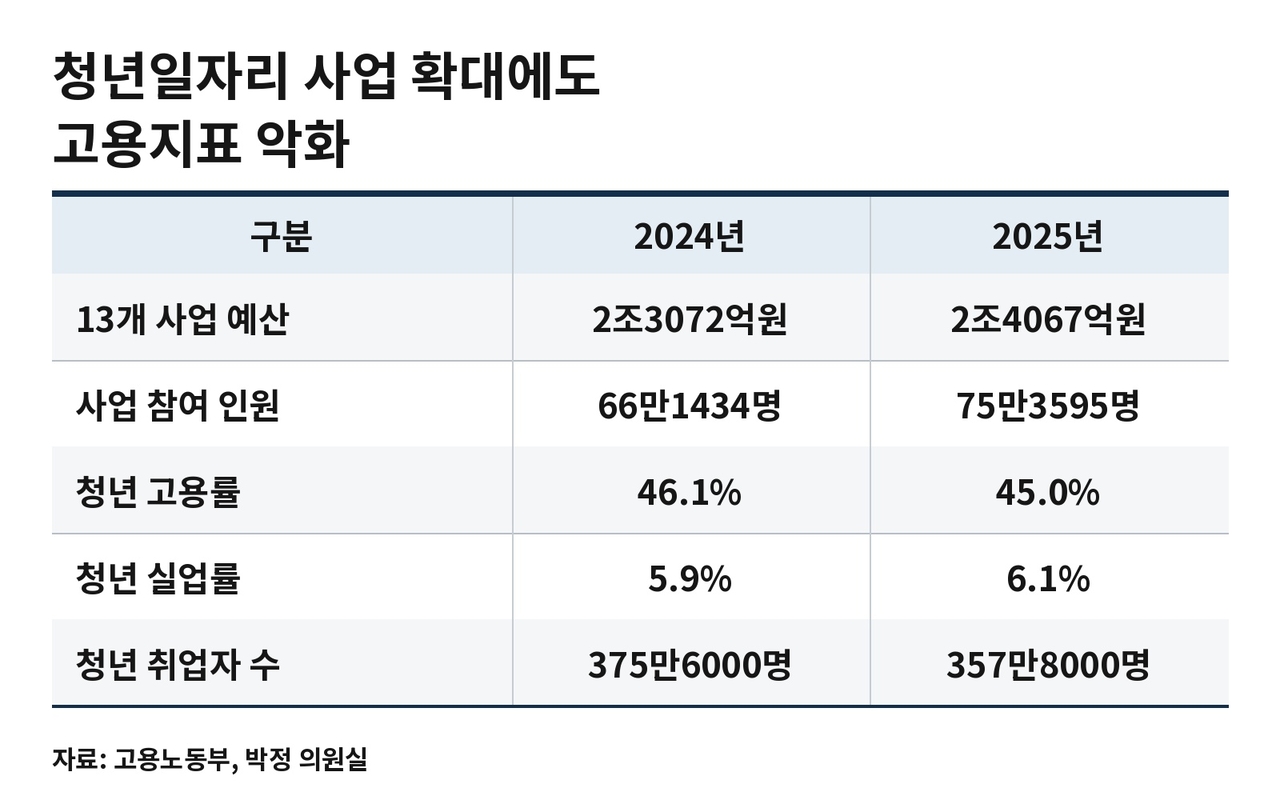
Youth employment conditions, however, deteriorated. The youth employment rate fell 1.1 percentage points last year to 45.0 percent. The number of employed young people dropped from 3.756 million in 2024 to 3.578 million last year, a decline of 178,000. Over the same period, the youth unemployment rate rose from 5.9 percent to 6.1 percent.
Program budgets and participation numbers both increased. The combined budget for 13 youth job programs covered in the data grew from 2.31 trillion won ($1.72 billion) in 2024 to 2.41 trillion won last year, while the number of participants expanded from 661,434 to 753,595. Support grew and performance targets were met, yet youth employment indicators moved in the wrong direction.
Some programs used participant satisfaction as their primary performance metric. While satisfaction scores reflect how participants rate a program, they offer limited insight into whether participants actually secured employment. Critics argue it is difficult to assess how much the programs contributed to easing youth unemployment based solely on whether stated targets were achieved.
"There is a growing gap between the reality of youth employment and what policy performance indicators show," Park said. "The performance evaluation framework needs a comprehensive overhaul so that it measures how much policy is actually helping young people find the jobs they want."
fact0514@heraldcorp.com





