
'Not aware of any current privatization plan,' chief says
Cheon Ha-ram calls it a critical national security issue
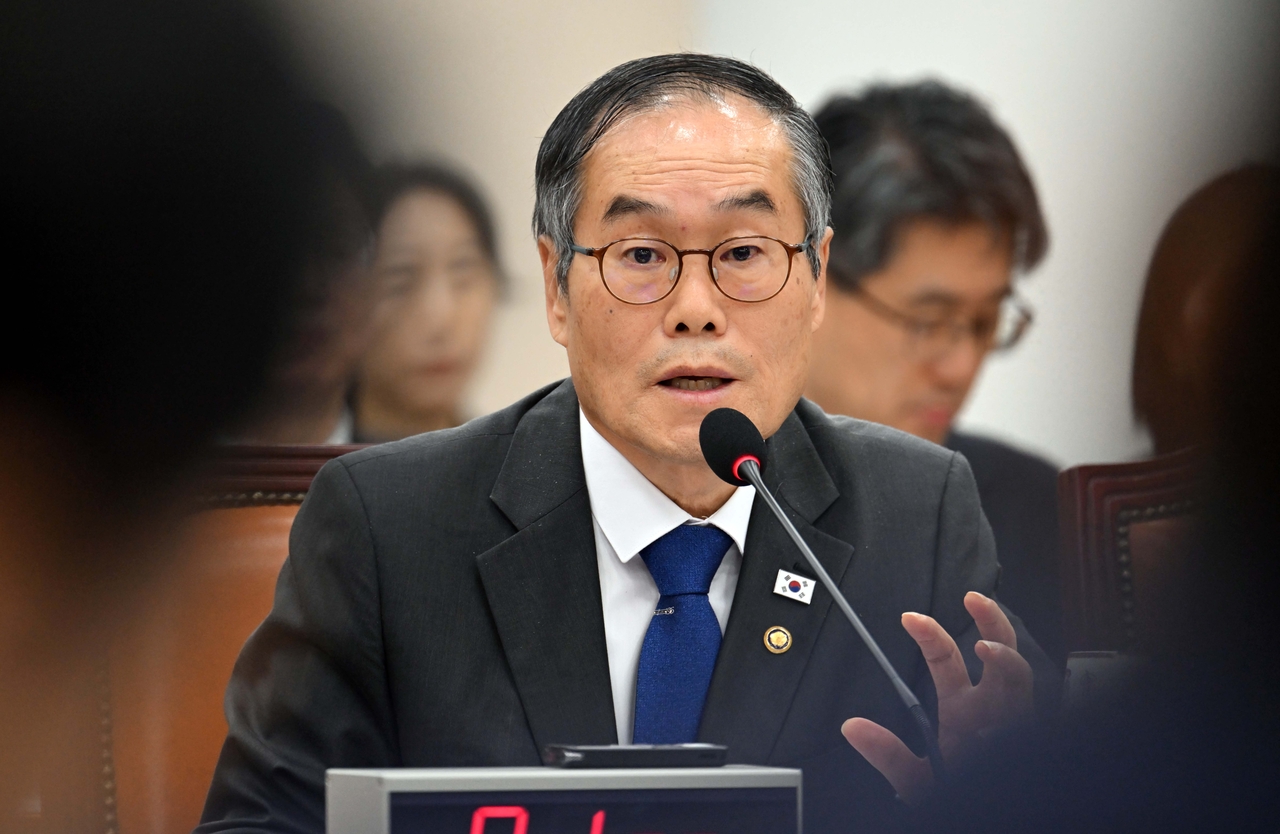
Lawmakers raised concerns Tuesday that Hanwha Group's potential acquisition of Korea Aerospace Industries could create a defense industry monopoly and pose risks to national security, calling for a thorough review of both the competitive implications and the timing of any sale — particularly as KAI's revenue is expected to surge with the full-scale mass production of the KF-21 fighter jet.
Defense Acquisition Program Administration Chief Lee Yong-cheol, appearing before the National Assembly's National Defense Committee national audit, said he agreed that "there are many variables that need to be examined from a national interest perspective" after People Power Party lawmaker Cheon Ha-ram raised concerns about the possibility of a defense monopoly and the appropriateness of the sale's timing. "When we offer our opinion, we will review it thoroughly," Lee said.
Cheon said Hanwha had secured a 15.89 percent stake in KAI and raised the possibility of a full acquisition. He noted that it was "somewhat unusual" to be discussing a merger and acquisition of a company held in the public sector at this stage.
Cheon questioned whether the government was "opening the door" to Hanwha's acquisition of KAI, citing President Lee Jae-myung's remarks at the National Space Council. Lee said he was "not aware of any current privatization plan."
Cheon's core concerns centered on the concentration of defense capabilities and the timing of a potential sale. He said Hanwha's acquisition of KAI was "not simply a matter of one company's merger and acquisition, but an issue that would have a major impact on the entire defense industry and national security."
He said a combined Hanwha-KAI entity would account for 40 to 50 percent of domestic defense industry sales, and 60 to 70 percent when measured against the top four companies — warning that defense capabilities across the land, maritime, aviation and space sectors could all become concentrated within a single conglomerate.
Cheon asked whether there was any global precedent for a single company holding an overwhelming No. 1 position across a country's land, sea, air and space sectors. Lee acknowledged that "in terms of market share within a single country, there would likely be a fairly significant concentration."
Cheon also questioned whether it was appropriate to discuss a sale at a time when KAI was just beginning to reap the rewards of its massive research and development investments.
"According to data I received from KAI, the company is projected to generate 90 trillion won ($67.4 billion) in sales over the next 10 years," Cheon said. "It has been pouring money into KF-21-related R&D and is now just starting to make a return."
"This is not about checking a specific company — the scale is simply so large that it is an important issue from a national security standpoint," he said, urging the government to examine both the monopoly concerns and the timing of any sale from a national interest perspective.
rimsclub@heraldcorp.com





