
Skin analysis, custom manufacturing to get support; on-site pharmacist rules to be eased
7.2 billion won for AI development; medical tourism visas, regional hubs also targeted
![Deputy Prime Minister and Minister of Economy and Finance Lee Hyung-il [Yonhap]](https://wimg.heraldcorp.com/news/cms/2026/10/14/rcv.YNA.20261012.PYH2026101201100001300_P1.jpg)
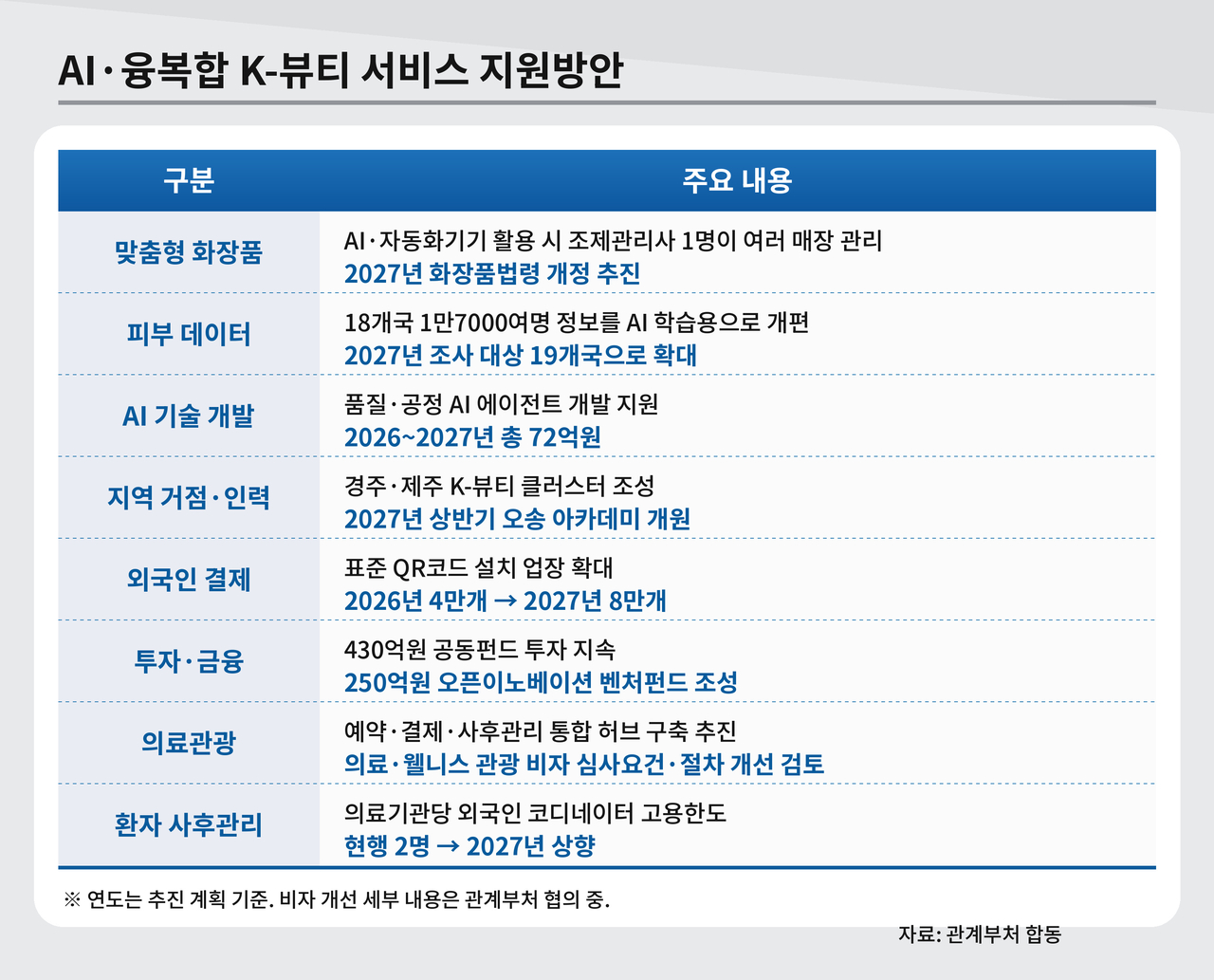
A camera scans a customer's face, AI analyzes the skin condition and recommends cosmetics, and a robot blends ingredients tailored to the individual. The government plans to nurture this kind of personalized beauty service by expanding research and development support and skin data resources. Regulations requiring a licensed formulation manager to be present at each cosmetics store using AI and automated equipment will also be eased, allowing a single manager to oversee multiple locations.
Deputy Prime Minister and Minister of Economy and Finance Lee Hyung-il announced the plan Wednesday at Government Complex Seoul during a joint session of the Emergency Economic Headquarters, the Economic Ministers' Meeting and the Service Industry Development Task Force. The initiative, titled "AI and Convergence Support Plan for the K-Beauty Industry," aims to transform the manufacturing-focused industry into a high-value service sector integrating skin analysis, customized production and medical tourism.
Domestic companies are already developing AI-powered skin analysis and personalized product solutions. Lululab's AI skin analysis solution scans the face and uses big data to recommend cosmetics and treatment options. Kolmar Korea is developing a device called the Scar Beauty Device that photographs a wound, uses AI to analyze it, and then precisely sprays a combination of a treatment matched to the patient's skin tone and a cover makeup powder. The Ministry of Food and Drug Safety said it is in discussions with the industry on how to commercialize the Kolmar Korea device.
The customized cosmetics manufacturing process works by measuring a customer's skin condition, using AI analysis to determine the ingredient blend, and then having automated equipment mix the components into a finished product. To help this model spread, the government plans to revise the rule requiring a licensed formulation manager to be on-site at every store. It will pursue an amendment to the Cosmetics Act next year to allow a single manager to oversee ingredient and equipment quality, hygiene and finished-product safety across multiple locations.
The government will gather industry feedback based on a regulatory sandbox pilot that has been running from 2022 through the end of this year, and will draw up inspection and evaluation guidelines to ensure consistent quality from automated equipment.
Data support for AI skin analysis will also be strengthened. A skin data bank holding information on the skin characteristics of more than 17,000 people from 18 countries will be restructured next year to make it more suitable for AI training. The Korea Cosmetic Industry Institute, which has collected and provided the data to companies since 2011, will standardize and refine the format. The number of countries covered will grow to a cumulative 19, and with consent from participants, makeup before-and-after photos and survey data from 2,000 people — including foreign visitors to Korea — will also be made available.
A total of 7.2 billion won ($5.39 million) will be invested this year and next to develop AI agents for quality control and manufacturing processes that the entire cosmetics industry can share. The program will verify AI applications across prescription design, quality management, manufacturing processes, regulatory review and clinical efficacy prediction, feeding results into follow-on research and development.
Regional beauty services linked to tourism and shopping will also be developed. K-beauty clusters combining promotional experiences and consultations with overseas buyers will be established in Gyeongju and Jeju. A K-beauty academy is set to open in Osong, North Chungcheong Province, in the first half of next year, training an average of 1,900 domestic and foreign professionals annually. The number of merchants equipped with standard QR codes to ease payments for foreign tourists will double from 40,000 this year to 80,000 next year.
Policy financing will be bolstered to support companies expanding overseas. The government will continue investing through a 43 billion won global K-beauty joint fund established with Kolmar Korea and Cosmax, and will create a 25 billion won open-innovation venture fund to foster collaboration between beauty-tech startups and corporate venture capital. Cosmetics companies with outstanding technology will receive preferential loan guarantees, with the guarantee ratio raised from 85 percent to up to 95 percent and the guarantee fee rate cut by 0.2 percentage points.
Support for "medical beauty" — combining skin and plastic surgery services with cosmetics and tourism — will also be expanded. The government plans to build a K-Healthcare integrated hub between 2027 and 2028 that will allow foreign patients to check medical institution information, make reservations and payments, manage pre- and post-treatment care, and arrange accommodation and tourism, all in one place.
The government will expand the number of high-performing regional clinics eligible to issue visas quickly, and will review improvements to visa screening requirements and procedures for medical and wellness tourism. A pilot program is planned for the first half of next year, with specific details to be determined through consultations among related ministries. The current cap of two foreign patient coordinators per medical institution will also be raised next year.
Medical beauty complexes will be developed through competitive bids among local governments, and stay-based packages linked to anti-aging services will also be created. The K-Bio Desk, which supports overseas licensing and export operations, will extend its coverage next year from pharmaceuticals and medical devices to K-beauty.
Joo Hwan-wook, policy coordination director at the Ministry of Economy and Finance, said the government would "push ahead with this plan without a hitch to strengthen the global competitiveness of K-beauty," adding that it would "work closely with the National Assembly to enact a basic law on service industry development that will lay a systematic foundation for nurturing high-value service industries, promoting convergence across sectors, and rationalizing regulations."
fact0514@heraldcorp.com





