
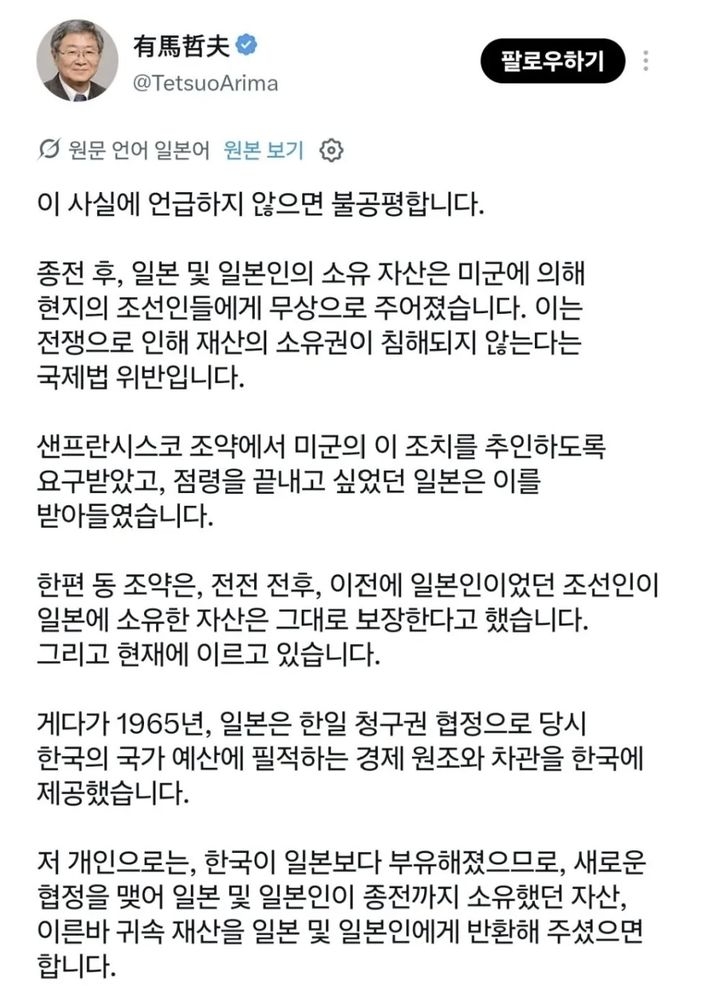
A professor at Japan's Waseda University has stirred controversy by arguing that South Korea, now wealthier than Japan, should return assets that Japan and Japanese nationals owned at the time of Japan's defeat in World War II.
Arima Tetsuo, a sociology professor at Waseda University, posted the claim on X on Tuesday.
Arima said that after Japan's defeat, assets owned by Japan and Japanese nationals were transferred free of charge to local Koreans by the US military. He said the move violated an international law principle holding that property rights should not be infringed upon as a result of war.
He then cited the San Francisco Peace Treaty, saying Japan "was required to accept this US military action and, wanting to end the occupation, agreed to it." He also said the treaty guaranteed that assets held in Japan by Koreans who had been Japanese nationals remained protected.
Arima also brought up the 1965 Korea-Japan Claims Settlement Agreement, noting that Japan at the time provided South Korea with economic cooperation funds and loans on a scale comparable to Japan's entire national budget.
"Since South Korea has become wealthier than Japan, I would like a new agreement to be concluded to return to Japan and Japanese nationals the assets they owned until the end of the war — the so-called vested properties," he said.
The post spread across social media and online communities, drawing widespread criticism.
One user pushed back sharply. "Don't make me laugh. Can you explain why Japanese people showed up on Korean soil in the first place? They invaded and plundered someone else's land and property," the user wrote. "It's like killing the homeowner's family, then screaming that the homeowner stole your things once you were subdued."
Arima had earlier co-authored a paper on the comfort women issue with J. Mark Ramseyer, a professor at Harvard Law School, also drawing controversy.
In the paper, published in 2022, they said "corrupt organizations with close ties to North Korea took over the comfort women movement, inflaming nationalism in South Korea and halting reconciliation with Japan," adding that "all of this occurred amid North Korea consistently developing nuclear weapons."
They also denied the forced mobilization of comfort women, claiming that "some women were deceived by recruiters, and some were pressured by abusive parents," but that "the rest did the work to earn money."
bbo@heraldcorp.com





