
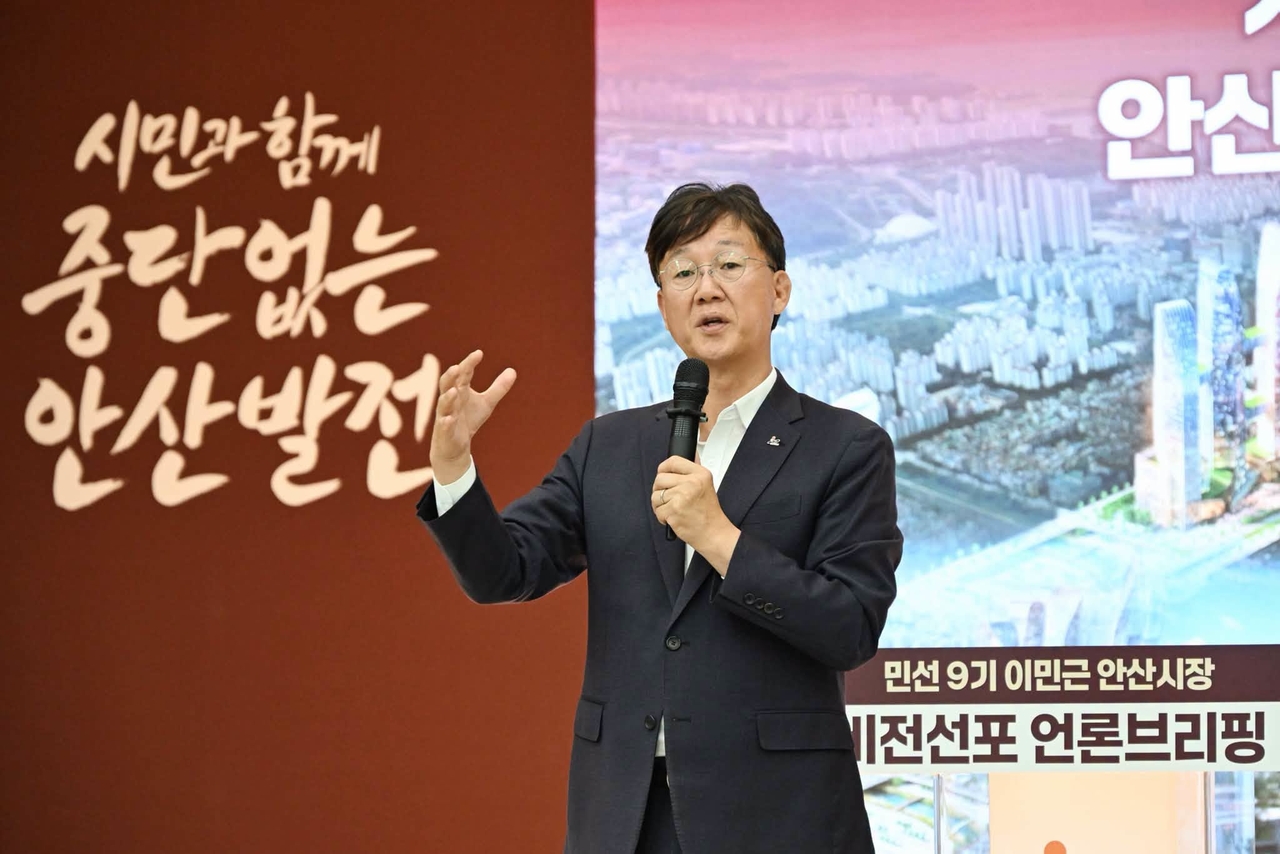
Ansan Mayor Lee Min-geun took to social media Wednesday to announce a press briefing on the policy direction and key campaign pledges of his ninth elected-term administration, posting under the message "Uninterrupted development of Ansan, together with citizens."
"If the eighth term was the time to sow seeds for Ansan's future, the ninth term is the time to turn those seeds into results that citizens can feel," Lee said. "We will press ahead without wavering on the key projects that will transform Ansan's future — fostering AI and robotics advanced industries centered on the free economic zone, undergrounding the Ansan Line, overhauling transportation, and attracting a Hanyang University hospital."
He described the governing philosophy of the ninth term as "Ieum Sijung" — an administration of connection. "We will connect policy to policy, carry the achievements of governance into citizens' lives, and prove ourselves not through plans but through results, not through words but through action," he said. "We will work together with citizens to achieve uninterrupted development of Ansan and make living here a source of pride."
Marking the 100th day of the ninth term, Lee formally unveiled "Ieum Sijung" as his governing philosophy and announced the full launch of five major goals and nine strategic priorities: citizen-centered governance, advanced innovation, welfare and culture, future education, and transportation and environment. The city plans to focus its administrative capacity on translating the industrial, transportation, welfare and education foundations built during the eighth term into tangible outcomes — jobs, public safety, care services, better schools and improved transit.
The vision centers on raising industrial competitiveness through the Ansan Science Valley (ASV) Gyeonggi Free Economic Zone and an AI transformation of the Banwol National Industrial Complex, while undergrounding the Ansan Line, expanding the rail network, and broadening welfare and education infrastructure to make Ansan a city its residents are proud to call home.
The briefing was organized to explain the city's development direction and implementation plans to citizens, timed to coincide with the finalization of ninth-term campaign pledges and building on the achievements of the eighth term.
"The first 100 days of the ninth term were not about finding a new direction — they were about reviewing the projects started in the eighth term and mapping out concrete implementation plans," Lee said. "I take the fact that citizens gave me another opportunity as a mandate to add visible results on top of the foundation we built in the eighth term."
During the eighth term, the city achieved a campaign-pledge fulfillment rate of 92.7 percent and earned the top SA rating in pledge-fulfillment assessments for two consecutive years. It also secured the designation of the ASV Gyeonggi Free Economic Zone, won selection as a national pilot project for undergrounding the Ansan Line, and launched the AI transformation project for the Banwol National Industrial Complex.
Connecting eighth-term foundations to ninth-term results: 'Ieum Sijung'
The governing philosophy of the ninth term — "Ieum Sijung," or an administration of connection — means linking past achievements to future opportunities, connecting the city to its people, and bridging industrial growth with citizens' well-being to bring to fruition the seeds planted in the eighth term.
To that end, the city will pursue its ninth-term agenda around five goals and nine strategies: citizen-centered governance, advanced innovation, welfare and culture, future education, and transportation and environment.
On the citizen-centered front, the city will operate multipurpose community centers close to residential areas and open school gymnasiums, sports fields and parking lots for shared community use. In 2027, it plans to expand the coverage of its citizen safety insurance and simplify the application process to strengthen support for residents affected by disasters and accidents.
In advanced innovation, the city will pursue the development of a 500-bed general hospital and an advanced medical cluster on the Hanyang University ERICA campus, and will develop the approximately 1.65 million-square-meter Gyeonggi Free Economic Zone into a global innovation hub concentrating robotics, AI and smart manufacturing industries alongside research and development functions.
The Banwol National Industrial Complex will receive 28 billion won ($20.9 million) through 2028 to build an AI transformation demonstration complex. An AI transformation comprehensive support center and a manufacturing AI open lab will be established to help small and midsize manufacturers test and apply AI technology on the production floor. Plans for the Daesong complex will be developed to use it as a future growth space for Daebudo Island, encompassing tourism, agriculture, biotech and renewable energy.
From youth to seniors: changes that reach every citizen's life
In welfare and culture, the city is preparing a program to provide rental housing to young residents at 1,000 won a day — about 30,000 won a month — and will expand tailored welfare services for people with disabilities as well as housing, care and employment support for senior citizens.
To support families balancing work and child-rearing, the city will introduce a "Working Mom All-Pass" program and pursue four publicly run kids' cafes and a shared parenting allowance for fathers. It will also expand year-round signature festivals, add park golf courses, and develop a wetland protection center on the Daebudo tidal flats and a seaside park on Nueseom Island to broaden everyday cultural, leisure and marine ecology offerings.
In future education, the city will expand personalized college and career counseling centered on its career guidance centers and strengthen education in AI, robotics and other emerging technologies. An education-focused "Edu Town" will be developed on blocks 89 and 90 in Sadong to create a connected pipeline of education, career pathways and employment opportunities so that talent nurtured in Ansan can find new opportunities and put down roots in the city.
Ansan Line underground, wider regional transit: raising the city's competitiveness
On transportation, the city will push ahead without delay on the integrated development project to underground the Ansan Line. The roughly 5.12-kilometer above-ground corridor from Choji Station to Jungang Station will be redeveloped into a citizen-centered space blending green areas, parks, cultural, leisure, residential and commercial functions, forming a new urban spine connecting the old city center with new development areas.
The city will also actively pursue the addition of a Sinansanson Jai Station and the extension to Daebudo in the national rail network construction plan, while working to improve headways on the Suin-Bundang Line during rush hours, secure 5,000 additional safe parking spaces and expand express bus services to Seoul.
"If the eighth term was the time to lay the groundwork for Ansan's future, the ninth term is the time to produce results that citizens can feel on that foundation," Lee said. "We will accelerate the projects already under way, fill in what is lacking, and deliver results citizens can experience."
He added: "We will carefully manage the schedule and targets for each campaign pledge and will speak honestly with citizens about progress and anything that needs adjustment. Together with citizens, we will achieve uninterrupted development of Ansan and build up results — one by one — through action rather than words."
fob140@heraldcorp.com





