Part of the Jiseokcheon Riverside City Masil-gil Development Project, the observatory covers 106 square meters and offers views of the surrounding landscape.
The facility revives the name of a Joseon-era pavilion in Nampyeong, linking the area's past and present as a symbolic cultural space.
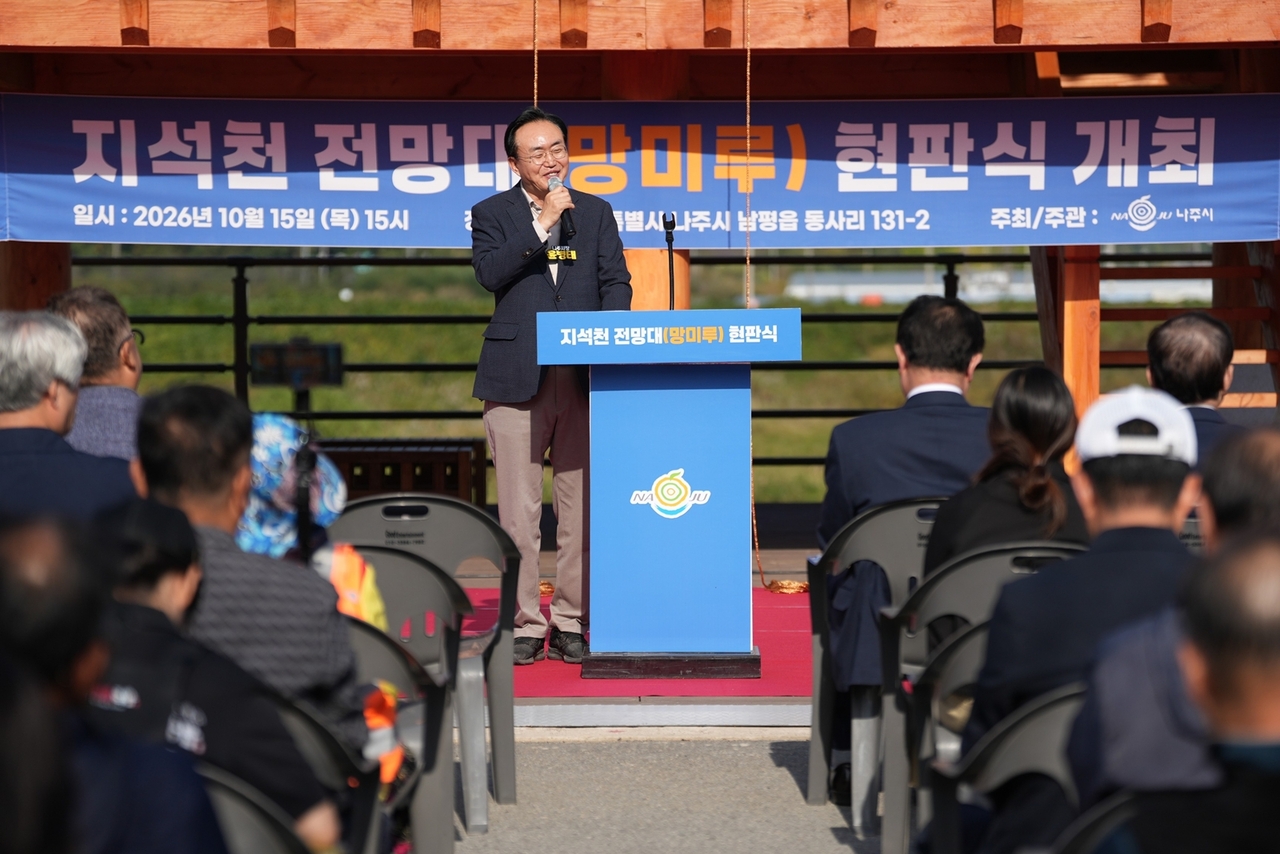
Naju has unveiled a new riverside observatory bearing the name of a historic Joseon-era pavilion, reviving the legacy of "Mangmiru" while offering sweeping views of the Jiseokcheon River as part of efforts to boost tourism in the Nampyeong area.
According to Naju city, a signboard installation ceremony for the Mangmiru Observatory was held Thursday at 131-2 Dongsa-ri, Nampyeong-eup, with Naju Mayor Yun Byeong-tae, members of the Naju City Council, heads of local institutions and civic organizations, and area residents in attendance.
The observatory was built as part of the Jiseokcheon Riverside City Masil-gil Development Project and covers 106 square meters, designed to offer panoramic views of the Jiseokcheon River and the surrounding Nampyeong landscape.
Construction began in December 2025 and was completed in September, with a total project cost of 410 million won ($296,000).
The name "Mangmiru" carries a dual meaning — gazing upon beautiful scenery and looking up to the king with reverence.
The original Mangmiru was reportedly built west of the local government office by Nampyeong County Magistrate Jo Jae-ho during the mid-Joseon period. No physical structure survives today, but its existence and history have been documented through old maps and historical records.
The newly built observatory is not a restoration of the original Mangmiru in its historical location or architectural form.
Rather, it revives the name and historical meaning of Mangmiru within a contemporary viewing space — bridging Nampyeong's past and present and allowing visitors to experience the area's history, culture and natural scenery together.
Naju city expects the observatory to serve as a place where residents can relax and connect while taking in views of the Jiseokcheon in their daily lives, and as a new destination where tourists can enjoy both the region's history and its scenic riverbanks.
The city plans to use the facility as a tourism infrastructure asset, linking the natural landscapes of the Jiseokcheon and Deudeurgang rivers with nearby tourist attractions to enhance Nampyeong's appeal and draw more visitors and longer stays.
"I hope the Mangmiru Observatory will become a new landmark where people can experience both the historical significance of Nampyeong and the beautiful scenery of the Jiseokcheon," Mayor Yun said. "I hope it will be a comfortable resting place for local residents and a space where tourists can discover the charm of Nampyeong anew."
kkm9971@heraldcorp.com