We see the world through food. Welcome to Middam, your guide to delicious stories.
![[Getty Images Bank]](https://wimg.heraldcorp.com/news/cms/2026/10/16/news-p.v1.20261016.e80b06f9b4de4169818cca7c9ced9af8_P1.jpg)
"It doesn't have sugar, so it's fine, right?"
Walk into any supermarket and you will find snacks emblazoned with the words "Zero Sugar" competing for shoppers' attention — chocolates, cookies, cake and more. But consumers who take the "zero sugar" label at face value and eat freely may be in for a rude awakening.
The real issue is carbohydrates. A product with less sugar may well be a healthier choice, but low sugar content alone does not mean fewer calories or fewer carbohydrates overall. Even when sweeteners replace sugar, other ingredients — wheat flour, vegetable oils and the like — remain. Only the method of sweetening has changed; the basic nutritional makeup of the snack has not.
The refined white flour used in cookies and cakes undergoes a milling process that strips away the bran and germ of the grain, reducing dietary fiber and some nutrients in the process. Foods made from refined grains tend to be less filling than whole-grain alternatives, which means eating too much of them can push total calorie intake higher.
![[Getty Images Bank]](https://wimg.heraldcorp.com/news/cms/2026/10/16/news-p.v1.20261016.c0cccb9d6f994542bbb9ef89b73e2017_P1.jpg)
It is also worth checking what has been used in place of sugar. Some products rely on sugar alcohols such as maltitol and maltitol syrup. Sugar alcohols behave differently from sugar, but depending on the type they can still affect blood glucose levels, and consuming too much can cause digestive symptoms such as bloating or diarrhea. Anyone choosing zero-sugar snacks specifically to manage blood sugar should check not just the sugar content but also total carbohydrates and serving size.
Understanding how sugar labeling works is equally important. Under domestic labeling rules, a "sugar-free" or "no sugar" claim is generally permitted when a product contains less than 0.5 grams of sugar per 100 grams. A nutrition label showing 0 grams of sugar therefore does not mean the product is free of carbohydrates or calories. Similarly, "no added sugar" means only that no sugar was added during manufacturing — not that the product contains no sugar at all.
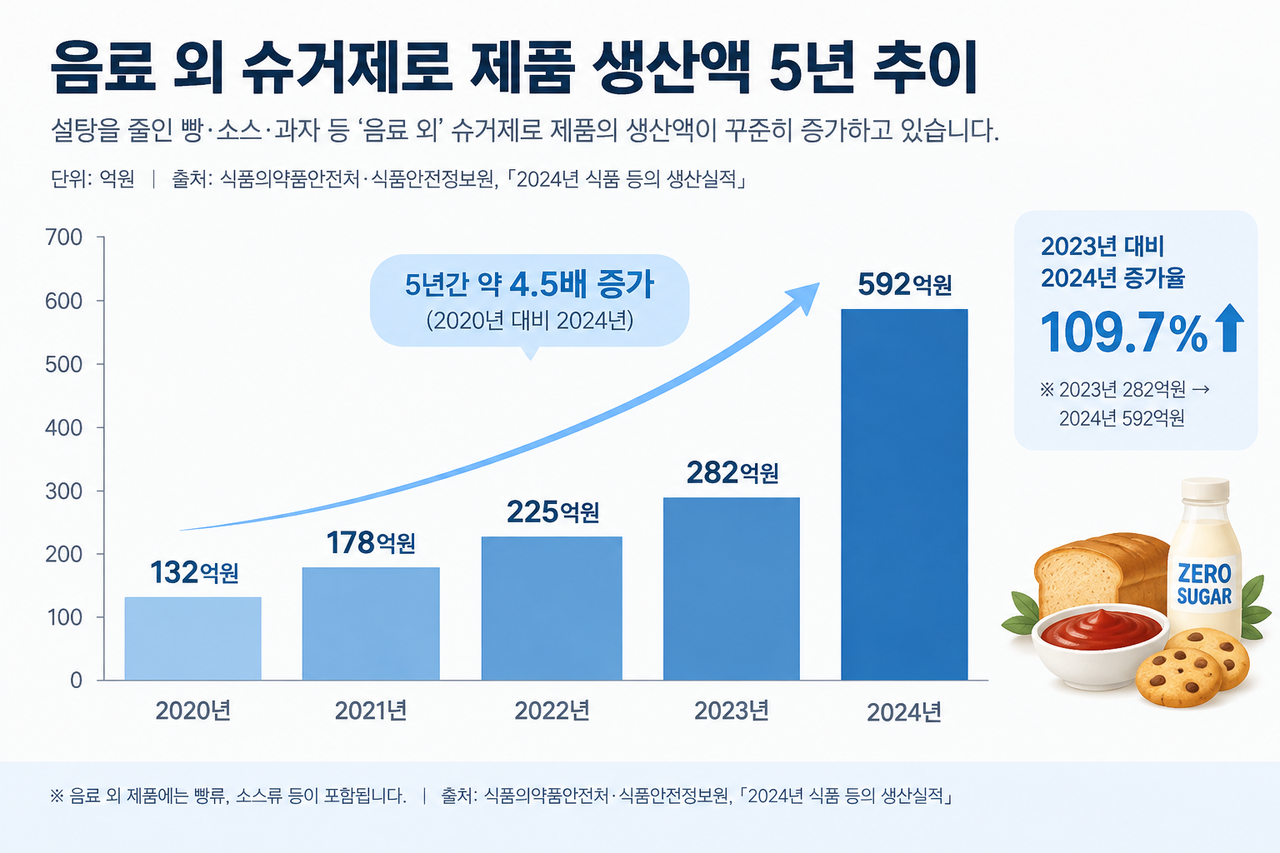
The sugar-free market is expanding at a striking pace. According to the Ministry of Food and Drug Safety and the Food Safety Information Service's "2024 Food Industry Production Performance" report, domestic production of sugar-free products reached 572.6 billion won ($425 million), up 20.1 percent from the previous year. The number of product lines also more than doubled year-on-year to 590. Sugar-free products outside the beverage category — including bread and sauces — saw production value reach 59.2 billion won, a 109.7 percent increase from the prior year.
The trend is equally visible within the snack industry. Lotte Wellfood's sugar-free brand Zero surpassed 100 billion won in cumulative sales within two and a half years of its May 2022 launch, and its 2024 sales exceeded 50 billion won. Zero Choco Pie, released in October of that year, sold 6 million packs within 50 days of hitting shelves — a clear sign that consumers are actively buying reduced-sugar snacks.
![[Getty Images Bank]](https://wimg.heraldcorp.com/news/cms/2026/10/16/news-p.v1.20261016.ad08b7010c8d4849af2dc4180aba7d64_P1.jpg)
None of this means sugar-free snacks are inherently bad. For consumers looking to cut back on sugar, they can be a useful option. What matters is not treating the word "zero" as a green light for unlimited consumption or as a marker of health food. Even a reduced-sugar product can drive up total calorie and carbohydrate intake if eaten in large quantities at once.
When choosing a snack, look past the marketing on the front of the package and check the nutrition label on the back first. Review the serving size, total calories, carbohydrates, fat and sugar together, then calculate based on how much you actually plan to eat. A single figure of 0 grams of sugar is not enough to judge the overall nutritional value of a product.
123@heraldcorp.com