
Fixed deposits up 11.75 trillion won in two weeks
Kospi plunge fuels rush to safe assets

A 40-year-old office worker surnamed Lee lost nearly 10 million won ($7,420) in paper value on Samsung Electronics shares alone in just one week. Samsung Electronics' share price fell from 262,000 won on Oct. 8 to 210,000 won on Thursday.
"I was already suffering through the rollercoaster Kospi, but losing almost 10 million won in a single week makes me think that even a modest but stable investment is better," Lee said. "I'm thinking of turning to fixed deposits — even if the rate is just 4%, at least I won't lose what I put in."
Total deposits at KB Kookmin, Shinhan Bank, Hana, Woori and NH NongHyup Bank — the country's five major lenders — stood at 2,286.76 trillion won as of Thursday, down 5.14 trillion won from 2,291.9 trillion won recorded the previous day, according to financial industry data released Friday. Despite the daily dip, the level remains elevated. The combined total recorded on Wednesday marked the highest since the data series began in January 2022.
While overall deposits edged down, fixed-term deposits — where customers lock up lump sums for extended periods — actually increased. The five banks' combined fixed deposit balance reached 1,017.84 trillion won on Thursday, up 1.31 trillion won from 1,016.52 trillion won the day before. Compared with 1,006.09 trillion won at the end of September, the balance has grown by about 11.75 trillion won in just two weeks.
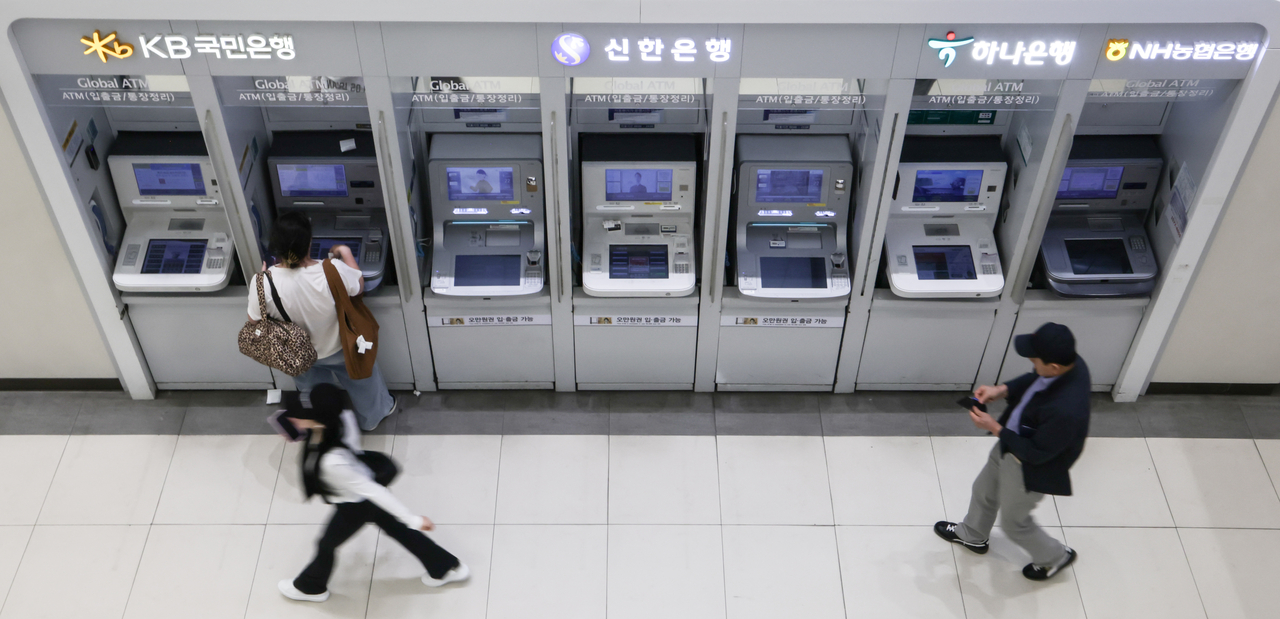
Two forces are driving money into deposits simultaneously: rising deposit rates and a sharp stock market selloff. A series of benchmark interest rate hikes by the Bank of Korea has pushed annual fixed deposit rates at major banks to around 4%, while a surge in Kospi volatility has dimmed the appeal of equities — making guaranteed-rate products with no principal risk comparatively more attractive.
Shinhan Bank is selling its "Super SOL Welcome Fixed Deposit" at a maximum annual rate of 4.0%, capped at 500 billion won ($371 million) — the first time the bank has offered a 4 percent fixed deposit in about three years. NH NongHyup Bank has also launched a special-offer deposit product with a maximum annual rate of 3.9%, likewise capped at 500 billion won. Products exceeding 4 percent annually have also appeared at regional and foreign-owned banks.
The stock market, meanwhile, has moved in the opposite direction. The Kospi plunged 7.57 percent on Thursday to close at 5,554.22 after a circuit breaker was triggered during trading. The index has fallen for seven consecutive sessions, accumulating a decline of 20.8 percent — the third-largest seven-session drop since 2005. Samsung Electronics shed 19.8 percent over the same period.
"As deposit rates rise, the interest investors can safely earn has grown, while the stock market plunge has reduced the appeal of equity investment — and it seems the flow of money into deposits is accelerating," a financial industry official said.
rim@heraldcorp.com





