
Mapo revives its 5-million-tree drive; Seodaemun targets 300,000 trees — both districts aim to build livable green networks, not just beat the heat
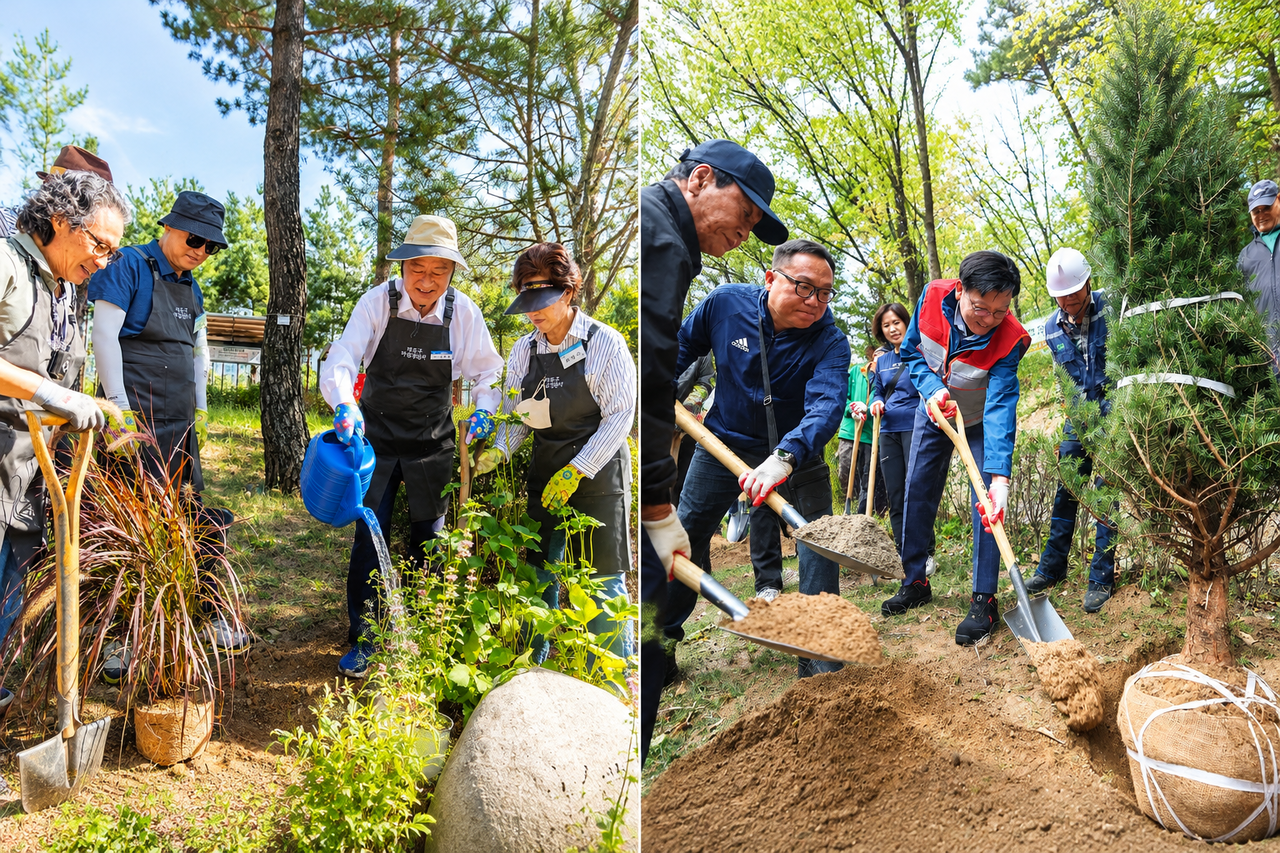
Two Seoul districts — Mapo-gu and Seodaemun-gu — are throwing their weight behind ambitious tree-planting campaigns.
Mapo-gu has relaunched its "5 Million Trees" initiative, a signature green policy from its seventh elected administration, now revived under the ninth. Seodaemun-gu, meanwhile, has announced a plan to plant 300,000 trees by the first half of 2030 — enough to give every resident one tree of their own.
The back-to-back drives reflect a growing recognition that trees are not mere urban decoration but critical infrastructure for combating heat waves and the urban heat island effect while improving residents' living environment.
As climate change makes summer heat waves a routine occurrence, shade and greenery in city centers are increasingly shaping residents' health, walkability and quality of rest. Tree planting is evolving from an environmental policy into a quality-of-life measure woven into everyday urban life.
Mapo-gu: restarting a stalled 5-million-tree project
Mapo-gu's revived "5 Million Trees" campaign draws attention for its continuity with — and recommitment to — a past policy.
The district was the first in Seoul to pursue a 5-million-tree planting project during its seventh elected administration. The initiative has now been relaunched as a flagship program under District Mayor Yoo Dong-gyun in the ninth administration.
The district has set a target of planting more than 5 million trees by June 2038. The plan extends planting sites beyond parks and roadsides to schools, apartment complexes and idle private land, with the aim of drawing in residents and businesses as participants.
A particular focus is on expanding greenery that residents can feel in their daily lives.
The district plans to plant shade trees at crosswalks and traffic islands, create green strips between street trees, and convert alleyways and leftover spaces into green areas. Where planting space is scarce, mobile planters will be used, and community-led planting and care programs will be expanded.
A launch ceremony held Tuesday at Mapo Saevit Culture Forest drew about 200 people, including residents from all 16 neighborhoods. That same day, a real-time planting progress board was installed in the lobby of the district office to keep residents informed and engaged.
Mapo-gu's challenge is to build on past planting achievements while demonstrating tangible results. A proper assessment of the project will require looking beyond the number of trees planted — tracking survival rates, the growth of shaded areas, and whether residents actually notice an improvement in summer walkability.
Seodaemun-gu: linking mountains, streams and neighborhoods with 300,000 trees
Seodaemun-gu's 300,000-tree project places its emphasis on connecting green spaces scattered across the district.
District Mayor Park Woon-ki announced plans to invest a total of 12.5 billion won ($9.27 million) through the first half of 2030 to plant 300,000 trees. The goal is not simply to increase the number of trees but to build a green network across the entire district by linking mountain to mountain, mountain to stream, and parks to residential areas.
Seodaemun-gu is home to five mountains — Ansan, Inwangsan, Baengnyeonsan, Gungdongsan and Bukhansan — and two streams, Hongjechen and Bulgwangcheon. The district intends to leverage these natural assets so residents can enjoy forests and shade close to home.
The project is organized into five areas: building a forest-trail ecological network, expanding green space in residential parks, connecting green corridors along roads and streams, increasing private-sector greenery, and community memorial tree planting.
Under the detailed plan, 4 billion won will go toward the forest-trail ecological network to plant 50,000 trees, while 3.4 billion won will fund 48,000 trees in residential parks. Another 4.4 billion won will be used to plant 62,000 trees along roads and waterways.
Notably, 40 percent of the total target — 120,000 trees — will be secured through private development projects. The strategy is to tap parks and green spaces created during redevelopment and reconstruction projects, as well as mandatory landscaping requirements for construction, to expand urban greenery without placing the full burden on the planting budget.
A community participation component is also planned. A "one household, one tree" memorial planting program will invite residents to mark family milestones — births, marriages, school enrollments — with a tree, encouraging them not just to plant but to tend their trees over time.
Seodaemun-gu held a launch ceremony Friday near Silrak Children's Park on Bukhansan. About 100 residents and officials took part, planting more than 2,500 trees of seven species — including Korean hill cherry, fir, Korean maple, royal azalea and Japanese kerria — across a 650-square-meter site.
Tree planting as both a heat response and an investment in the future
Both districts share the goals of addressing climate change and improving the living environment, though their approaches differ.
Mapo-gu draws on the policy experience of its seventh administration to push forward a large-scale planting target, while Seodaemun-gu focuses on enhancing green connectivity by making use of existing mountains and streams and combining private development with community participation.
Ultimately, the success of both projects will be determined not at the moment of planting but through the long process of trees growing and reshaping the urban environment.
Trees in city centers can provide shade and improve walkability. However, their effectiveness varies depending on species, size, planting location, and soil and water management, making locally tailored planning and sustained maintenance essential.
That is why administrative performance should not be measured by planting numbers alone. Survival rates, growth conditions, actual shaded area and residents' access to green space in their neighborhoods all need to be tracked alongside the headline figures.
Mapo-gu's 5 million trees and Seodaemun-gu's 300,000 differ in scale but share the same vision: using trees to fight heat waves, transform the spaces where residents walk and rest, and pass on a better urban environment to future generations.
In an era of climate crisis, a city's competitiveness is no longer measured only by the height of its buildings or the width of its roads. How comfortably residents can walk in the shade, how easily they can find a place to rest nearby, and how much green space they can enjoy in their daily lives are becoming equally important benchmarks.
Whether the trees planted in Mapo-gu and Seodaemun-gu grow beyond administrative statistics to become genuine neighborhood forests for residents remains to be seen.
seouldream01@heraldcorp.com





