
Traditional Korean music fills Hwaeomsa's Boje-ru pavilion amid the autumn colors of Jirisan
![Haegeum player Choi Seo-ho performs traditional jeongak at Hwaeomsa on Saturday alongside gayageum player Oh Ye-jin and janggu drummer Do Gyeong-han. [Hwaeomsa]](https://wimg.heraldcorp.com/news/cms/2026/10/18/news-p.v1.20261018.27eefd82e398478faf3409c71d2bfa07_P1.jpg)
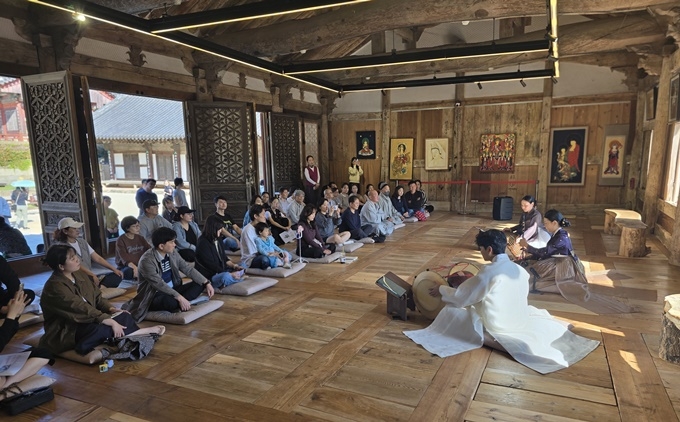
The first solo haegeum recital by Choi Seo-ho — titled "Yeongsanhoesang" — drew a warm reception at Hwaeomsa, the head temple of the 19th district of the Jogye Order of Korean Buddhism on Jirisan.
Organized as part of the South Jeolla Province Culture Foundation's arts activity support project, the recital took place Saturday afternoon on a special stage at the temple's Boje-ru pavilion, where traditional music and Buddhist culture came together to illuminate the essential beauty and contemplative value of Korean music.
The Boje-ru pavilion, a traditional wooden structure that has stood for a millennium within the Hwaeomsa complex, lent the performance a quiet, timeless atmosphere that paired naturally with the delicate tones of the haegeum — a traditional Korean bowed string instrument — deepening the musical experience for all who attended.
Choi performed the complete score of Yeongsanhoesang, one of the most celebrated instrumental works in Korean traditional jeongak (court and aristocratic music), with the haegeum at the center. Gayageum player Oh Ye-jin and janggu drummer Do Gyeong-han joined him, weaving together restrained melody and rhythmic pattern in close ensemble.
Yeongsanhoesang originated in a Buddhist context and evolved over centuries into an instrumental form of jeongak.
The piece opens with slow, stately melodies that gradually shift in character, drawing listeners into deep concentration and inner reflection.
At Saturday's recital, the haegeum's distinctively plaintive yet resonant timbre met the flowing lines of Yeongsanhoesang, bringing out the beauty of traditional music with particular clarity.
The performer's precise bow work, the bright resonance of the gayageum, and the measured rhythms of the janggu converged into moments where three distinct voices became a single musical breath.
The recital carried a dual significance: preserving the tradition of Korean classical music while contributing to the vitality of arts and culture in the local community.
The performance also demonstrated that a profound artistic experience need not rely on elaborate staging or large-scale facilities — the ancient temple's traditional space and the natural resonance of Korean music proved more than sufficient to move the audience.
The event further underscored Hwaeomsa's growing role as an open cultural space where local residents and tourists can encounter and enjoy traditional arts, beyond its function as a site of religious practice.
The temple has steadily expanded that role through a range of cultural programs — including the Hwaeom Music Festival, performances of Gurye Hyangje Julpungnyu (a regional genre of traditional ensemble music), and contemporary art exhibitions — establishing itself as a space where a millennium of history coexists with contemporary sensibility.
Head monk Wuseok said the recital was "a beautiful moment in which the melodies of the haegeum, resonating through a space that holds a thousand years of history, brought the music of the past back to life as today's emotion, and tradition met a new generation."
parkds@heraldcorp.com





