Broiler prices down 37.7% in six months
Government moves to probe chicken price fixing
Bird flu cycles, high volatility limit pass-through
Delivery platform fees among costs to watch, industry says
The wholesale price of broiler chickens supplied to some franchise chains has fallen recently as supply disruptions caused by highly pathogenic avian influenza stabilized. However, industry watchers say the drop is unlikely to be enough to bring down the price of a bucket of fried chicken.
Fresh chicken prices that major domestic franchise companies supply to their franchisees have been on a downward trend, according to industry sources. The cuts were not a deliberate corporate decision. "It wasn't a policy-driven price reduction," a company official said. "The supply price is linked to the Korea Broiler Association's market rate, so it moved down with that."
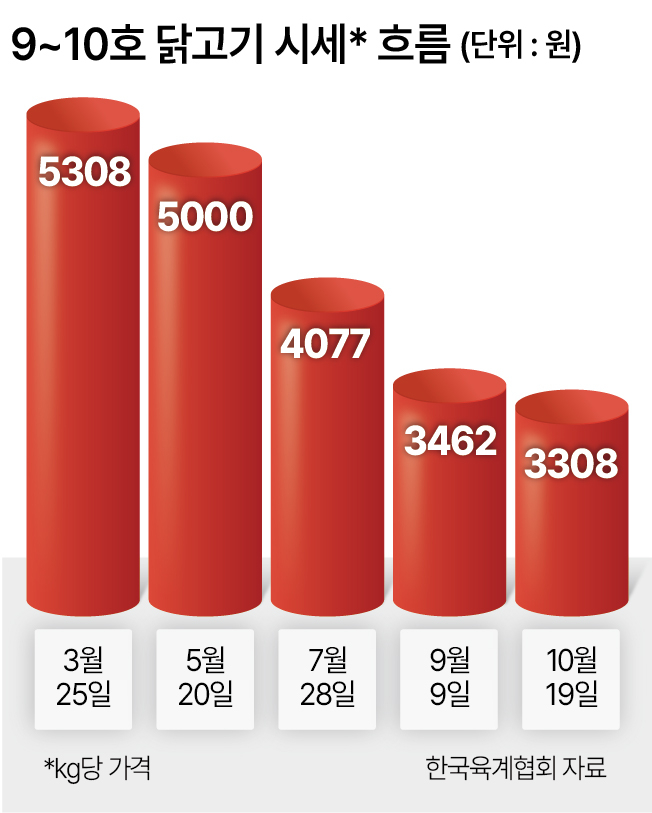
According to the Korea Broiler Association, the price of grade-9 to grade-10 broilers stood at 3,308 won per kilogram on Monday. That is about 37.7 percent below the peak of 5,308 won per kilogram recorded in March, when supply anxiety was at its height due to the highly pathogenic avian influenza outbreak. The recovery reflects the rebound of broiler farms hit during last winter's outbreak. The Korea Rural Economic Institute projected that the number of broilers slaughtered in October would rise about 5.3 percent year-on-year to between 69.14 million and 70.47 million, and that November slaughter would increase 3.7 percent to between 64.85 million and 66.12 million.
Broiler market prices have become a politically charged issue. Late last month, President Lee Jae-myung said he would "take a look" at chicken prices, and within a week the Korea Fair Trade Commission launched a price-fixing probe into the chicken industry.
Whether falling broiler prices will translate into cheaper chicken at the counter remains uncertain. The return of highly pathogenic avian influenza this coming winter is a key variable. According to the Ministry of Climate, Environment and Energy and the Ministry of Agriculture, Food and Rural Affairs, the number of migratory bird sightings at domestic stopover sites — birds of the Anatidae family that are high-risk carriers of the virus — has risen 2.9 times compared with the same period last year. The World Organisation for Animal Health reported 2,957 detections of highly pathogenic avian influenza in wild birds overseas, including in Europe, from January through August this year, more than double the figure for the same period a year earlier. The government began stepping up biosecurity measures in September.
Broiler prices themselves are also highly volatile. Grade-9 to grade-10 broilers fell to 3,308 won per kilogram in late September during a sustained decline, only to spike to 3,923 won in early October. "Because market rates keep shifting, the supply price for each store moves depending on when it places its order, within a set price ceiling," one industry official said. In the second quarter, raw material costs rose as supply instability and higher logistics costs tied to the war in the Middle East weighed on margins — yet the three major franchise chains, BBQ, bhc and Kyochon Chicken, held their prices steady.
The spread of dual pricing — where individual franchisees independently set different prices for in-store and delivery orders — is also cited as a factor eroding headquarters' ability to control prices. "You have to look at the full picture: labor costs that rise every year, logistics costs, and delivery platform fees," another industry official said.

soho0902@heraldcorp.com