Ministry of Health and Welfare proposes amendments to medical law enforcement rules
New rules restrict geographic access, limit prescriptions to 7 days and cap telemedicine share
Patients on long-term medications for hair loss and chronic conditions hit hardest

"Are they telling me to visit a doctor 13 times just to get a three-month supply?" — a user of a telemedicine platform.
A government plan to cap telemedicine platform prescriptions at seven days is fueling growing frustration among not only hair loss patients but also those with chronic conditions.
Because the restriction applies even to medications that must be taken consistently for years — not short-term cures — patients now face far more frequent clinic visits than before. Concerns are mounting in the telemedicine industry that the rules could drive the sector to the brink of collapse.

According to industry sources Wednesday, the Ministry of Health and Welfare recently announced a legislative notice for proposed amendments to the enforcement rules of the Medical Service Act and related administrative disposition rules.
The proposed rules governing telemedicine include: restricting first-visit patients to clinics in the same city or province as their registered address (with exceptions for rare diseases and other cases); capping prescription lengths at seven days (with a one-time exception allowing up to 30 days); limiting telemedicine consultations to no more than 30 percent of a medical institution's total consultations; and prohibiting prescriptions for obesity treatments, drugs prone to misuse or abuse, and narcotics or psychotropic substances.
The most contentious provision is the seven-day prescription cap. The Ministry of Health and Welfare did attach a condition allowing a one-time exception of up to 30 days per patient.
In practice, however, telemedicine doctors have no way to check a patient's prescription history at other medical institutions. That means a doctor cannot verify whether a patient has already used the one-time allowance for a 30-day prescription.
Industry insiders say this will likely lead telemedicine doctors to avoid issuing 30-day prescriptions altogether, fearing an inadvertent rule violation. The concern is that patients will in effect be limited to seven-day prescriptions through telemedicine platforms.
Dissatisfaction is growing among both hair loss patients who take medication consistently and those managing chronic conditions.
An analysis of about 4.92 million telemedicine consultations conducted on telemedicine platforms from June 2023 through July this year found that 45.2 percent of users received prescriptions of seven days or fewer, 8.5 percent received prescriptions of eight to 29 days, and 46.3 percent received prescriptions of 30 days or more.
Prescriptions of 30 days or more were concentrated among hair loss and chronic disease patients — hair loss (98.12 percent), hyperlipidemia (94.10 percent) and hypertension (92.18 percent).
Under the seven-day cap, patients seeking prescriptions for hair loss medication and similar drugs would need roughly 13 additional telemedicine consultations over three months. In that scenario, consultation fees alone — excluding the cost of medication — would rise from 4,500 won to about 60,000 won ($45).
That is because patients would need to schedule far more appointments than the single visit that previously covered a 90-day supply, medication costs excluded.
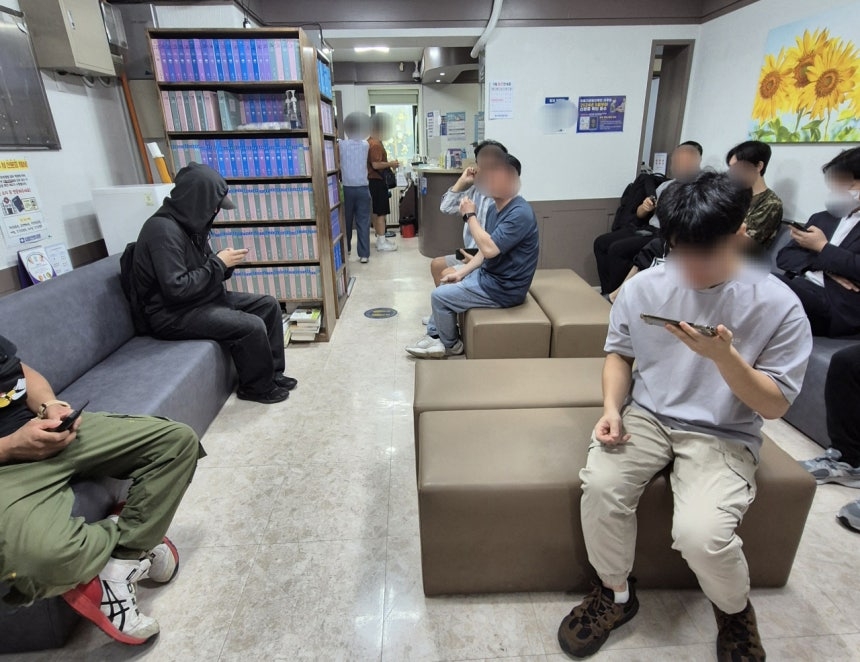
Criticism is growing within the industry that layering a seven-day prescription cap on top of already overlapping restrictions — geographic limits on first-visit telemedicine consultations and caps on the share of telemedicine per institution — will increase the burden on medical professionals and add to patient inconvenience.
"There is no way to verify whether the one-time exception for a 30-day prescription has been used, so providers in the field will likely avoid applying it — meaning the rule will in effect become a blanket seven-day cap for first visits," an industry official said. "This will not only threaten the survival of the telemedicine sector but also disrupt treatment continuity for patients on long-term medications, and drive up both out-of-pocket medical costs and national health insurance fiscal burdens through repeated consultations."
The official added that instead of limiting the prescription-length exception to a single use, the regulation should be revised to allow medical professionals who have reviewed a patient's health information to exercise their own clinical judgment, with the rationale and details recorded.
ko@heraldcorp.com