Authorities guide shark toward Marina Bridge, opposite direction from second attempt
Officials vow to minimize stress on shark, prioritize worker safety
Busan's Bukhang Waterfront Park draws 1.6 million visitors since shark's arrival
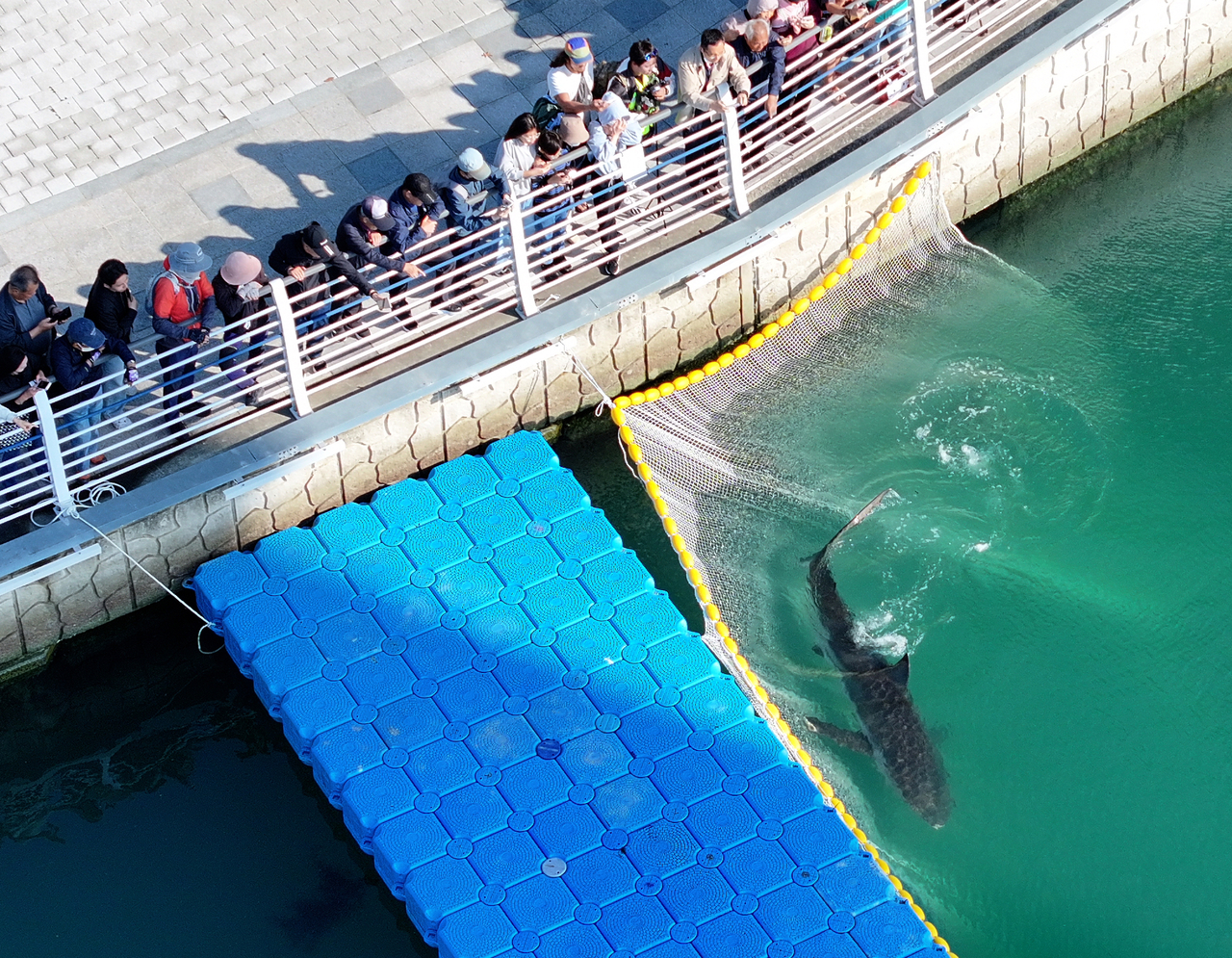
A third attempt Wednesday to guide "Bukangi" — an approximately 3-meter blacktip shark that has spent 34 days in the ornamental waterway at Busan's Bukhang Waterfront Park — back out to open sea fell short, with the shark still refusing to leave the channel as of past 5 p.m.
The Ministry of Oceans and Fisheries, Busan city, the National Marine Biodiversity Institute of Korea and the National Institute of Fisheries Science joined forces in the third herding operation Wednesday, pushing Bukangi toward the waterway exit near Marina Bridge — the opposite direction from the second attempt on Oct. 2. Authorities drove the shark from the area around pedestrian bridges four and five toward the Marina Bridge exit.
Authorities guided Bukangi to the vicinity of Marina Bridge in the afternoon and secured a net in place, but the shark continued to circle around the net without venturing into open water. Officials are understood to be committed this time to seeing the operation through, however long it takes.
Crews spent the morning setting up barrier nets and pontoons — floating platforms used for waterborne operations — between pedestrian bridges five and six, completing a drill before the main operation began in the afternoon.
Wednesday's effort was designed to address the shortcomings of the two previous attempts. The first, on Sept. 29, used water pumps and failed. The second, on Oct. 2, pushed Bukangi to within about 100 meters of the waterway exit using nets, but had to be called off when the nets snagged on obstacles on the channel floor. The shark cleared the nets the following day and retreated back inside.
After that, authorities waited for Bukangi to leave on its own, but when the shark showed no sign of departing, they decided to mount a third operation. The urgency was driven by health concerns: no feeding activity had been confirmed, and the shark had recently developed wounds on its snout and fins while also displaying abnormal behavior, including striking its head against the channel walls.
Falling temperatures posed an additional threat. The shallow, 2-to-3-meter-deep waterway is highly sensitive to outside air temperatures, and the Korea Meteorological Administration forecast Busan's low to drop to between 2 and 10 degrees Celsius on Thursday — roughly 10 degrees lower than Tuesday's range of 12 to 18 degrees. Some shark experts warned that if such conditions persist, the shark's survival window could shrink to about two weeks. The National Institute of Fisheries Science, however, said a recent on-site inspection found no immediate serious health concerns, based on the shark's swimming condition.
In Wednesday's operation, rescue crews secured the nets to pontoons to prevent Bukangi from doubling back and to keep the net formation stable. Because the water deepens near the channel exit — creating gaps between the net and the seabed — crews installed supplementary nets on the inner side to block any retreat. Workers stationed on the flat, barge-like pontoons slowly moved them toward open water while keeping the shark from turning around. Drones tracked Bukangi's position in real time, and professional divers were deployed to check for underwater obstacles and monitor the nets.
Busan city and other authorities said they would "minimize stress on Bukangi and prioritize the safety of workers and visitors." Meanwhile, Bukhang Waterfront Park — where Bukangi was first spotted on Sept. 18 — has become a nationwide attraction, drawing a cumulative total of more than 1.6 million visitors as of Wednesday.
kaf2002@heraldcorp.com