Lawmaker Kim Tae-hyo introduces ordinance bill on senior transportation support
"Mobility in a super-aged society goes beyond transit welfare — it is a complex policy agenda"
A proposed ordinance that would cover all or part of bus fares for Busan residents aged 70 and older has been put forward.
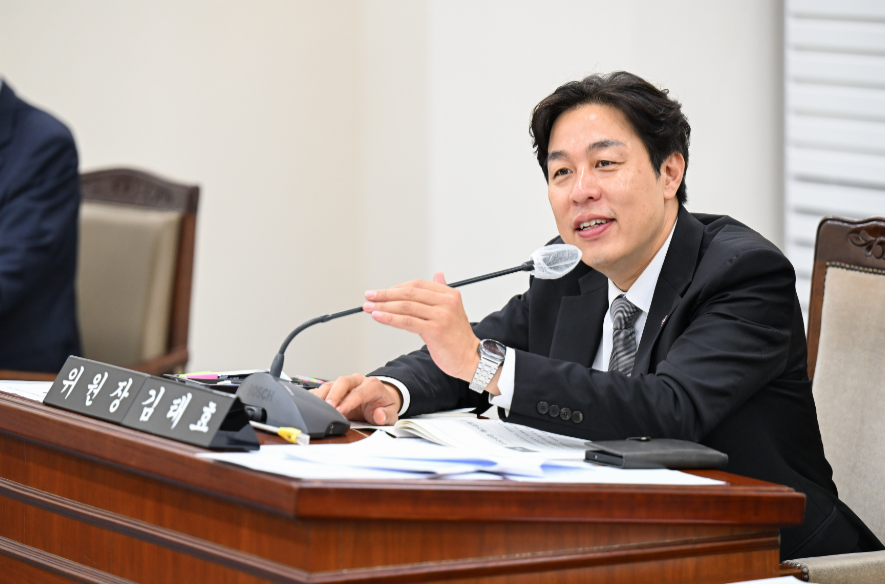
People Power Party Busan City Council Member Kim Tae-hyo, representing Haeundae-gu's Banyeo 2 and 3-dong and Jaesong 1 and 2-dong, announced Thursday that he is introducing the "Busan Metropolitan City Senior Transportation Support Ordinance." Kim first raised the need for public transit fare support for older residents during a five-minute open-floor speech at the 338th extraordinary session on July 14, and has since drafted the ordinance.
Busan was the first among South Korea's special and metropolitan cities to enter super-aged society status, and residents aged 70 and older number 559,000 this year — 17.3 percent of the total population. While subway and urban rail services offer free rides for senior citizens, city buses and community buses remain paid, meaning older residents in hillside neighborhoods, older downtown areas and outlying districts — where bus dependency is high — face transit costs the moment they leave home.
The ordinance aims to address the transportation welfare gap that arises depending on whether a resident lives in a transit-oriented area or not.
Other metropolitan cities have already introduced similar systems. According to the ordinance's review report, Seoul and Incheon began offering support in July — Seoul for those aged 70 and older, Incheon for those 75 and older — while Ulsan has operated a program for those 70 and older since late 2025 and Daejeon since September 2023.
The bill would give Busan the legal basis to cover part or all of bus fares for registered residents aged 70 and older when they use city buses, community buses or demand-responsive buses with a city-designated transit card.
The bill also includes provisions for drawing up an annual support plan covering eligible recipients, benefit amounts, delivery methods and funding sources, as well as for building and operating a transit card settlement system. However, the specific level of support and the timeline for implementation will be determined by the Busan city government after reviewing its budget and projected demand.
The ordinance bill is expected to go before the relevant standing committee at the Busan City Council's 341st regular session before being submitted to a plenary vote, with passage anticipated sometime in November.
"I hope the Busan city government will now begin working out the specifics — who qualifies, how much support to provide, a phased rollout schedule, how to secure funding, and how to issue and settle transit cards — so this becomes a policy that residents can actually feel," Kim said.
kaf2002@heraldcorp.com