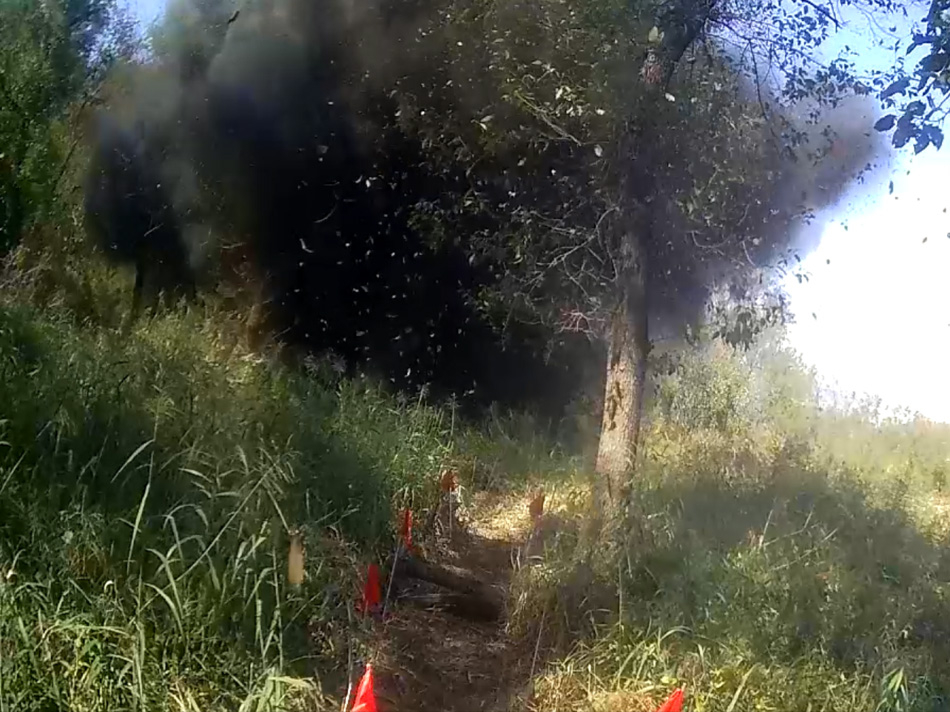
North Korea is estimated to have laid close to one million landmines in the Demilitarized Zone over the past two years, according to multiple lawmakers' offices.
Offices of lawmakers on the National Assembly's intelligence and defense committees said the military reported to the Assembly that North Korea has planted an estimated 960,000 mines in and around the DMZ since 2024, Yonhap reported.
Experts in the field estimate the total number of mines currently buried in the DMZ — including those laid by South Korean forces — at roughly two million.
Unification Minister Jeong Dong-young also cited the two-million figure when he raised the DMZ mine issue during a national audit on Oct. 7.
If the military's reported estimate of 960,000 mines laid by North Korea since 2024 is accurate, roughly half of all mines now in the DMZ were planted within the past two years.
North Korea appears to be deploying mines on a massive scale as part of a "border fortification" campaign along the Military Demarcation Line. Pyongyang began the effort in earnest in April 2024 after redefining inter-Korean relations as those between "two hostile states." Beyond the large-scale mine-laying, North Korea has also been reported to be erecting barriers, clearing vegetation, building tactical roads and barbed-wire fencing, and severing the road links along the Gyeongui and Donghae lines.
As North Korea pressed ahead with the work along the armistice line, a North Korean mine exploded south of the MDL on Sept. 21, seriously injuring South Korean soldiers.
North Korean troops have repeatedly crossed the MDL in the course of the fortification work, heightening military tensions in the area.
South Korean forces have responded with warning broadcasts and warning shots directed at North Korean troops crossing the line. Pyongyang has pushed back, calling such measures a threat to its soldiers' safety and warning it would resume loudspeaker broadcasts toward the South.
Foreign Ministry to send letter to UN Security Council president
The Ministry of Foreign Affairs said it plans to send a letter to the president of the UN Security Council over North Korea's DMZ mine explosion and its recent escalatory actions, Yonhap reported Thursday.
Foreign Ministry spokesperson Park Du-sun said the letter would explain that the explosion was caused by a mine planted by North Korean troops and constitutes a clear violation of the Armistice Agreement, demand a North Korean apology and responsible action, and call for dialogue to prevent further escalation and restore trust.
Park also said the letter would draw attention to North Korea's recent attempts to label South Korean forces' legitimate operations near the MDL as provocations and shift responsibility for regional tensions onto Seoul.
The letter will be addressed to the Greek ambassador to the UN, who currently holds the Security Council presidency.
After the president receives it, the letter is expected to be circulated among Security Council member states within a few days and subsequently posted on the council's website.
That process would place the DMZ mine explosion on the official Security Council record and allow South Korea to disseminate its position more broadly.
The government had taken no notable diplomatic steps since South Korea's UN ambassador called for a "public apology and responsible measures" at a UN General Assembly First Committee session on Oct. 8 (local time). The latest move is seen as a response to North Korea's announcement that it would resume loudspeaker broadcasts toward the South and its leader's inspection visits to "border fortification" sites, both of which have further raised tensions.
yul@heraldcorp.com