Work-related disease claims up 2.7-fold over five years; faster processing to expand to noise-induced hearing loss, occupational cancer
'Pureun Siat' retirement pension fund to extend to workplaces with fewer than 100 employees next year
Korea Occupational Safety and Health Agency to focus on high-risk small workplaces; Human Resources Development Service seeks to restore trust in qualification exams
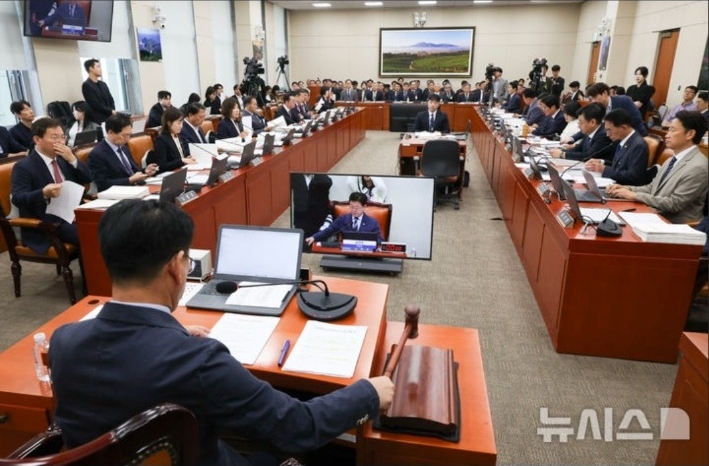
The Korea Workers' Compensation and Welfare Service said it will cut the processing time for industrial accident compensation — which has been growing longer — to within 120 days by the end of next year. The agency plans to streamline procedures for musculoskeletal disorders, which account for a large share of work-related diseases, and then extend the same approach to noise-induced hearing loss and occupational cancer.
Korea Workers' Compensation and Welfare Service President Park Seung-heup made the pledge Friday at a national audit of 12 agencies under the Ministry of Employment and Labor, conducted by the National Assembly's Climate, Energy, Environment and Labor Committee. "We will build a swift and fair compensation system to respond to the surge in work-related disease claims," he said.
Work-related disease claims have risen 2.7-fold over the past five years, the agency said. The combination of rising claims and the difficulty of establishing a link between a disease and a worker's duties has pushed processing times higher.
The agency has been accelerating processing for musculoskeletal disorders, which make up 64 percent of all work-related disease cases, by setting up dedicated teams and standardizing procedures for occupations that generate the most claims.
Park said those measures had increased throughput by 64.3 percent year on year and cut processing time by 67.3 days. He added that the agency would apply the same approach to noise-induced hearing loss and occupational cancer, saying it would "definitely achieve the national policy target of processing within 120 days by the end of next year."
The agency is also preparing to broaden the coverage of employment and industrial accident insurance. In line with an income-based overhaul of the insurance application and contribution system set to take effect next year, it plans to ensure that young workers and part-time workers are protected regardless of their employment type or working hours.
The agency also plans to expand enrollment in Pureun Siat, a retirement pension fund for employees at small and medium-sized enterprises. After widening eligibility to workplaces with fewer than 50 employees in July, it intends to extend coverage to workplaces with fewer than 100 employees starting in January. Park said the fund currently has 200,000 enrolled workers, holds 1.9 trillion won ($1.43 billion) in reserves and has posted an average annual return of around 8 percent.
The Korea Occupational Safety and Health Agency said it will concentrate its prevention efforts on small, high-risk workplaces.
Korea Occupational Safety and Health Agency President Kim Hyeon-jung said the downward trend in fatal workplace accidents that began in the first half of the year has continued, but accidents caused by failure to observe basic safety measures — such as fall prevention and guarding against entrapment — keep recurring. The agency plans to strengthen collaboration among the government, labor, management and private organizations to make prevention activities more effective.
The agency is expanding financial support for small workplaces and using "safe workplace guardians" to gather advance information on hazardous tasks such as roofing work, then conducting on-site inspections timed to when those tasks are carried out to prevent accidents.
The agency is also building an AI- and big data-driven industrial accident prevention system and plans to expand tailored safety education for workers who are particularly vulnerable to workplace injuries, including foreign nationals and older workers.
The Human Resources Development Service of Korea identified restoring trust in national qualification exams and expanding vocational training in response to the AI transition as its top priorities.
Human Resources Development Service of Korea President Lee Byeong-hun said the organization would review every stage of the national qualification exam process — from registration through question-setting, administration, grading and announcement of results — to eliminate the root causes of problems. More than 4.4 million people sit the exams each year.
To support the AI transition, the agency plans to provide AI capability assessments and tailored consulting to 140,000 companies and offer new-technology training programs to about 2.11 million workers. It will also strengthen efforts to ensure the stable recruitment of foreign workers, protect their rights, and support young Koreans seeking employment abroad.
Lee said the agency launched an internal innovation task force and an external public growth committee in July to discuss reform initiatives. "We will reinvent ourselves into an organization that earns the public's trust through bone-deep reform," he said.
fact0514@heraldcorp.com