[Banks' liquidity battle]
Corporate deposits had cushioned banks even as retail savings shrank
Year-end maturities and capital spending plans raise the specter of a mass exodus
Rising corporate deposit outflows are dragging down banks' LCR liquidity ratios
Banks racing to launch high-rate deposit promotions and issue bank bonds
Financial authorities ask banks to stagger bond issuance timing
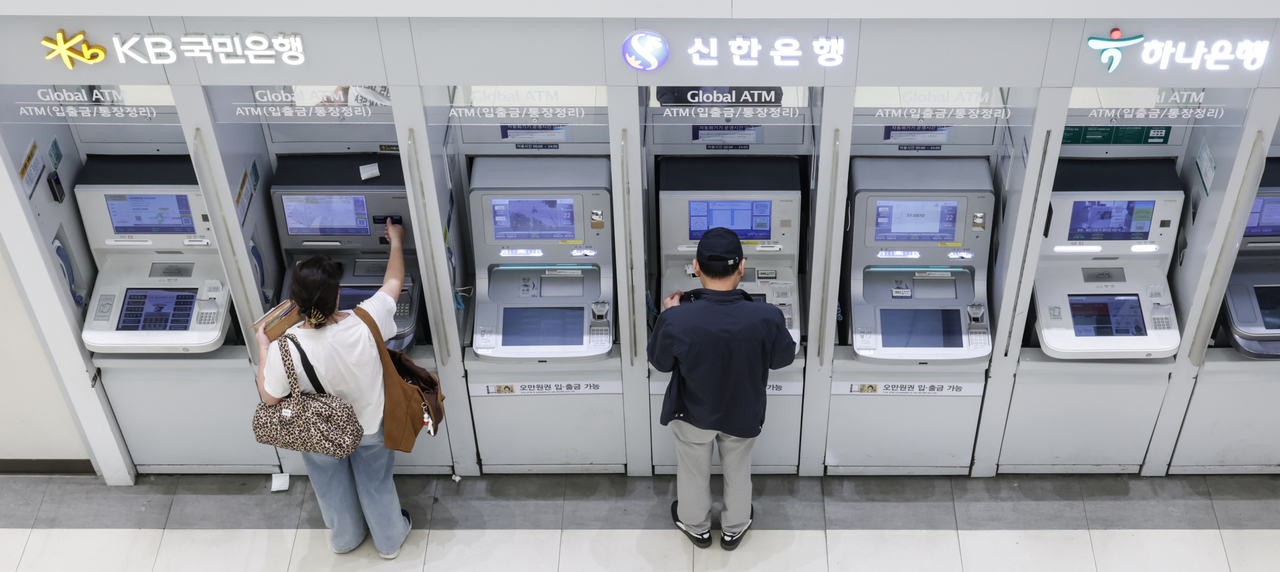
Corporate time deposits, which had served as a liquidity lifeline for South Korea's banks even through this year's stock-market money migration, are showing cracks in the fourth quarter. After swelling by nearly 60 trillion won ($45.3 billion) over the course of the year, corporate time deposits have begun to shrink as year-end maturities arrive — and with major new capital expenditure plans still on the horizon, analysts expect the outflows to accelerate.
For banks that have grown heavily dependent on corporate deposits, the situation has become urgent. Uncertain about when large sums might be pulled, lenders are rolling out high-rate time deposit promotions at 4 percent annually and issuing bank bonds beyond their original plans.
The concern is that intensifying competition for deposits among banks could raise funding costs for savings banks and other second-tier financial institutions as well. Higher deposit rates and heavier bank bond issuance push up borrowing costs, which can feed through to higher lending rates. Financial authorities have stepped in, asking banks to spread out their bond issuance schedules to manage the risk.
Corporate deposits rescued banks during the money migration — rising 13 trillion won while retail savings fell 3 trillion won
The combined balance of corporate time deposits at South Korea's five largest banks — KB Kookmin Bank, Shinhan, Hana, Woori Bank and NH NongHyup — stood at 560.6 trillion won as of Oct. 13, down 612.2 billion won from 561.21 trillion won at the end of last month, according to financial industry data released Friday.
Corporate deposits had consistently grown throughout this year's money-migration cycle, providing a crucial buffer for banks. Even at the end of June, when the Kospi had climbed into the mid-8,000s, the combined time deposit balance held by individuals and other non-corporate depositors had fallen to 435.91 trillion won — a drop of 2.96 trillion won from 438.88 trillion won at the end of last year. Over the same period, corporate time deposits rose by 13.08 trillion won. That divergence was the basis for banks' confident assertions that there was "no problem with liquidity flows" even as retail money poured into equities.
Analysts now say a genuine exodus has begun as corporate time deposits reach their maturity dates this month. At least one bank saw its corporate deposit balance fall by 8.4 trillion won in just over ten days between the end of last month and Oct. 13.
The outflows are expected to pick up speed as year-end approaches. "When a retail time deposit matures, customers tend to roll it over, but companies sometimes choose not to reinvest if a sudden funding need arises — for capital expenditure, for example," an official at a major commercial bank said. "Year-end also brings scheduled payment obligations, so corporate deposits cannot simply be treated as stable funding." An industry official echoed the concern, noting that large deposit withdrawals often coincide with the execution of investment plans that require substantial cash outlays, such as factory expansions.
Banks' liquidity ratios deteriorate — LCR falls at all four major banks
As corporate deposit outflows begin in earnest, lenders are under mounting pressure. They must meet year-end regulatory liquidity requirements while also securing enough funding to satisfy government-backed productive-finance lending initiatives.
The strain is already showing up in the liquidity coverage ratio, the key liquidity metric for banks. The combined average LCR of the four major banks — KB, Shinhan, Hana and Woori — rose from 106.08 percent at the end of the first quarter to 106.14 percent at the end of the second quarter, then fell to a preliminary 104.76 percent at the end of the third quarter.
The LCR measures how much high-quality liquid assets a financial institution holds relative to its projected net cash outflows over a 30-day stress period. Regulators require a minimum of 100 percent. The ratio falls as net cash outflows increase.
Under Basel III standards, corporate deposits carry cash outflow rates up to ten times higher than retail deposits, depending on the type of entity and the nature of the deposit. This means that even an identical time deposit generates a larger calculated cash outflow if held by a corporation rather than an individual, adding greater downward pressure on the LCR. Corporate deposits' share of total time deposits has in fact risen — from 53.2 percent at the end of last year to 55.3 percent as of Oct. 13 — meaning banks are more exposed to the higher-outflow category even as those deposits begin to leave.
"Retail customers tend to leave their money in the bank once they deposit it, but corporates are unpredictable," a financial authority official said. "That is precisely why corporate deposits are assigned a higher outflow rate in LCR calculations — they are qualitatively lower-quality assets." The official added that banks' recent push to issue bank bonds aggressively is also aimed at acquiring government bonds and other high-quality liquid assets to shore up their liquidity ratios.
Banks pay a premium to issue bonds as the money-migration bill comes due — and borrowers feel the ripple effect
The recent wave of high-rate time deposit promotions offering 4 percent annually is a direct response to the corporate deposit risk. Inside the industry, there is talk that banks are now receiving the bill for the money migration.
Bank bond issuance is also climbing. KB Kookmin Bank disclosed plans to issue an additional 6 trillion won in bank bonds during the fourth quarter, after exhausting its original annual issuance limit of 11 trillion won.
None of the other three major banks — Shinhan, Hana and Woori Bank — have yet disclosed additional issuance plans for this year, but all have already issued more bank bonds in 2026 than in 2025. Data from the Korea Financial Investment Association's bond information center show that the four major banks' cumulative issuance through Oct. 15 reached 47.43 trillion won, surpassing last year's full-year total of 45.3 trillion won. Across the entire banking sector, issuance stood at 226.36 trillion won, also exceeding last year's total of 221.61 trillion won. "The volume of bank bonds maturing in the fourth quarter is higher than a year ago, and there is pressure to issue before rates rise further," an official at a major commercial bank said.
Banks are expected to pay an increasingly steep price for bond issuance as the year draws to a close. With supply rising and competition for investors intensifying, lenders will need to offer higher yields to place their bonds. Year-end book-closing by major market participants could tighten supply-demand conditions further, adding upward pressure on rates.
The costs are also being passed on to second-tier financial institutions. Savings banks, which fund a significant portion of their operations through deposits, must maintain deposit rates above those of commercial banks to attract customers — meaning every time a bank raises its time deposit rate, savings banks must follow. Credit card companies and capital firms face a similar dynamic: as bank bond supply grows, lower-rated specialty credit finance companies must offer even higher yields to place their own bonds.
Borrowers are feeling the effects as well. Fixed-rate bank loans are benchmarked to bank bond yields, so fiercer bond issuance competition translates directly into higher lending rates. The new COFIX rate, which serves as the benchmark for variable-rate loans, also rises as funding costs from deposits and bank bonds increase. As of Thursday, the upper end of fixed-rate bank lending stood at 7.02 percent annually, with variable rates at 6.74 percent, and some in the industry are raising the possibility of rates reaching 8 percent before year-end. Second-tier lenders will have no choice but to pass their own higher funding costs through to borrowers as well.
Not yet a Legoland-level crisis — but regulators urge banks to ease up on deposit competition
Financial authorities are closely monitoring the year-end deposit competition among banks. Although the spread between bank bond yields and specialty credit finance company bond yields has narrowed somewhat following the government's recent reduction in Treasury bond issuance, regulators believe the structural risk posed by volatile corporate deposits makes it too early to be complacent. Earlier this month, authorities collected bank bond issuance plans from lenders and asked them to stagger the timing.
"The situation does not call for drastic measures like the bond issuance moratorium imposed during the Legoland crisis, but we are continuously urging banks to manage their risks as we monitor market conditions," a financial authority official said.

hyuk@heraldcorp.com
rim@heraldcorp.com