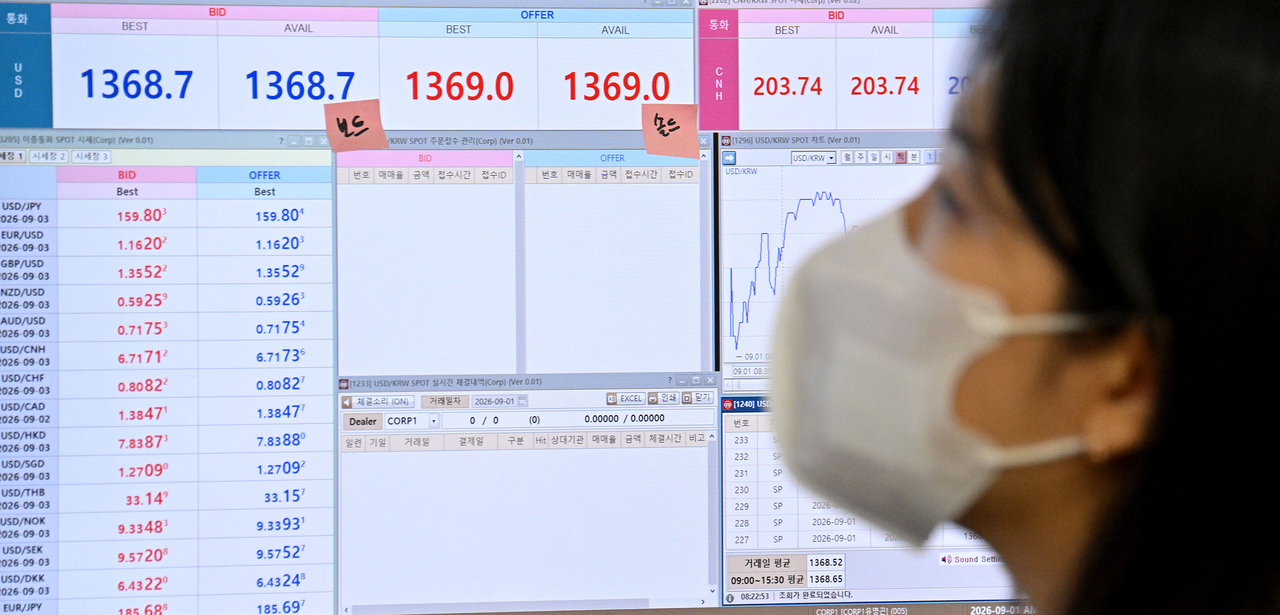
"When I buy, it falls. When I sell, it rises."
It is a kind of Murphy's Law that has long circulated among retail stock investors. The self-deprecating saying goes: the moment you finally summon the courage to buy, share prices sink as if on cue — and the moment you can no longer hold on and sell, the market rebounds as if nothing happened. The flip side holds that when foreign investors buy, the market goes up, and when they sell, it goes down.
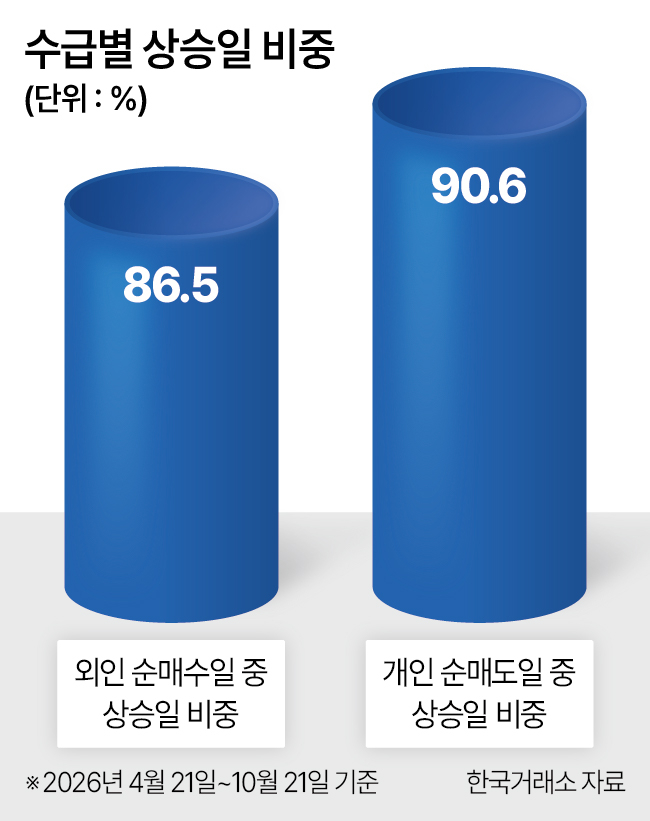
That joke, passed around among retail investors, has now been confirmed to be largely true. Over the past six months, the Kospi rose on roughly 87 percent of the trading days when foreign investors made net purchases of domestic shares. Conversely, on days when retail investors were net sellers, the Kospi advanced on a striking 91 percent of occasions.
The trend has grown more pronounced of late. The tendency for the Kospi to move in the opposite direction from retail investor trading has also become increasingly conspicuous.
Kospi up 86% on foreign buying days; alignment hits 92% in October
An analysis of daily investor trading data and Kospi figures from Korea Exchange shows that foreign investors were net buyers on the domestic Kospi market on 37 trading days over the six months from April 21 to Oct. 21. Of those, the Kospi rose on 32 trading days — a rate of 86.5 percent. In other words, nearly nine times out of 10 when foreigners were buying, the benchmark index finished higher.
Over the same period, the Kospi rose on 70 of 122 total trading days, a rate of 57.4 percent. The advance rate on days of foreign net purchases was 29.1 percentage points higher than the overall rate — suggesting the index gains on those days cannot be explained simply by a broader upward trend in the market.
More recently, the tendency for the Kospi to fall on days when foreign investors are net sellers has grown steadily more pronounced. In May alone, the Kospi fell on only five of the 16 trading days when foreigners were net sellers — a rate of just 31.3 percent. That means the index actually rose more than twice as often as it fell even when foreigners were selling.
By June, however, that rate had climbed to 47.1 percent, and by July it had risen to 75.0 percent. It dipped back to 50.0 percent in August before rising again to 69.2 percent in September. This month the figure reached 88.9 percent — on eight of the nine trading days between Oct. 1 and Oct. 21 when foreigners were net sellers, the Kospi fell.
The shift becomes even starker when both foreign net buying and net selling days are considered together. Defining an "alignment" as a day when the Kospi rises on a foreign net-purchase day or falls on a foreign net-selling day, the alignment rate in May was just seven out of 18 trading days — 38.9 percent, below even half. At the time, it was common for the Kospi to rise even when foreigners were selling.
By July, however, the alignment rate had climbed to 72.7 percent, then moved through 65.0 percent in August and 75.0 percent in September before soaring to 92.3 percent in October.
In October in particular, the Kospi rose on all four trading days when foreigners were net buyers and fell on eight of the nine days when they were net sellers. In 12 of 13 trading days, the direction of foreign trading and the direction of the Kospi matched.
The sole exception was Oct. 2, when foreigners were net sellers yet the Kospi rose 0.46 percent from the previous session. Setting that one day aside, foreign trading direction has in effect been a near-perfect guide to the Kospi's daily movement this month.
Kospi up 91% when retail investors sell; 100% decline rate on net-purchase days in Sept. and Oct.
The picture for retail investors was the mirror image. Whereas the Kospi tended to rise when foreign investors were buying, it tended to rise when retail investors were selling.
Over the past six months, retail investors were net sellers on 53 trading days. Of those, the Kospi rose on 48 — a rate of 90.6 percent. The market adage that share prices go up when retail investors sell held true more than nine times out of 10.
That is 33.2 percentage points above the overall Kospi advance rate of 57.4 percent over the same period, and even higher than the 86.5 percent advance rate on days of foreign net purchases.
Another notable feature is that the pattern held consistently throughout the entire six-month period.
Breaking it down by month, the Kospi rose on every single day retail investors were net sellers in May and June — a 100 percent alignment rate across five and six trading days, respectively. The rate dipped to 75.0 percent in July before returning to 100 percent in August and reaching 90.9 percent in September. So far this month, the Kospi has risen on five of the six trading days when retail investors were net sellers.
The flip side — that the Kospi falls when retail investors buy — has grown more pronounced of late. Over the full six months, retail investors were net buyers on 69 trading days, and the Kospi fell on 46 of them, a rate of 66.7 percent. Two out of every three times retail investors were buying, the index finished lower.
Looking at just the past two months, the pattern is even more extreme. In September, the Kospi fell without exception on all nine trading days when retail investors were net buyers. The same has been true this month: the index has fallen on all seven trading days when retail investors were net buyers.
Combined, retail investors were net buyers on 16 trading days in September and October — and the Kospi fell on every single one of those 16 days. It amounts to an extreme phenomenon in which the index has declined every time retail investors have been buying over the past two months.
As a result, the rate at which retail investor trading and the Kospi move in opposite directions has risen sharply of late. In May, retail investor trading ran counter to the Kospi's direction on 10 of 18 trading days — a rate of just 55.6 percent.
By July the rate had climbed to 81.8 percent, and by August to 85.0 percent. In September, retail trading and the Kospi moved in opposite directions on 19 of 20 trading days — a rate of 95.0 percent. This month the figure stands at 92.3 percent, with 12 of 13 trading days showing the same divergence.
Across the full six-month period, retail investor trading and the Kospi moved in opposite directions on 94 of 122 trading days — a rate of 77.0 percent.
Supply and demand over fundamentals? Foreign flows emerge as key market driver
The increasingly sharp divergence between the trading direction of foreign and retail investors — and its correlation with Kospi moves — aligns with a growing view in the brokerage community that supply-and-demand dynamics are playing a larger role in driving the market.
Analysts say that as the domestic market has swung sharply in both directions of late, the trading behavior of foreign investors has emerged as a key short-term variable for gauging market direction.
Share prices fundamentally reflect a company's earnings power and growth potential, but in the short term they are driven by the tug-of-war between buying and selling pressure. Even strong corporate earnings cannot prevent a share price from falling if a wave of sell orders hits the market at once — and conversely, prices can rise even without any change in underlying value if buying interest surges.
Market observers say conditions have recently entered a phase in which supply-and-demand forces are exerting an unusually strong influence. As the index has increasingly moved in different directions depending on whether foreigners are buying or selling, analysts argue that tracking foreign capital inflows and outflows deserves as much attention as corporate earnings or valuations.
Hwang Su-wook, a researcher at Meritz Securities, said investor sentiment and supply-and-demand dynamics are currently having a greater impact on share prices than corporate fundamentals.
He said that with retail and institutional investor flows failing to establish a clear market direction, the movement of foreign capital warrants close attention.
"I believe share prices are being driven more by investor sentiment and supply-and-demand than by fundamentals," Hwang said. "It would not be too late to assess the market's direction after observing whether foreign buying flows in on a sustained basis."
That said, the high alignment rate between foreign trading and Kospi moves does not by itself prove that foreign buying and selling determines index direction. This analysis examined how often the two moved in the same direction on the same day over the past six months; it does not establish causation or demonstrate predictive power for future index moves.
※ The analysis covers 122 total trading days from April 21 to Oct. 21, 2026, based on daily data from Korea Exchange. Trading days on which the index was unchanged (0.00 percent) were included in the total trading day count but excluded from both the advance and decline tallies.
th5@heraldcorp.com