Participation rate stands at just 50.3% three years in; city to tap national database instead of waiting for voluntary reports
Expansion to private buildings planned for next year; evaluation categories to grow from 26 to 56
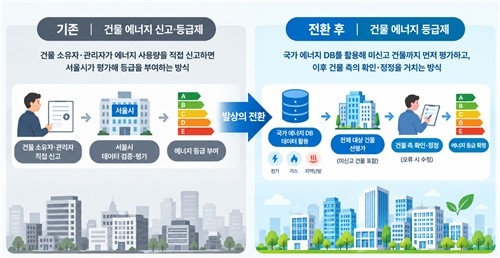
The Seoul Metropolitan Government will shift its building energy reporting and rating system away from voluntary owner submissions and toward direct use of a national energy database, allowing it to assign ratings to buildings whose owners have not filed reports.
According to the city, the system currently requires building owners or managers to report the previous year's consumption of electricity, city gas and district heating. Seoul then evaluates energy use per unit floor area and assigns a grade from A to E.
Seoul introduced the system in 2024, the first city in the country to do so. It covers a total of 15,117 buildings — public buildings with a gross floor area of at least 1,000 square meters and private non-residential buildings of at least 3,000 square meters. Participation has grown from 4,281 buildings (28.3 percent) in 2024 to 6,392 buildings (42.3 percent) last year, reaching 7,604 buildings (50.3 percent) as of the end of September this year.
The pace of growth has slowed — from 2,111 new buildings joining in 2025 to 1,212 through September this year. At that rate, the city estimates it would take roughly seven more years for all eligible buildings to participate.
In response, Seoul will move beyond the voluntary reporting model and begin assigning ratings to buildings that have not submitted reports, with individual building representatives given the opportunity to verify or correct the results. Starting next month, the city will rate public buildings that have yet to file, calculating preliminary grades based on the national energy database, notifying building managers of the results and allowing them to review and supplement the data.
From next year, the system will expand to cover all buildings, including private ones, enabling the city to manage even those whose energy consumption had previously been difficult to track.
The city also plans to refine its evaluation criteria from 26 building-use categories to more than 56 to better reflect the characteristics of different building types and operations. Educational and research facilities, for example, would be broken down into general educational facilities, research facilities, universities and high schools.
The B and C rating bands, which contain a disproportionately large share of buildings, will also be subdivided to draw finer distinctions in energy performance. To encourage real improvements in energy use, the city will expand incentives — including interest rate reductions for buildings that move up one rating tier and enroll in the Building Retrofit Program loan support project, and commemorative plaques for buildings that rank in the top 1 percent.
Legislation to make the building energy reporting and rating system mandatory is pending in the National Assembly. Seoul said it plans to work with the central government, including the Ministry of Land, Infrastructure and Transport, to revise the relevant laws and regulations to mandate the system and strengthen local governments' authority over building energy management.
"We will develop the rating system so that more buildings can check their energy performance and find ways to improve, using the national energy database," said Yoon Jae-sam, head of the Seoul Metropolitan Government's Climate and Environment Bureau. "We will continue to consult with the central government on legislative revisions and institutional support to ensure the system operates stably and can spread nationwide."
ken@heraldcorp.com