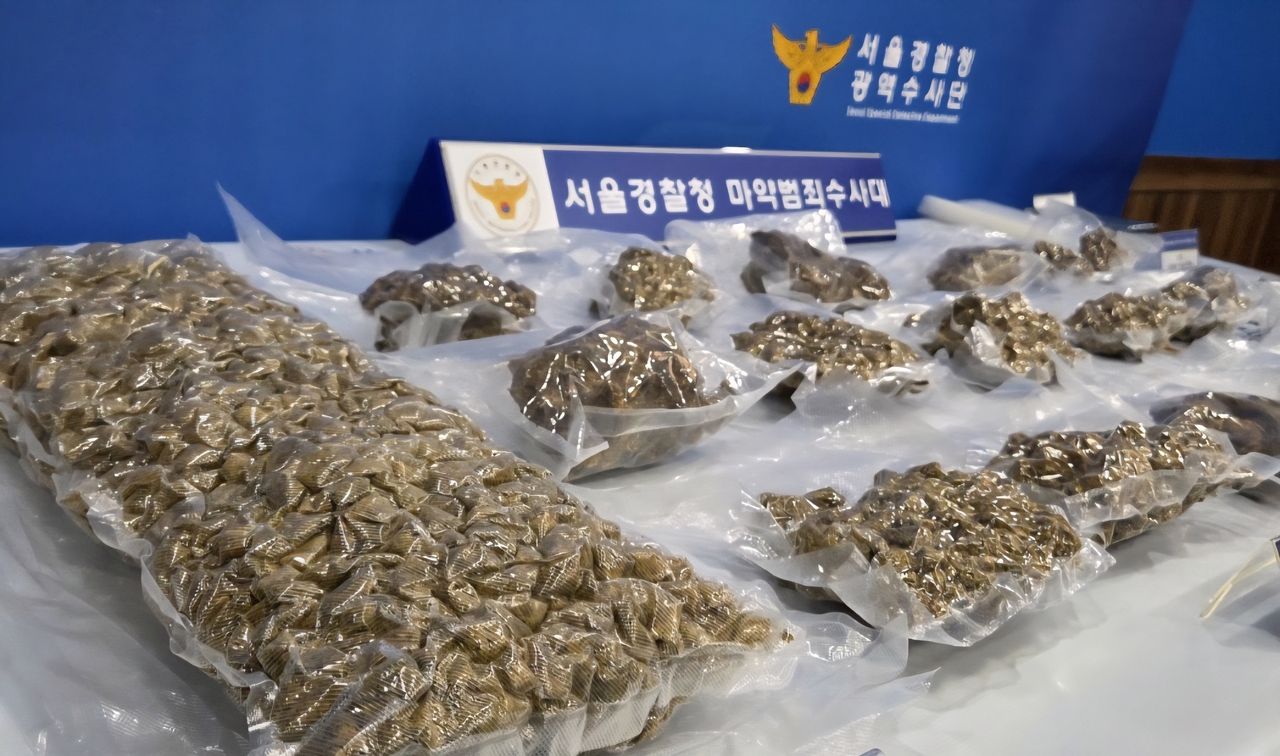
Despite SK hynix's announcement that it is halting the Solidigm IPO, the dual-listing controversy may not be fully extinguished, given the tangled affiliate ownership of NPS and the possibility of a future NPS listing.
Has the fire really gone out?
SK hynix announced Friday it is suspending its pre-IPO fundraising and initial public offering review for Solidigm, saying it needs to reassess whether a listing is the most advantageous path for the company and its existing shareholders given current capital market conditions and recent share price trends.
Yet calling this a clean abandonment of a dual listing would be premature. The ownership structure SK Group has put in place leaves the question very much open.
Affiliate cross-investment — illegal at home, tangled abroad
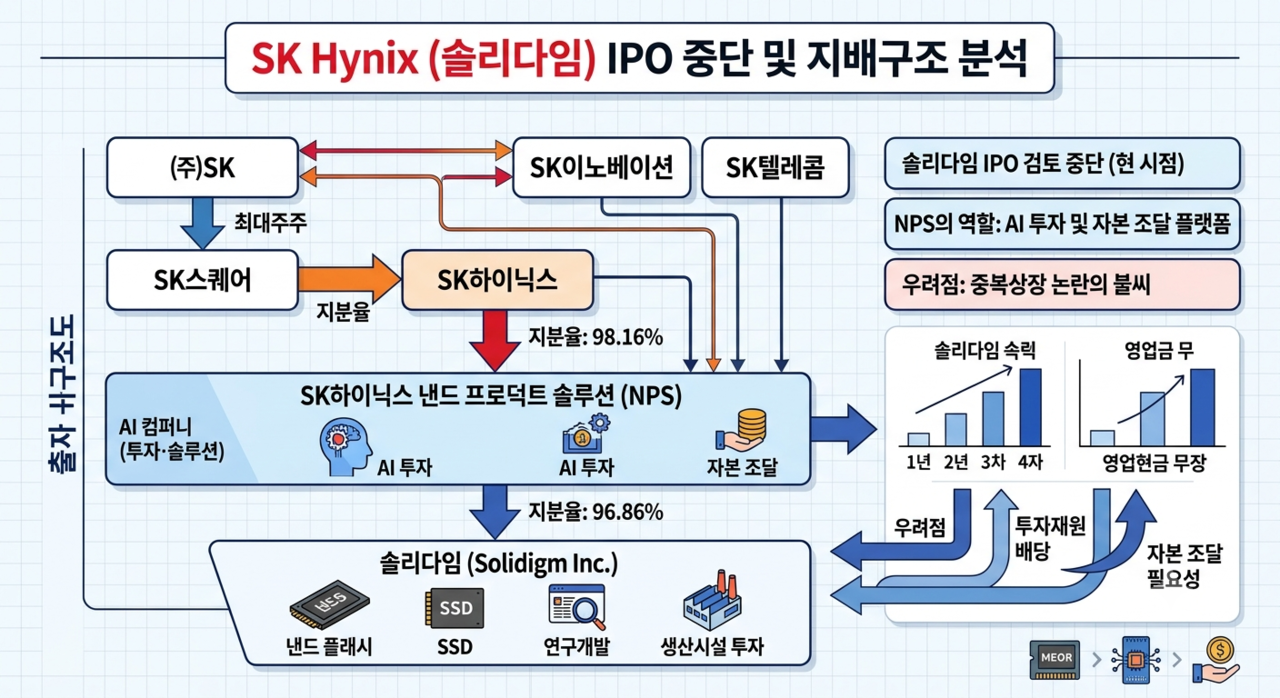
Earlier this year, SK hynix decided to transform its US subsidiary SK hynix NAND Product Solutions (NPS) into an AI investment and solutions company. The existing NAND flash and SSD sales and research and development operations that NPS had been running were transferred to a newly created entity, Solidigm Inc. The assets, liabilities, contracts, rights and personnel transferred in March were valued at 15.37 trillion won ($11.6 billion) — approximately 10.65 billion dollars at the exchange rate prevailing at the time (1,442.8 won per dollar). NPS received 1.65 billion newly issued Solidigm shares in return.
The 15.37 trillion won figure is the business transfer price. It cannot be equated directly with the enterprise value of Solidigm or NPS, but it is far from meaningless — because immediately after the business was moved over, SK Group affiliates, not SK hynix itself, subscribed to newly issued NPS shares.
As recently as the end of March, SK hynix held 100 percent of NPS. By the end of the first half, that stake had fallen to 98.16 percent, as SK and SK Innovation entered as new shareholders. SK Telecom subsequently acquired additional NPS shares, and SK Innovation made a further capital contribution.
SK, SK Innovation and SK Telecom are all SK Group affiliates, but they occupy very different positions in SK hynix's direct ownership chain. SK hynix's largest shareholder is SK Square, a subsidiary of SK. SK Innovation and SK Telecom are also subsidiaries of SK — making the arrangement look rather like a grandfather and an uncle moving into a house that had belonged to a father and his child.
What SK, SK Innovation and SK Telecom acquired was not Solidigm stock but newly issued NPS shares. One of NPS's most important assets is its stake in Solidigm. Becoming an NPS shareholder means participating indirectly in any future appreciation of Solidigm's value. A structure has now been created in which a portion of the Solidigm value that would originally have accrued entirely to SK hynix shareholders can instead flow — via NPS — to shareholders of other listed affiliates.
Did they know about the NAND windfall in advance? — value surged right after purchase
SK hynix committed to investing up to $10 billion in NPS through 2030 via a capital call arrangement, under which funds are drawn down as investment opportunities arise. Separately, the boards of SK, SK Innovation and SK Telecom approved commitments of $250 million, $380 million and $480 million, respectively — a combined pledge of $1.11 billion from those three companies alone.
The prices at which SK, SK Innovation and SK Telecom acquired their NPS shares deserve close scrutiny.
SK committed $250 million and had paid in $133.89 million by the end of the first half. In May it acquired 1,295 newly issued NPS shares for approximately 199.7 billion won — about 154.21 million won per share. Back-calculating from the number of shares then outstanding, the implied total equity value of NPS was approximately 15.7 trillion won.
SK Innovation committed $380 million. It paid in $59.97 million in the first half, with second-quarter investment of approximately 92.4 billion won. On July 23 it made an additional capital contribution of $143.4 million through a US subsidiary, bringing the disclosed total to $203.37 million. The number of shares acquired and the per-share price from that additional contribution cannot be confirmed from publicly available disclosures alone.
SK Telecom committed a total of $480 million for up to 1,198 shares. In the first capital call it acquired 642 shares for 397.13 billion won — approximately 618.58 million won per share, roughly four times the per-share price paid by SK.
There was a gap of roughly two months between SK's first contribution and SK Telecom's. In that interval, the earnings outlook for the NAND business shifted dramatically. SK hynix's quarterly report shows that NPS and its subsidiaries posted first-quarter NAND sales of 3.78 trillion won and net profit of 1.27 trillion won. A year earlier, sales had been 1.42 trillion won and net profit 136.7 billion won.
The quarterly report containing those figures was filed on May 15. SK's acquisition of NPS shares came after that date. SK Telecom's investment also preceded the filing of the semi-annual report on Aug. 13. Based on publicly available disclosures alone, the transactions were conducted at different prices after first-quarter results had already been made public.
The Solidigm figures disclosed in SK hynix's semi-annual report — filed after SK Telecom's investment — were even more striking: first-half sales of 12.25 trillion won and net profit of 5.84 trillion won. The explosive earnings growth prompted market speculation that Solidigm's IPO valuation could range from a minimum of $100 billion to as much as $150 billion.
Applying SK Telecom's per-share price of approximately 618.58 million won — the most recent publicly disclosed transaction price — the 1,875 NPS shares held by SK and SK Innovation at the end of the first half would be worth approximately 1.16 trillion won. The two companies paid approximately 292.1 billion won to acquire those shares. Using SK Telecom's actual transaction price as the benchmark, the value of their combined stake exceeds their acquisition cost by approximately 867.7 billion won. How many shares SK Innovation acquired in its July 23 additional contribution, and at what price, still needs to be confirmed.
If not Solidigm — could the parent NPS list instead?
NPS is Solidigm's controlling shareholder, holding a 96.86 percent stake at the end of the first half. If Solidigm's value continues to rise on the back of strong earnings, NPS's own value will inevitably track it closely — and the future value available to NPS's outside shareholders, namely the SK Group affiliates, will grow accordingly. The suspension of the Solidigm IPO review does nothing to change that structure.
Solidigm generates substantial earnings. Its full-year net profit could well exceed 12 trillion won. New production facilities are not built by spending all the money at once; with its own cash flow and borrowing capacity, Solidigm has considerable ability to fund a significant portion of its capital expenditure needs internally.
NPS, by contrast, currently has no core operating business that generates large-scale cash directly. The NAND and SSD operations — its former engine — have been moved down to Solidigm. NPS's new role is to invest in AI companies and develop related solutions businesses.
As an investment company, NPS must generate fresh capital to reinvest through exits, dividends or profits from its own operations. Receiving dividends from Solidigm or monetizing part of its stake would provide an important source of investment funding.
But Solidigm also needs capital. Even as SK hynix suspended the Solidigm listing review, it said the need to invest in new US production facilities to meet growing AI memory chip demand remains unchanged. If Solidigm embarks on large-scale US investment, its capacity to pay dividends up to NPS will be correspondingly reduced.
In that scenario, NPS's primary sources of investment capital for now are likely to be affiliate contributions and returns from its own investments. Current commitments to NPS total up to $11.11 billion — up to $10 billion from SK hynix and $1.11 billion combined from SK, SK Innovation and SK Telecom. Measured against the scale of AI ecosystem investment today, that sum is large in some respects and modest in others.
But what if NPS needs more money for its investments? SK hynix and the affiliates could inject additional funds. NPS could borrow. It could bring in outside investors. In that process, it could sell part of its Solidigm stake.
The greater the need for external capital, the stronger the case for revisiting a listing. That could mean reviving the Solidigm IPO — or it could mean NPS itself pursuing a listing.
If NPS were to list under the current structure, investors would in effect be buying exposure to Solidigm's value alongside NPS's AI investment assets. Whatever the legal entity's name, SK hynix shareholders would face a dual-listing controversy returning in a different form. Moreover, outside shareholders are already inside NPS. They too will eventually need a mechanism to monetize their investment or establish a market price for it. Severing the link between NPS and Solidigm is the only way to put the dual-listing debate fully to rest.
NAND back under SK hynix's roof — a reversal is needed
The review of a Solidigm listing has been suspended, but the capital structure that could make a listing necessary again has not gone away.
SK hynix's announcement suspending the Solidigm listing review is worth reading carefully in that context. The company was explicit that it is halting the ongoing pre-IPO and IPO review work — meaning the listing process currently under way is being set aside. But it is difficult to read that as permanently closing the door on a future listing.
The company said it had decided not to pursue a listing "at this time," adding that Solidigm's growth potential and investment needs had not changed and that it would continue to review the timing, scale and financing methods for investment.
In other words, the current listing review has been suspended — but the listing option itself has not been permanently retired.
Protecting SK hynix shareholders' rightful share of the enterprise value of NPS and Solidigm — and of the NAND business that underpins it — requires normalizing the ownership structure. For NPS to be recognized as a genuine AI investment platform rather than a stepping stone to a dual listing, SK hynix needs to restore a structure in which it directly controls Solidigm.
That is easier said than done, now that outside shareholders have already taken positions in NPS. Unwinding their stakes would be impossible to do without acknowledging Solidigm's sharply higher value. From SK hynix shareholders' perspective, the company would be buying back at a premium economic interests it had previously distributed at a lower price. From the perspective of shareholders in SK, SK Innovation and SK Telecom, selling appreciated stakes cheaply is equally untenable.
Yet if this dilemma goes unsolved, it is hard to say the dual-listing ember has truly been extinguished. If SK Group does not resolve it, the market will keep asking whether the intent to pursue a dual listing remains very much alive.
For now, the immediate question is whether SK, SK Innovation and SK Telecom will continue to honor their capital commitments to NPS. If the plan is to unwind the Solidigm ownership structure, there is no reason to keep putting more money in.
kyhong@heraldcorp.com