Minister signals downward revision to demand forecast; nuclear review process blamed for delay to 12th basic electricity plan
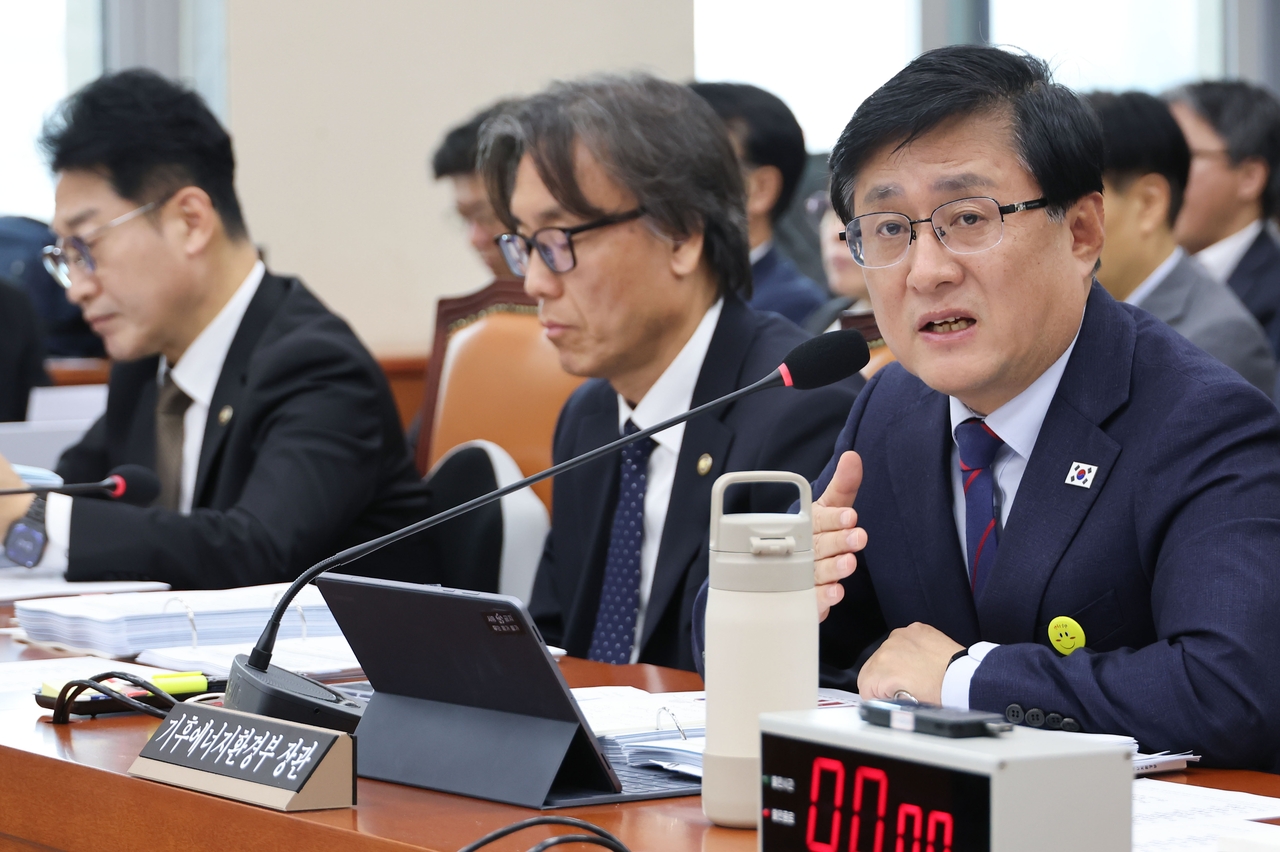
Climate, Environment and Energy Minister Kim Sung-hwan said Monday that a downward revision to the projected power demand from AI data centers would be reflected in the 12th Basic Plan for Electricity Supply and Demand, covering 2026 to 2040.
Speaking at a comprehensive audit of the Ministry of Climate, Environment and Energy by the National Assembly's climate, energy, environment and labor committee, Kim told People Power Party lawmaker Lee Jong-bae that the ministry would incorporate realistic AI data center demand into the 12th plan "without overestimating or underestimating."
"When we announced the three mega-projects, we tried to reflect corporate demand as fully as possible, but when it came down to it, the amount of demand that had actually been confirmed turned out to be less than we expected," Kim said. "It is difficult to include vague demand projections in the 12th plan, so we will take into account companies' plans and realistic demand."
The demand forecasting subcommittee of the 12th plan's steering committee projected in August that peak power demand from AI data centers would reach 11.9 GW by 2040.
The subcommittee had put the figure at 4.0 GW in April, before the three mega-projects were announced, then raised it by 7.9 GW four months later. That 7.9 GW increase is equivalent to the combined capacity of about 5.6 large nuclear reactors.
The subcommittee said at the time that it had "reflected only demand that had been concretely planned at the current point," but critics said even that figure was an overestimate.
The ministry is in talks with related ministries and industry to scale back the AI data center power demand forecast.
Separately, lawmakers raised concerns that the government's public deliberation process on new nuclear power plant construction amounted to performative administration, even as public support for new plants remains high.
Lee said Kim had "suddenly announced a three-month public deliberation process without warning" on new nuclear plant construction, despite more than 80 percent of the public supporting it, and that the move had delayed the 12th basic electricity plan by more than three months.
Lee also noted that Kim had previously opposed nuclear power and that, even after taking office, a decision on whether to proceed with nuclear plant construction under the 11th basic electricity plan had been revisited through a public opinion poll.
"Ultimately, the electricity plan committee could just decide on its own — I don't see why it needs to go through a public deliberation process and cause delays," Lee said. "The conclusion seems obvious. I'm not sure whether the minister is putting on a show for anti-nuclear advocates, or whether he simply dislikes the Lee Jae Myung administration's blitzkrieg approach to its mega-projects."
In response, Kim maintained that public deliberation was necessary to gather public opinion.
"The 11th basic electricity plan concerned how the Lee Jae Myung government would implement decisions made under the Yoon Suk Yeol government," Kim said. "Conducting a full public deliberation on top of that would have taken too long, so we gathered public opinion through a polling process and finalized the plan on that basis."
He added that the process had drawn criticism for being too convenient or rushed. "The 12th plan is something the Lee Jae Myung government must judge and decide for itself, so even if it takes a little more time, we felt it was necessary to examine public opinion in greater detail — which is why we are going through a public deliberation process," Kim said.
Kim asked for understanding on the timeline, noting that the basic electricity plan is updated roughly every two years and that the 11th plan was finalized in February 2025. "Even with the deliberation process, the schedule has not been pushed back further," he said.
The audit also heard concerns that the lengthy license renewal review process for nuclear power plants — stretching nearly four years in some cases — was creating power supply risks due to delayed restarts.
According to People Power Party lawmaker Park Su-min, four of the nine nuclear reactors currently undergoing license renewal reviews have been taken offline. Some reviews have taken 48 months and 44 months respectively, with the process showing no sign of shortening.
License renewal is a system under which the safety of a nuclear reactor that has reached the end of its design life is reviewed before it is permitted to continue operating. A reactor that fails the safety review cannot generate power once its design life expires.
"It has now been 48 months to get approval for a 10-year extension," Park said. "Does that mean we're only going to use the remaining six years?"
Park said the government should take a more proactive approach to the license renewal process, given the significant time and cost involved in building new nuclear plants.
Park also claimed that while Kim had said he would consult with the Nuclear Safety and Security Commission, the commission had indicated it had not received any such communication.
Kim said in response that license renewal falls under the commission's jurisdiction and that "the relevant bureau is working to move as quickly as possible within the legal procedures."
His remarks underscored that the review must proceed according to legal procedures, as the authority to grant license renewals rests with the commission.
Kim acknowledged, however, that coordination among the relevant agencies has been difficult. He noted that the commission and Korea Electric Power Corporation and Korea Hydro & Nuclear Power fall under different supervising ministries, making close coordination a challenge.
oskymoon@heraldcorp.com