232 SME support projects to be merged or cut
Citizen budget at record 301 billion won
Youth participation share to rise to 40%
The government will begin identifying additional spending efficiency measures in November, following the inclusion of 44.2 trillion won ($33.4 billion) in efficiency plans in next year's budget proposal. It plans to use AI to scrutinize inefficiencies in fiscal programs and expand public participation, with findings to be reflected in the fiscal 2028 budget proposal.
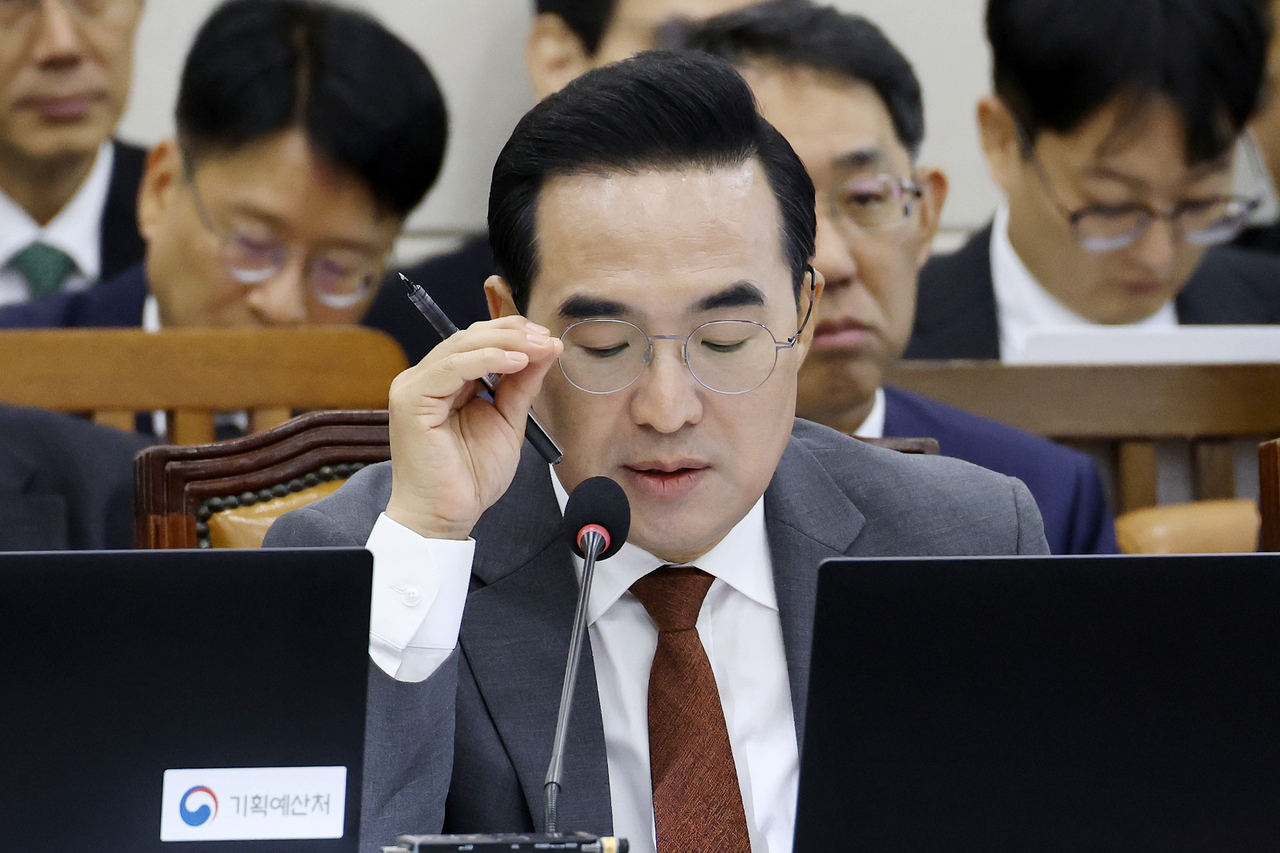
The Ministry of Planning and Budget said Monday it held the third session of the Fiscal Management Strategy Council at Government Complex Seoul, chaired by Minister Park Hong-keun, and confirmed three agenda items: the performance of the spending efficiency task force, plans to revitalize the citizen participatory budget system, and a reform of the fiscal execution management framework.
The government will launch next year's spending efficiency TF early, starting in November, to bring forward the timeline for identifying reform tasks and incorporate findings into the fiscal 2028 budget proposal and the national fiscal management plan. Policy improvements identified through the previous year's integrated performance evaluation will also be reviewed and, where necessary, linked to in-depth assessments of fiscal programs.
The government will deploy an AI assistant called "Jichul Dotbogi" — a spending review tool — to analyze programs and examine issues flagged by the National Assembly, the Board of Audit and Inspection, and the media. The ministry will also draw on overseas case studies to develop improvement measures, expand the number of private-sector members on the TF, and broaden civil society participation. Proposals submitted through the citizen participatory budget platform will be actively incorporated into efficiency reform tasks.
Since the spending efficiency TF was launched late last year, the government has identified more than 300 reform tasks, of which 88 were translated into 44.2 trillion won in efficiency measures reflected in the fiscal 2027 budget proposal. The TF involved 41 ministries, agencies and offices along with about 80 private-sector members, and held more than 100 meetings across 15 working groups.
Key measures included restructuring mandatory expenditure and consolidating overlapping programs. The local education finance grant system, which had been automatically tied to domestic tax revenues, will be reformed so that allocations grow steadily based on economic growth and the school-age population. The employment insurance benefit system was also adjusted to correct a distortion in which jobless benefits exceeded wages earned while working.
Scattered fiscal programs across ministries were also reorganized. The government reviewed all 472 small and medium-sized enterprise support projects run by 17 ministries and merged or scaled back 232 of them. An additional 47 overlapping projects within information and communications technology funds were also consolidated.
The government abolished the Type II National Scholarship, participation in which had been declining among universities. The freed-up funds will be redirected to support low-income students and those at regional national and private universities. For the Tomorrow Learning Card program, support for short-term and general training courses was streamlined, while long-term and advanced training in high-demand fields such as AI and digital technology was expanded.
The citizen participatory budget system will also be expanded. Since its introduction in 2018, the system has channeled 543.9 billion won into 298 projects. The fiscal 2027 budget proposal allocates a record 301 billion won across 21 projects.
To ensure steady growth in the citizen participatory budget, the government will set medium-term targets and establish new criteria for project selection — measures aimed at preventing budget concentration in a small number of projects.
Opportunities for citizens to propose budget projects will also be broadened. The ministry will run monthly outreach sessions to collect public proposals and resume deliberative participation workshops where citizens, experts and ministry officials jointly design projects. An AI writing assistant will be introduced on the online platform to lower the barrier to submitting proposals.
The share of young people in the citizen participation panel will be raised from 20.7 percent to 40 percent. To that end, the number of youth participants aged 19 to 34 will be doubled from 120 to 240, and a youth policy idea competition will be held.
The citizen participatory budget and the resident participatory budget will be linked so that users can view and select from both on a single screen, and the system will be improved to allow users to track progress at each stage from proposal review to budget inclusion. Outstanding proposers will receive commendations and prize money, and those who wish may have their names attached to adopted projects.
The fiscal execution management framework will be restructured to focus on actual spending performance. A detailed reform plan will be announced separately Tuesday, reflecting the outcomes of Monday's meeting.
"The nation's finances belong to the people," Park said. "Not a single won should be wasted, and the public must be able to see the entire process transparently."
y2k@heraldcorp.com