Four-term lawmaker, ambassador to Japan — and now leading South Korea's top unification advisory body
Critical voices welcome; citizen input to feed presidential policy recommendations
Japan dialogue expected to broaden engagement; overseas Koreans seen as public diplomacy asset
What stayed with Kang Chang-il from a peace and unification dialogue held in Jeju in September was the proposal of a middle school girl. Rather than topics prone to political or ideological conflict, she suggested starting peace from shared activities — climate action and youth exchanges between the two Koreas.
Recalling the students' idea of practicing peace in everyday life during an interview with Herald Japan, Kang, senior vice chairman of the National Unification Advisory Council, said, "I could sense how much the students had thought and agonized over this, and it filled me with pride." He went on to say that he would create more opportunities for people to speak their minds freely and listen to others.
The direction he envisions for the NUAC is captured in that moment: citizens taking part directly in discussions on peaceful unification, exchanging differing views, and having those voices shape national policy. "If minority opinions are simply dismissed, we cannot even call it democracy," Kang said.
Born in Jeju in 1952, Kang has moved through democratic activism, historical research, parliamentary politics and diplomacy. While studying Korean history at Seoul National University, he was sentenced to 10 years in prison in 1974 in connection with the National Democratic Youth and Student Federation incident. He later earned master's and doctoral degrees from the University of Tokyo and went on to serve as a professor at Pai Chai University and director of the Jeju April 3 Research Institute. He devoted his youth to uncovering the truth behind the Jeju April 3 incident and restoring the honor of its victims, efforts that ultimately led to the enactment of a special law on the matter in late 1999. He entered the National Assembly in 2004 and served four consecutive terms representing Jeju through the 20th Assembly. He led the Korea-Japan Parliamentarians' Union, promoting inter-parliamentary exchanges between the two countries, and after stepping back from the 2020 general election served as ambassador to Japan from 2021 to 2022.
The senior vice chairman of the NUAC — a post Kang assumed this past April — is responsible for conveying domestic and overseas public opinion on peaceful unification to the president. The NUAC is a presidential advisory body grounded in Article 92 of the Constitution, with the president serving as its chairman. It gathers public opinion at home and abroad, builds national consensus, and submits policy recommendations drawing on the will and capacity needed for peaceful unification. Kang said that in this process, critical views of government policy must be accurately captured as well. The goal is to broaden public consensus, he explained, but participants in dialogue must never be pushed toward a single conclusion.
Regarding the "2026 Japan Peace and Unification Empathy Dialogue" organized by the Japan Eastern Regional Council, Kang said he hopes participation and empathy will spread throughout the Korean community in Japan. Drawing on his experience as ambassador, he highlighted shifts in South Korea-Japan relations and the importance of people-to-people exchanges, and identified the trust that overseas advisory members and Korean diaspora communities build in their local societies as an asset for peace on the Korean Peninsula. The following is an edited transcript of the interview.
— What has been your top priority since taking office?
Dialogue, communication and education. I want to make sure everyone can participate as an active subject. We are investing heavily in dialogue, empathy and future-oriented unification education through initiatives such as the Peace and Unification Social Dialogue, the One Million Citizens Interview for Peace and Unification, the Peace and Unification Citizens' Classroom, and the Youth Peace and Unification Classroom.
Without public interest in and empathy for peace on the Korean Peninsula, peaceful unification cannot move forward. Discussing peaceful unification amid severe intra-South divisions and national discord is like building a sandcastle. What matters first is creating dialogue, communication and shared understanding.
— How should critical views of government policy, or opinions that never reach consensus in social dialogue, be handled?
If minority opinions are simply dismissed, that cannot be called democracy. Deliberately omitting or deleting content just because it is critical is out of the question. We try to reflect accurately what the public is thinking and what it is worried about.
The goal of social dialogue is not consensus. It is not about signing a contract and reaching a conclusion — it is a process of recognizing differences and narrowing them. Forcing everything toward a final agreement may produce a marathon debate, but it does not produce social dialogue. It is better to acknowledge and understand differences for what they are.
— What process does public opinion gathered in the field go through before it reaches the president?
The NUAC submits formal policy recommendations to the president, who serves as chairman, once per quarter — four times a year. Advisory members participate through regional councils, regional consultative bodies and subcommittees. Expert opinion from academia and other fields is gathered at policy forums and submitted on an ongoing basis, and national unification polling is also used to inform policy recommendations.
The One Million Citizens Interview for Peace and Unification, launched this past April, had drawn about 270,000 participants at home and abroad as of this month. Domestically, advisory members meet citizens directly at local events; overseas, they have gathered opinions from Korean residents and local citizens at K-pop festivals and similar gatherings. The views collected on desirable inter-Korean relations and peace and unification on the Korean Peninsula will be reflected in policy recommendations in a variety of ways going forward.
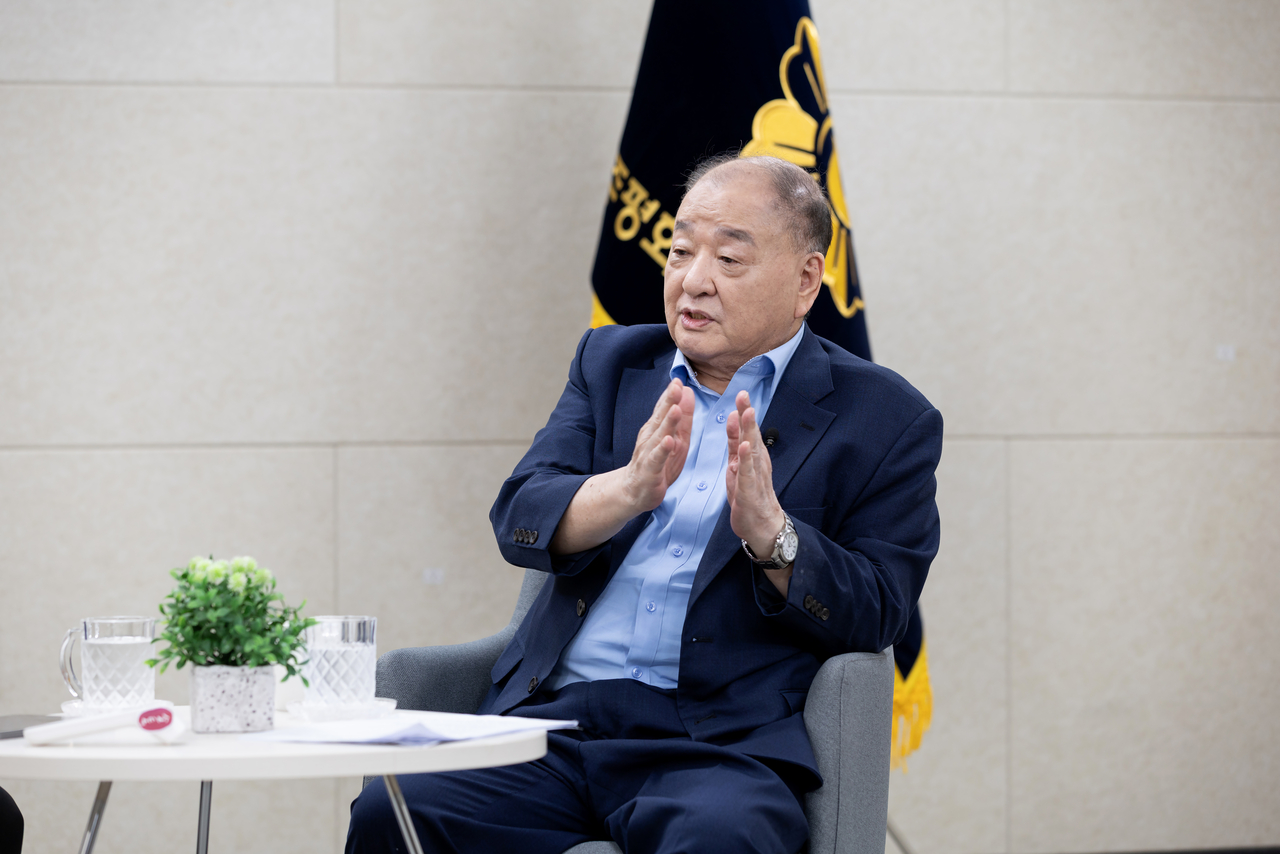
Kang Chang-il, senior vice chairman of the National Unification Advisory Council, during an interview
— How would you explain to young people preoccupied with finding jobs and housing that peace and unification is connected to their own lives?
In the past, unification was accepted as an unconditional imperative, but that logic does not work with today's youth. Young people are rational, and if given good reasons they are actually more proactive. We need to present sound reasoning and logic.
The military standoff between the two Koreas imposes economic burdens and costs on us. The risk of war can dampen investment sentiment and create pressure for capital outflows. I believe that if even a portion of the defense spending burden could be redirected toward youth support or investment in new industries for young people, their lives could change. I want to provide more opportunities for young people to think through these issues themselves, speak their minds freely and hear others' views.
— How far along is the roadmap for peaceful coexistence and shared growth?
We are preparing with a dedicated team centered on experts. It is difficult to share the details now, but the focus is on putting peace on the Korean Peninsula into practice. The plan will address how to pursue cooperation while responding to North Korea's hostile two-state doctrine and a rapidly shifting international landscape, and how to proactively manage problems that may arise. We are also paying close attention to ways of gathering public opinion in favor of peace on the Korean Peninsula and creating the conditions for it.
— How do you respond to concerns that peaceful coexistence could entrench the division?
The adversarial relationship in which guns are trained across the ceasefire line must be transformed into a peaceful one. Inter-Korean dialogue and exchanges are needed first. We must build trust by starting with steps to prevent accidental clashes, reduce military tensions and avoid provoking each other. Concrete efforts to convert the armistice system into a peace regime through a peace deal are also necessary. Anti-peace and anti-unification words and actions that stoke conflict and confrontation between the two Koreas must be eradicated.
Peaceful coexistence is not about cementing division. It is a realistic strategy of achieving peace first, then advancing through exchanges and cooperation toward peaceful unification. On the issue of North Korean human rights as well, I believe that expanding dialogue and exchanges will contribute more to genuine improvements in residents' human rights. Human rights must not be exploited for political purposes.
— How has the South Korea-Japan relationship changed compared with when you served as ambassador from 2021 to 2022?
The relationship has improved considerably and I can feel the progress. When I was serving as ambassador, the fallout from Japan's 2019 export restrictions and South Korea's boycott of Japanese products was still playing out. The atmosphere between the two countries was frosty and the difficulties were significant. I managed the crisis while patiently explaining the need to restore normal relations and promote goodwill.
I hope the friendship and trust between the peoples of the two countries deepens further, not just the relationship at the government level. I hope a people-to-people friendship takes root that is not shaken by the political and inflammatory remarks of politicians.
— What must the two governments do to advance South Korea-Japan cooperation while resolving historical issues?
South Korea and Japan have helped each other through their respective periods of growth. We must complement each other's strengths and build deeper trust. That said, the issue of the past cannot simply be buried. I believe it can be resolved if both sides have the will to do so.
Japan must uphold the Kono Statement, which acknowledged the involvement and coercive nature of the Japanese military regarding the comfort women issue and expressed remorse and apology. South Korea needs to consider restoring the comfort women foundation, paired with a promise — built on a sincere apology — not to raise the issue again. The overarching direction must be maintained: that stronger friendship and cooperation between the two countries benefits both their peoples and their nations.
— What role can Japan play in reducing tensions on the Korean Peninsula and establishing peace?
I hope Japan becomes a country that can speak of peace — one that contributes to building peace on the Korean Peninsula. Alongside efforts to resume Japan-North Korea dialogue, Japan needs to provide diplomatic support so that inter-Korean dialogue can move forward. Efforts to properly understand and address historical responsibilities are also important.
Diplomatic coordination between South Korea and Japan is needed on humanitarian issues as well, including the abduction of Japanese nationals. Through this, Japan can gain broader support on the international stage and expand its diplomatic options for resuming negotiations with North Korea.
— What outcomes do you hope to see from the "2026 Japan Peace and Unification Empathy Dialogue" organized by the Japan Eastern Regional Council?
The core is participation and empathy. It is about spreading a culture of dialogue and communication to both advisory members and the public, and broadening shared understanding of peace on the Korean Peninsula.
The Japan Eastern Regional Council covers a wide area from Tokyo to Sendai and Sapporo, and plays an important role in fostering harmony within the Korean community in Japan and advancing public diplomacy there. I hope this dialogue becomes a rallying point that broadens participation and empathy across all regions of Japan, and a time for advisory members and members of the Korean diaspora to seriously reflect together on what they can do for peace and unification on the Korean Peninsula.
— How can overseas advisory members and members of the Korean diaspora contribute to peace on the Korean Peninsula in their daily lives?
Public diplomacy means communicating directly with local citizens, broadening shared understanding of culture and policy, and building trust. Among the roughly 25,000 NUAC advisory members, about 5,000 active in 137 countries overseas also serve as public diplomats. I take pride in the fact that they carry out their activities with a sense of responsibility and a spirit of service as advisory members appointed by the president.
People-to-people exchanges centered on universities, civic organizations and young people are hardest to start. Governments and local authorities need to help by opening channels of communication and enabling the exchange of information. There is no better public diplomacy than our diaspora communities integrating well into their local societies, building trust and living as exemplary members of those communities.
wssong@heraldcorp.com