NIPA submits plan to strengthen tracking of cumulative support history and growth outcomes per company
"Management criteria must be made concrete so government support translates into real results"
The National IT Industry Promotion Agency (NIPA) has submitted an improvement plan addressing concerns raised during a parliamentary national audit over how the government tracks support given to AI and software companies — and calls are growing for the Ministry of Science and ICT to turn that plan into a concrete action program.
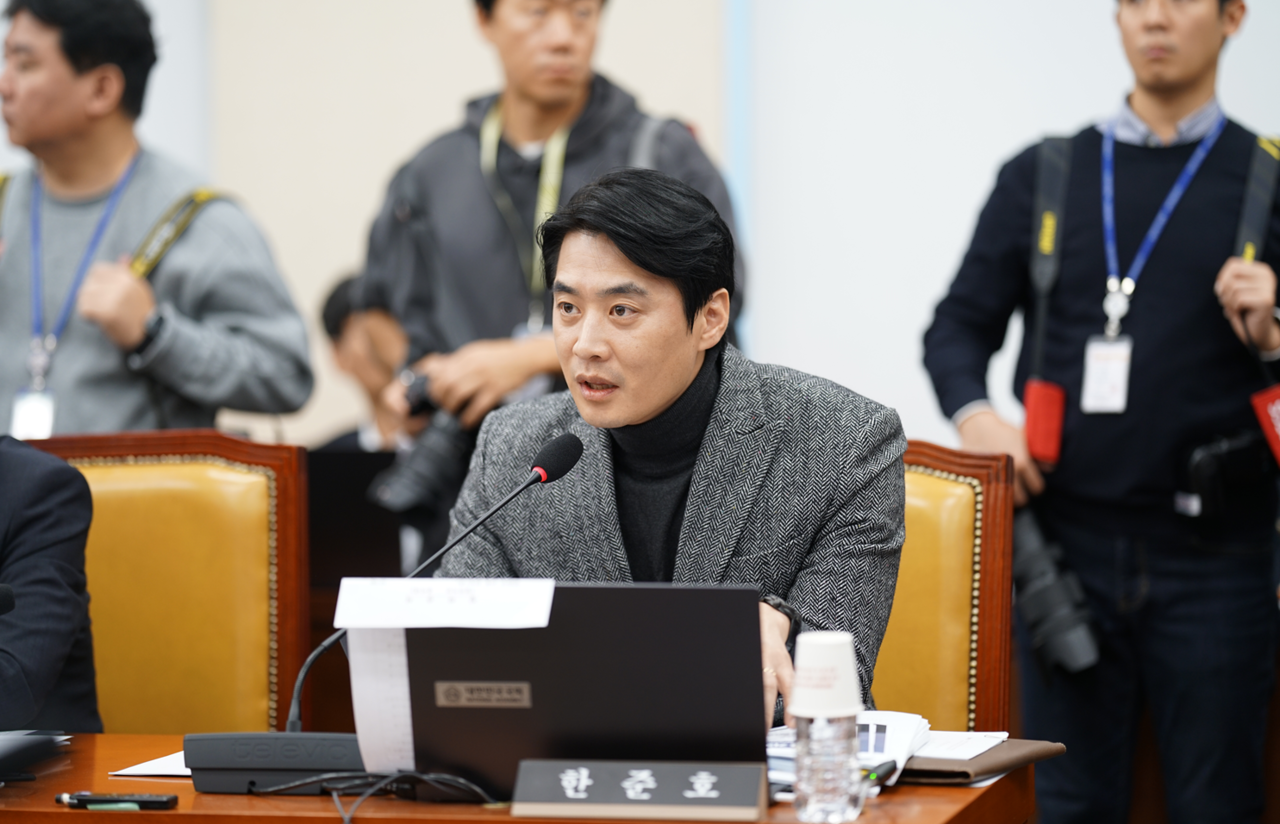
Rep. Han Jun-ho of the Democratic Party of Korea, a member of the National Assembly's Science, Technology, Information, Broadcasting and Communications Committee, said Tuesday that at NIPA's national audit on Oct. 15, he had flagged cases in which the same company had participated in or been repeatedly selected for multiple support projects, and called for a comprehensive system to track cumulative funding and actual growth outcomes for each company.
In response, NIPA submitted a comprehensive management plan for AI and software company support projects to Han's office on Monday and Tuesday of last week, outlining improvements including stronger tracking of each company's cumulative support history, enhanced monitoring of growth outcomes, and better coordination among overlapping programs.
According to the data NIPA submitted, the total number of companies supported under AI and software support projects from 2022 to 2026 came to 5,847 on a year-by-year combined basis, with total funding of approximately 5.22 trillion won ($3.94 billion). However, the 5,847 figure is a sum of annual counts; the number of unique companies, excluding those that received support across multiple years, stands at 3,087.
NIPA also identified companies selected for two or more support projects within the same year, based on their business registration numbers. The figures were 207 companies in 2022, 163 in 2023, 105 in 2024, 100 in 2025 and 81 in 2026.
The fact that a single company participated in multiple support projects does not by itself indicate improper duplication. AI and software companies may legitimately require different types of support at different stages of growth — from technology development and demonstration to commercialization and overseas expansion.
The comprehensive management plan NIPA submitted covers several areas: linking and managing each company's cumulative support history; strengthening checks on growth outcomes such as sales, investment attraction and employment; using those results to inform follow-on support and program improvements; screening for unnecessary duplication; and coordinating among similar programs.
Han welcomed NIPA's move to develop an improved performance management framework following the national audit, but said more specifics were needed. "Concrete management criteria and an implementation schedule are needed to apply this in actual program operations," he said. "Additional criteria must be established for how cumulative support amounts will be linked to growth outcomes such as sales, investment attraction and employment — and for how long after a project ends performance will continue to be monitored."
AI and software company support programs are run not only by NIPA but also by the National Information Society Agency (NIA) and the Institute for Information and Communications Technology Planning and Evaluation (IITP). Han said the Ministry of Science and ICT needs to strengthen its overarching management framework so that each company's support history and outcomes can be reviewed comprehensively, while accounting for differences in each agency's program objectives and support stages.
"NIPA's move to develop a direction for comprehensively managing each company's cumulative support history and growth outcomes following the national audit questions is a meaningful step," Han said. "While continuing to provide the support companies need at each stage of growth, the government must systematically verify whether that support is translating into real growth outcomes — in sales, investment attraction and employment. What matters now is the substantive implementation of the improvement plan."
He added that he hoped the Ministry of Science and ICT would establish common management criteria linking each company's support history to its growth outcomes, and set up a coordination framework and a concrete implementation schedule among NIPA, NIA, IITP and other relevant agencies to further improve the effectiveness of AI and software company support policy.
bigroot@heraldcorp.com