- World Institute of Kimchi and Korea Photonics Technology Institute identify for the first time how lactic acid bacteria respond differently to light wavelengths
- Blue light increases reactive oxygen species and suppresses growth, pointing to potential for light-based control of kimchi fermentation

Korean researchers have found that the color of light alters how lactic acid bacteria in kimchi use nutrients and respond to stress. Red light activated genes involved in nutrient uptake, while blue light increased cellular stress and suppressed growth — opening the door to precise, light-based control of kimchi fermentation and bacterial metabolism.
The World Institute of Kimchi announced Tuesday that it had confirmed, in collaboration with the Korea Photonics Technology Institute, that red, green and blue light-emitting diodes affect gene expression, nutrient utilization and oxidative stress responses in kimchi lactic acid bacteria differently.
Lactic acid bacteria break down sugars and amino acids to produce lactic acid and other metabolites — a process central to kimchi's flavor and quality. While researchers have extensively studied how temperature, acidity and nutritional conditions affect these bacteria, the influence of light color on their physiological activity had not been fully established.
The research team exposed a laboratory strain (WCFS1) of Lactiplantibacillus plantarum — a lactic acid bacterium commonly found in kimchi — to red (630 nm), green (525 nm) and blue (470 nm) LED light, each at an energy dose of 10 J/cm², and compared the results against unexposed bacteria.
Red light increased the expression of genes involved in carbohydrate utilization and nutrient transport. Green light produced changes in gene activity related to arginine metabolism — arginine being a type of amino acid — and stress responses.
Blue light, by contrast, increased the expression of genes linked to stress response and protein quality control, while reducing expression of genes associated with carbohydrate and fatty acid metabolism.
The color of light also affected how the bacteria consumed glucose and arginine and accumulated lactic acid. Even when exposed to the same amount of light energy, the metabolic activity inside the bacteria differed depending on wavelength.
Blue light in particular was found to induce oxidative stress in the bacteria.
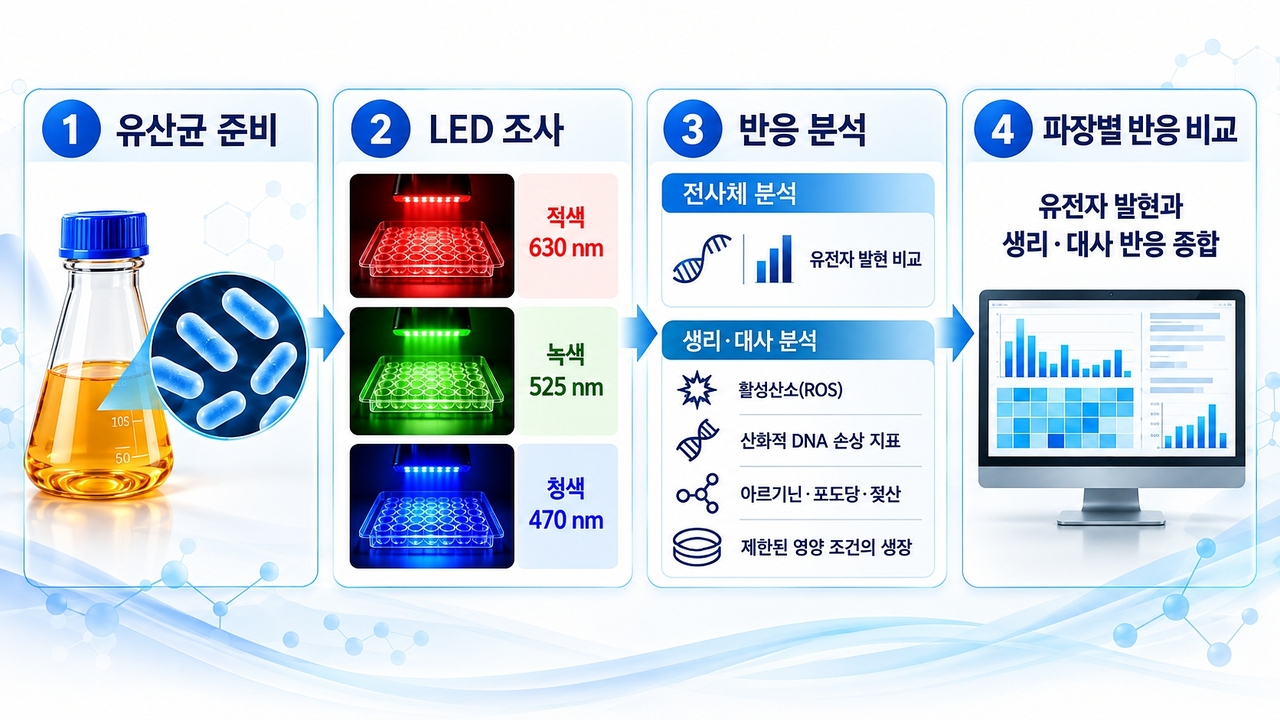
When the research team progressively raised the light energy to 5, 10 and 15 J/cm², reactive oxygen species inside the cells increased with each step under blue light. At the highest energy level of 15 J/cm², the marker 8-OHdG — an indicator of oxidative DNA damage — was also detected.
Red and green light did not produce a significant increase in reactive oxygen species. In growth experiments, bacteria exposed to blue light showed reduced growth compared with an unexposed control group, even when glucose and arginine were supplied in sufficient quantities.
The researchers said they expect the findings to serve as foundational data for developing light-based techniques to control lactic acid bacteria cultivation and fermentation processes. They described the study as presenting a new approach to regulating nutrient utilization and metabolite production in lactic acid bacteria through specific light wavelengths.
However, additional verification across a range of lactic acid bacteria strains and food environments will be needed before the findings can be applied to actual kimchi fermentation processes.
"This research, which examines how lactic acid bacteria — the key players in food fermentation — respond physiologically to different wavelengths, will serve as important foundational data for future convergence of food microbiology research and photonics technology," said Lee Jong-hee, a senior researcher at the World Institute of Kimchi.
The findings were published in BMC Microbiology, an international journal in the field of microbiology.
nbgkoo@heraldcorp.com