Core technology for fully unmanned autonomous vessels to be secured by 2032; maritime casualties to fall 30%
AI port test facility to be built at Gwangyang; port productivity to rise 30% by 2035
Smart aquaculture penetration to climb from 3.7% to 10%; AI to monitor illegal fishing and collect ocean waste
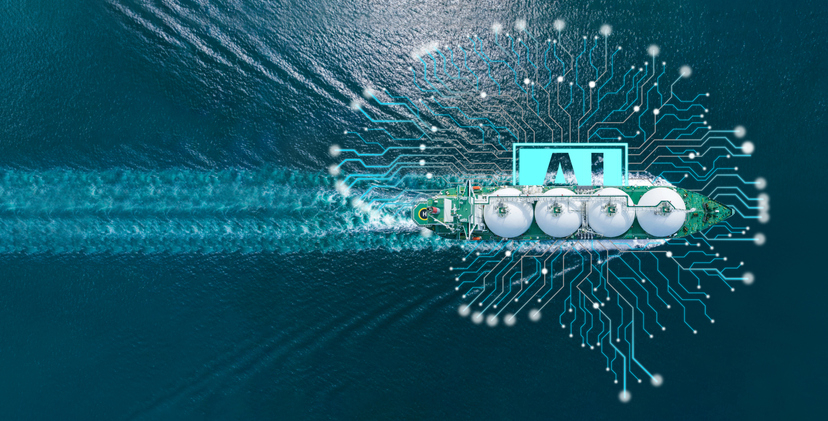
Ships that navigate the seas without a crew, ports where AI moves containers, fish farms where production and distribution are managed by data — this is the future the government envisions for South Korea's waters and harbors. Seoul plans to introduce AI across the full chain of maritime activity, from vessel operations and port cargo handling to aquaculture and ocean environment management. The goal is to secure core technology for fully unmanned autonomous vessels by 2032 and claim the top spot in the global autonomous-ship market by 2035.
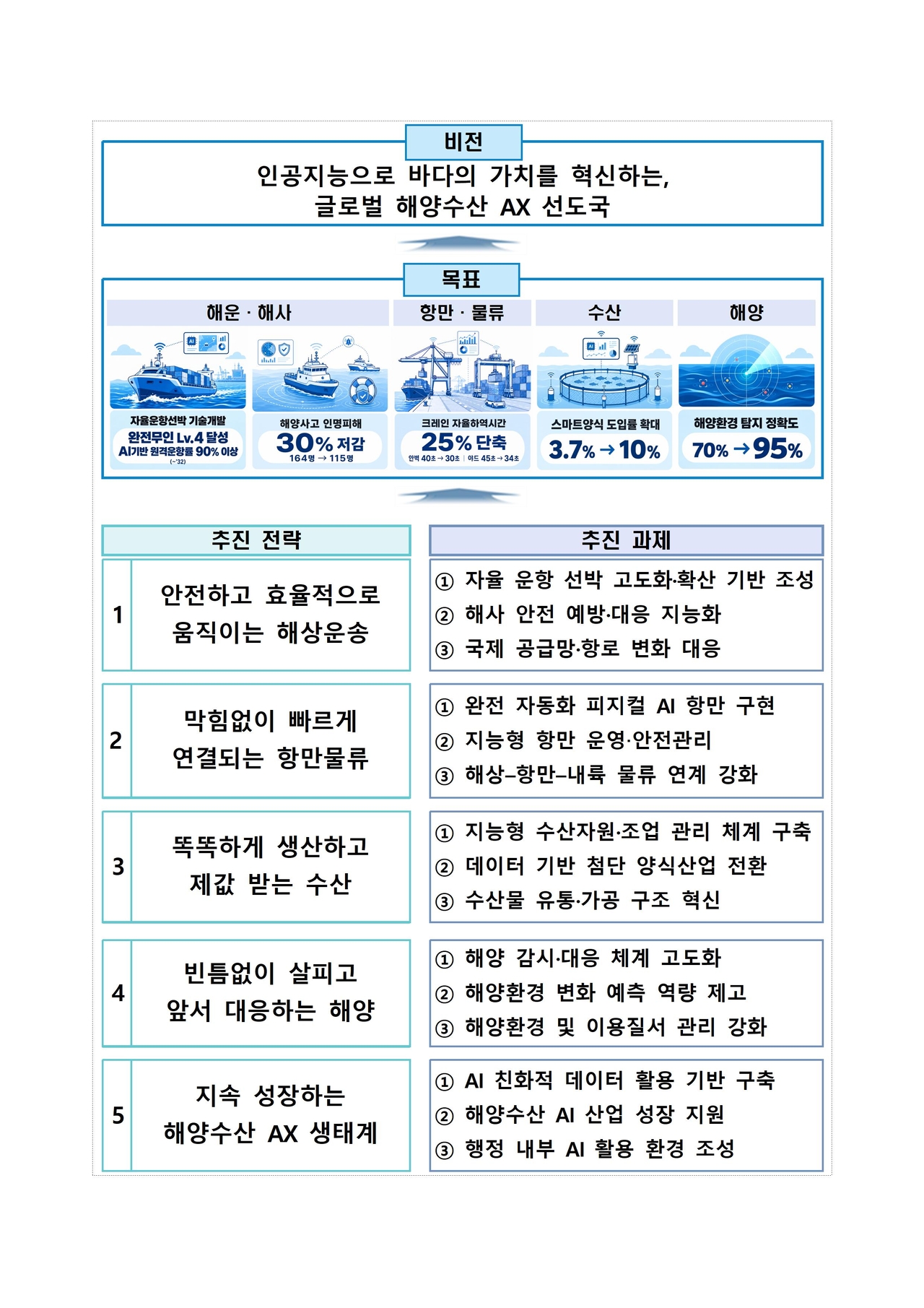
The Ministry of Oceans and Fisheries unveiled the plan Wednesday at a joint meeting of economic affairs ministers and science and technology ministers, calling it the "Maritime and Fisheries AI Transformation (AX) Strategy." The initiative covers four sectors — shipping and maritime affairs, ports and logistics, fisheries, and the ocean environment — and lays out five strategic pillars and 15 core tasks to drive AI innovation and build an industry ecosystem.
The strategy was drawn up in response to intensifying climate change and marine disasters, an aging and shrinking fishing-village workforce, and mounting competition in global logistics. The central idea is to deploy AI not merely as a data-analysis tool but as technology that makes real-time judgments and takes physical action in the field, raising both productivity and safety across the industry.
The most dramatic changes are expected at sea. The Ministry of Oceans and Fisheries, working with the Ministry of Trade, Industry and Energy, will develop core technology for Level 4 fully unmanned autonomous vessels — ships capable of operating without any crew on board — by 2032. Safety and reliability will be verified in actual domestic and international waters before commercialization proceeds.
On that foundation, South Korea aims to become the top order-winner in the global autonomous-ship market, projected to reach $200 billion by 2035. The plan is to raise the level of automation in vessel operations while securing new growth opportunities in the global shipbuilding and shipping markets.
AI will also serve as a safety guardian at sea. The system will analyze real-time navigation data and sea conditions to issue early warnings and support small vessels in assessing and responding to navigational hazards. A next-generation situational management framework capable of detecting warning signs across all domestic waters at an early stage will also be established. The government aims to cut maritime accident casualties by 30 percent by 2030 through these measures.
AI use will expand on Arctic routes as well. Observational data gathered along the Arctic route will be analyzed to provide shipping companies and cargo owners with the information they need to plan voyages. The government will also strengthen its capacity to detect risks in international maritime supply chains early and respond to logistics disruptions.
At ports, AI will be put to work operating equipment directly. The key technology is physical AI — artificial intelligence embedded in robots and machinery that perceives its surroundings, makes decisions and then carries out physical tasks. It will be applied to cargo-handling and transport equipment that lifts and moves containers, raising the level of automation in port operations.
The Ministry of Oceans and Fisheries will build an automated port test facility at Gwangyang by 2029. Physical AI-based cargo-handling and transport technology will be validated there before being rolled out to major ports, including Busan's Jinhae New Port.
Port operations will also gain what amounts to a digital foreman in the form of agentic AI. The system will analyze work conditions across the port and coordinate the movement of multiple pieces of equipment to optimize the overall workflow — shifting from a model in which workers issue instructions to each machine individually to one in which AI draws up work plans and directs the necessary systems itself.
A management platform to reduce safety risks will be built as well. Port-i, Busan Port's integrated information platform, will be upgraded to link maritime, port and inland transport data. Through these technologies, the government aims to raise port productivity by 30 percent by 2035 and is also exploring the possibility of taking automated port technology overseas.
AI will enter fish farms, too. The ministry will develop AI-based aquaculture technology centered on smart fisheries innovation districts and distribute technology tailored to regionally specialized species. The national smart aquaculture penetration rate, currently 3.7 percent, is targeted to reach 10 percent by 2030.
Fishery resources and catch volumes will also be managed through data. AI will monitor illegal fishing and support operational safety at sea. The management system covering production through distribution will be upgraded to keep pace with tightening international regulations.
AI will be applied to seafood price and supply-demand management as well. The system will analyze production and distribution conditions to forecast supply-demand shifts, and when supply instability arises, it will quickly identify the cause and trigger a response. Physical AI-based automation technology will be developed for seafood processing factories to raise productivity and added value.
The way South Korea monitors the sea and manages the marine environment will change, too. AI will detect anomalies in maritime activity at an early stage, and a framework will be built for relevant agencies to share information and respond swiftly.
The quality of ocean data — including sea temperature and salinity — will be improved to enable more precise forecasting of changes in the marine environment and ecosystem driven by climate change and ocean development. Technology to automatically detect and collect floating marine debris will also be introduced, and AI will be applied to monitoring unauthorized use of public waters and handling permit-related administrative work.
To ensure these technologies take root in the field, the government will also lay the necessary industrial groundwork. Maritime and fisheries data will be reorganized into formats suitable for AI training, and clear standards and accountability for data use will be established. Support will be provided for companies to commercialize AI products and services and for the training of specialist personnel.
AI use will expand within the ministry's own administration as well. The plan is to strengthen employees' AI capabilities and improve the working environment, raising administrative efficiency and the quality of public-facing services.
Fully unmanned autonomous vessels and AI-powered ports, however, are still at the stage of requiring core technology development and demonstration. Verifying safety and reliability in actual waters and ports, and then spreading the developed technology into the field, remain the key challenges ahead.
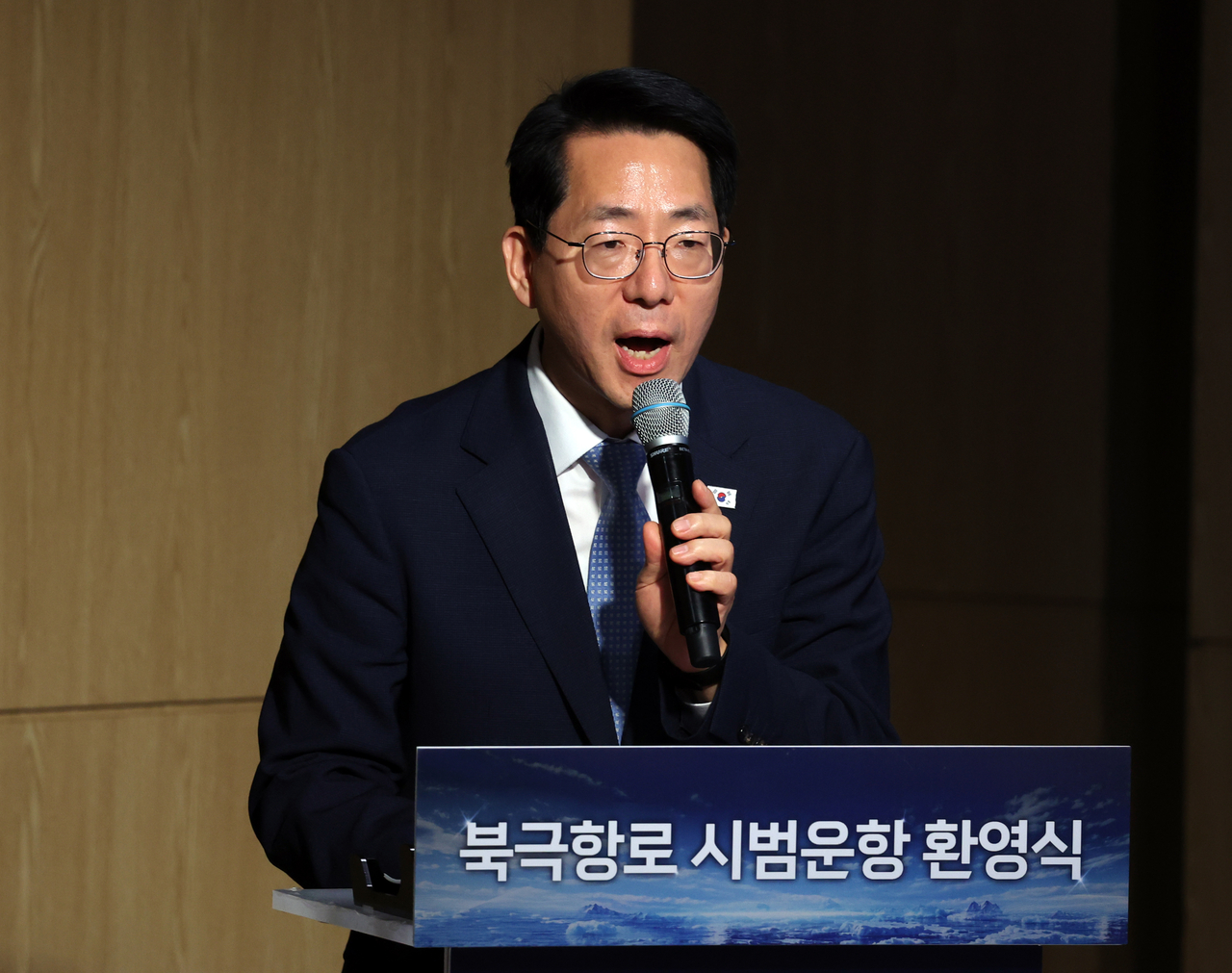
"AI is the core driver that will solve the immediate challenges facing the maritime and fisheries industry while creating new opportunities in the global market," Minister of Oceans and Fisheries Hwang Jong-woo said. "We will aggressively target the global market with competitive technologies such as autonomous vessels, and dramatically raise the productivity and efficiency of maritime logistics through physical AI ports."
Hwang added that the government would "actively support our maritime and fisheries industry not merely to keep pace with the changes of the AI era, but to lead global innovation," and pledged to "spread the fruits of innovation across the entire maritime and fisheries sector by actively applying AI to ocean safety and environmental management."
adastra@heraldcorp.com