Annual operation rate to rise from 36% to 47% with multi-crop processing
Seven crops piloted at facilities in Andong and Muan
Apple-sorting productivity up 150% as automation cuts labor needs
Agricultural produce APCs that once ran only during harvest seasons are being transformed into year-round facilities capable of handling multiple crops, using AI and robotics. By reconfiguring sorting and packaging equipment to handle different produce types, the project aims to raise the annual operation rate from 36% to 47%. Automation applied to apple sorting, packaging and transport has already boosted work productivity by 150%.
The Korea Institute of Planning and Evaluation for Technology in Food, Agriculture and Forestry announced Tuesday that it is developing core smart fulfillment APC technology powered by AI and robots — under the Ministry of Agriculture, Food and Rural Affairs' high-value food technology development project — and conducting field pilots in Andong, North Gyeongsang Province, and Muan, South Jeolla Province.
Conventional APCs have typically operated in sync with the harvest season of a specific crop, such as apples or onions. Once the harvest period ends, facility utilization drops sharply, and much of the sorting, packaging and transport work has had to rely on manual labor.
To address this, the Korea Institute of Robot and Convergence has been pursuing a project since 2022 to build fresh-produce fulfillment APCs and develop the underlying core technologies. The key concept is a system that combines and reconfigures equipment within a single facility to handle multiple crop types, rather than operating separate facilities for each.
By processing crops with different harvest seasons at the same facility, equipment can remain in use even during off-peak periods. The research team plans to use this approach to raise the annual APC operation rate by 11 percentage points — from roughly 36% to 47% — representing an increase of about 30.6% over the current rate.
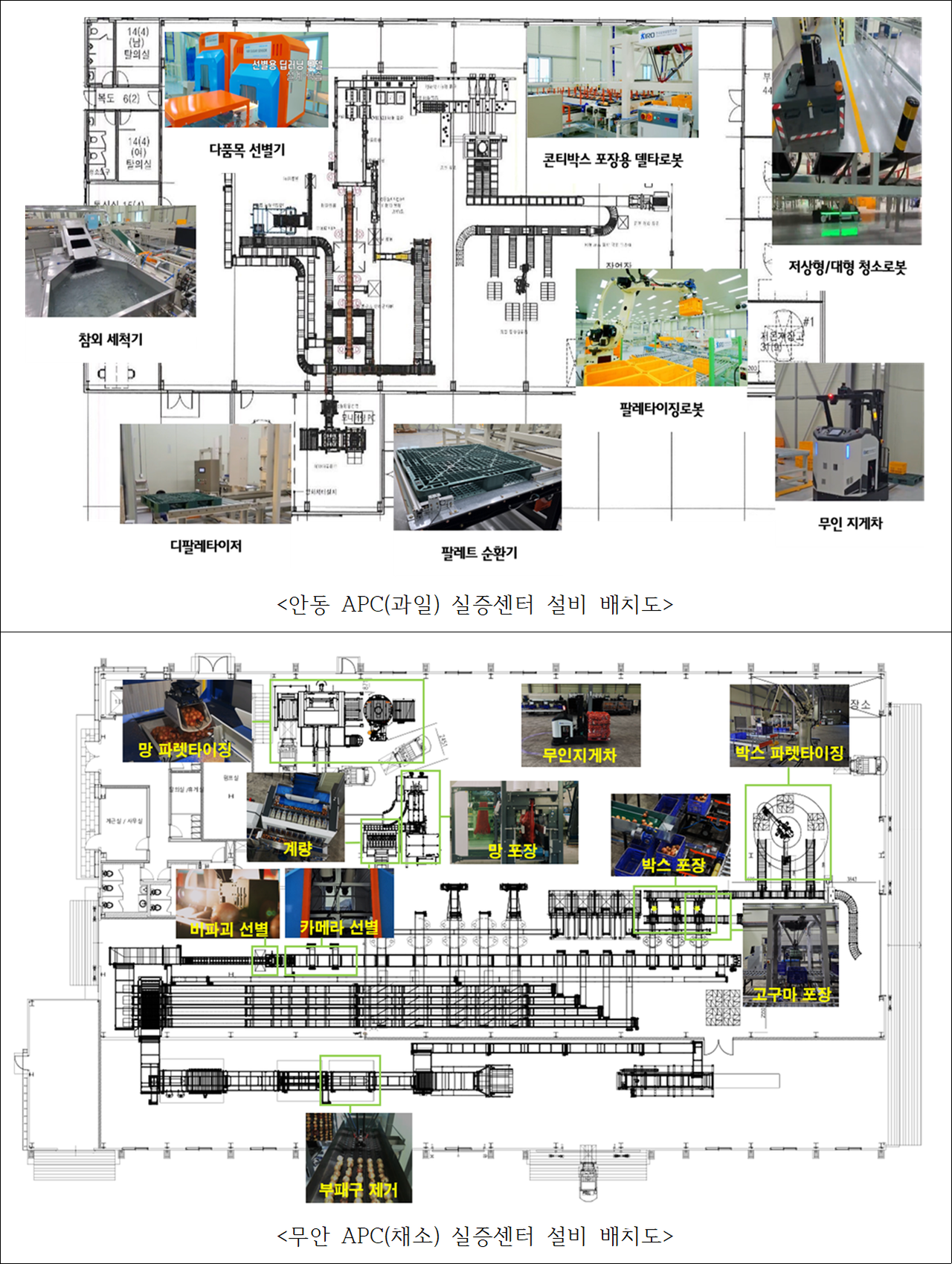
The team has established two smart fulfillment APC pilot centers, one in Andong and one in Muan. The Andong center is testing automation technology on four fruit varieties — apples, pears, peaches and oriental melons — while the Muan center covers three vegetable crops: onions, sweet potatoes and mini kabocha squash.
The sorting, packaging and transport processes employ an AI produce-sorting system, robotic grippers, automatic packaging machines and autonomous transport robots. The robotic grippers, which pick up and move produce, were developed to handle the distinct physical characteristics of each crop type.
For apples, work productivity under 24-hour automated operation has improved by 150% compared with the previous method. The research team is refining the technology with the goal of reducing the staffing needed for sorting, packaging and transport from 12 workers to just one through automation — though that workforce reduction remains a development target, not yet an achieved result.
An integrated control system that manages all robots and equipment simultaneously has also been built. Using a private 5G network, the team cut communication latency to under 10 milliseconds, and the facility has secured the capacity to process about 70 metric tons of produce per day based on 20 hours of automated operation.
The technology is also being supplied to other APCs. Partner research institutions supplied equipment including a robot- and QR-linked automatic sorting system, generating 750 million won ($562,000) in sales last year. The team plans to expand distribution to more APCs across the country.
By the end of this year, the research team will improve the performance of technology that automatically identifies spoiled produce and a robotic palletizing system that stacks packaged produce boxes onto transport pallets. The pilot centers will also verify the stability of running multiple automated systems simultaneously.
After the research project concludes, the Muan pilot center will be taken over and operated directly by the Jeonnam Southwestern Vegetable Agricultural Cooperative. The handover is intended to ensure that the technology developed during the research phase continues to be used in actual produce distribution operations.
Park Hong-jae, president of the Korea Institute of Planning and Evaluation for Technology in Food, Agriculture and Forestry, said the project represents a meaningful achievement in using AI and robotics to improve the efficiency of produce distribution at the source. "We will actively support the development of advanced technologies and the spread of research outcomes into the field, so as to reduce the labor burden on farms and strengthen the competitiveness of agricultural distribution," Park said.
adastra@heraldcorp.com