Food systems face a complex crisis driven by population growth and climate change
Big food corporations fuel labor exploitation and oversupply
Author urges readers to wake up and become 'food citizens'
Television shows featuring a single person devouring more than 10 servings at once draw massive audiences, chefs who appear on cooking programs become celebrities, and people line up before dawn to try a dessert trending on SNS. In contemporary society, food has become far more than sustenance — it is a dominant cultural force.
Yet as the appetite for sensational food experiences intensifies, the production and retail journeys that bring those meals to the table are increasingly ignored. Modern consumers may appear to enjoy endless choice at every meal, but in practice they may be conditioned by the illusion of convenience that large corporations have carefully engineered.
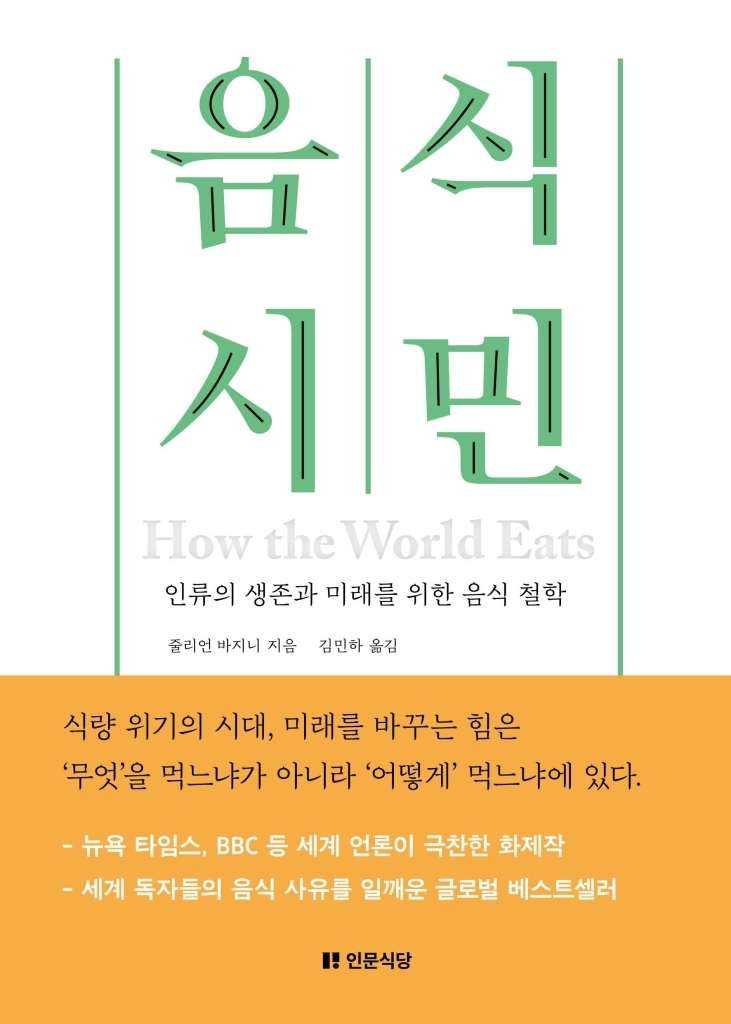
British popular philosopher Julian Baggini challenges that illusion in a new book, "Food Citizens." Examining food through the lens of the broader food system, Baggini reflects deeply on the power structures that dominate it and on how fragmented individuals can reclaim sovereignty as food citizens.
The global food system is entering a period of compounding crisis, entangled with population growth, resource scarcity, stagnating productivity, climate change and supply disruptions. At the center of climate-driven disasters — from the 40-degree Celsius heat waves that swept Europe this past summer to the glacial collapse in Nepal — sits a food system responsible for one-third of global greenhouse gas emissions. As of 2022, 2.4 billion people were experiencing food insecurity, yet global obesity rates have tripled since 1975, an irony the book does not let pass unexamined.
The book starts from an urgent sense that the broken food system must be repaired quickly, but it refuses the familiar good-versus-evil binary. With the cool-headedness characteristic of a philosopher, Baggini pushes back against the extreme positions that dominate contemporary food discourse. The book warns against the binary narrative that organic is unconditionally good and non-organic is bad, or that the only alternative to factory farming is full veganism — arguing that such polarization is precisely what makes solving the food crisis so elusive. Organic ingredients, for instance, may not always be what they seem, and organic farming yields less per hectare than conventional methods, meaning far more land would be needed to feed the same number of people.
Baggini dissects the landscape in which food has shifted from a means of survival to a profit-driven product, and highlights the labor exploitation embedded in the food system. Cocoa farmers in Ghana and Côte d'Ivoire earn less than $1 a day, yet American consumers pay more than that daily wage for a single chocolate bar. The pattern of raw materials exported at rock-bottom prices to wealthy countries, where they are repackaged as premium consumer goods, repeats itself across agricultural produce from low- and middle-income nations.
This inequality stems from large retail companies squeezing suppliers so hard that workers are exploited. The supply chain, the book argues, actively fosters a modern form of slavery. Child labor is not a glitch in the food system but a feature — an "adaptive advantage" that has never been eliminated. Nations and corporations that have wrung out food producers supply consumers with cheap food in abundance, pocketing the profits.
Animals, too, are treated as tools rather than living beings in the drive to cut costs. Chickens spend their entire lives in spaces smaller than an A4 sheet of paper, and sows are confined to gestation crates. Livestock are raised for ultra-rapid growth, leaving them to suffer broken bones and organ failure.
Attempts to break this cycle of exploitation have repeatedly foundered against resistance to higher food prices. Corporate logic dominates the market, and consumers look away from the grim reality. The comfortable eating habits enjoyed in wealthy countries are, in effect, sustained by the sacrifice of countless workers on the other side of the world.
Becoming a "food citizen" means waking from the hypnosis of that comfortable arrangement — moving from a consumer who follows a preset script to a sovereign who holds power structures to account.
The steps need not be grand. The starting point is recognizing food not as a private product exchanged for money but as the compressed result of human labor and the planet's ecosystem. Small acts matter: checking the code stamped on an egg to choose one produced in a slightly less cruel environment, or reaching for whole foods instead of ultra-processed ones.
Baggini does not burden readers with guilt or impose a rigid ideology; instead, he searches for the best that is achievable within real-world constraints. Even imperfect choices, Baggini argues, can change the world when enough individuals make slightly better ones — a practical ethics that emphasizes action. A sustainable planet requires people to act with wholeness, circularity and diversity in mind.
After reading the book, the food encountered every day looks different. When readers step down from the seat of the gourmet and take their place as food citizens, the dining table is transformed into a space for quiet revolution — one that connects each meal to the wider world.
"Food Citizens" by Julian Baggini, translated by Kim Min-ha; Inmun Sikdang
pink@heraldcorp.com