- Korea Research Institute of Chemical Technology, Postech produce bioplastic feedstock from sawdust without high-pressure equipment
- Purity exceeds 99%, production yield improved over existing processes, fossil resource use down 47.9%
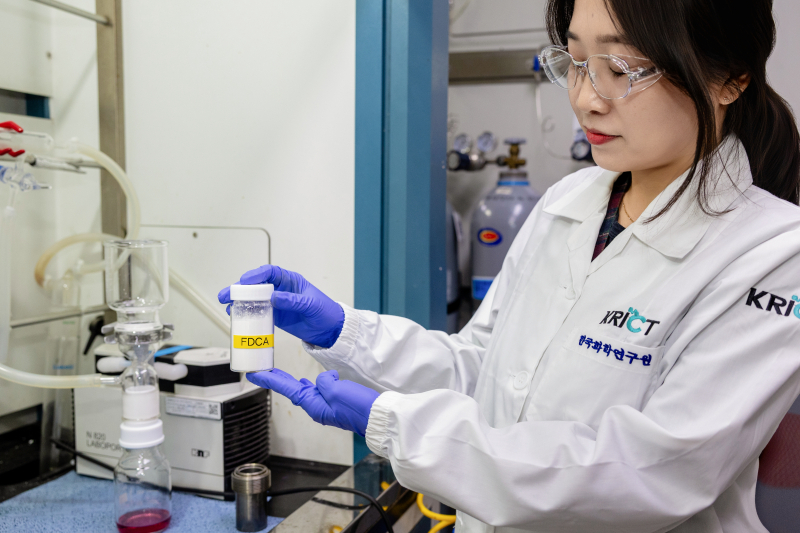
Korean researchers have developed a technology to convert discarded wood sawdust into raw material for eco-friendly plastic bottles and textiles. The process operates at atmospheric pressure without high-pressure equipment and yields a bioplastic feedstock with purity exceeding 99 percent. Analysis shows it can also cut carbon emissions by 60 percent compared with conventional manufacturing processes that rely on edible sugars.
The Korea Research Institute of Chemical Technology announced Sunday that a research team led by Senior Researcher Hwang Dong-won, working jointly with a team led by Postech Professor Han Ji-hoon, has developed a process to convert non-edible biomass — including wood sawdust — into 2,5-furandicarboxylic acid (FDCA), a high-value plastic feedstock.
FDCA is a bio-based chemical that can replace terephthalic acid, which is derived from petroleum. Polyethylene furanoate (PEF), made from FDCA, can substitute for PET used in conventional plastic bottles, making it applicable to food and beverage packaging, apparel textiles and everyday consumer goods.
Currently, FDCA is produced mainly from fructose or sugar derived from corn. That approach has drawn criticism for competing with food resources. Researchers have been exploring the use of non-edible biomass — such as waste wood and agricultural byproducts — to address the problem.
The challenge lies in production efficiency. Cellulose, the primary component of wood, has a rigid structure that is difficult to break down, and the intermediate compounds generated during manufacturing degrade easily. Some existing processes require high-concentration hydrochloric acid, chlorinated solvents and high-pressure sealed equipment, all of which have been obstacles to commercialization.
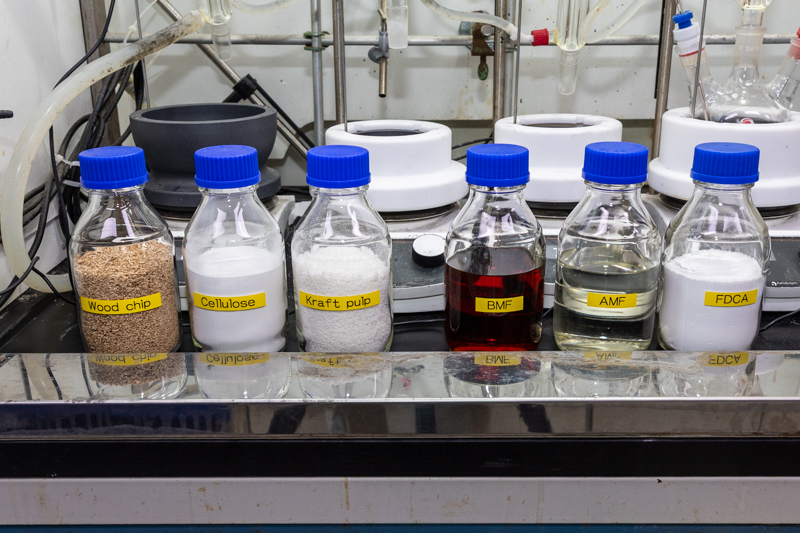
To overcome these limitations, the research team developed a three-stage linked process that converts cellulose into FDCA via two intermediate compounds, BMF and AMF.
The key innovations were eliminating high-pressure reactions and minimizing the separation and purification steps for the intermediate compounds.
In the first stage, the team used sulfuric acid and bromide salts to convert cellulose into BMF at atmospheric pressure. By using two immiscible liquids to rapidly separate the intermediate compound as it formed, the process suppressed the generation of unwanted byproducts.
The BMF yield reached a maximum of 82 percent — more than three times the productivity of previously reported comparable processes. A 10-liter reactor achieved yields of 73 to 79 percent. The use of halogenated substances was reduced by more than 30 times compared with conventional hydrochloric acid-based processes.
The team then developed a process to convert BMF into AMF at room temperature — 25 degrees Celsius. A single pass through a 1-liter reactor achieved yields exceeding 95 percent, and after 15 cycles of operation using regenerated ion-exchange resin as a catalyst, the yield remained at 97 percent.
In the final stage, AMF was oxidized without separate purification to produce FDCA with purity exceeding 99 percent.
The overall FDCA yield for the entire process reached a maximum mass yield of 56.8 percent based on cellulose and 45.5 percent based on sawdust. The cellulose-based figure surpasses the 32.7 percent reported in 2022 by researchers at the University of Groningen in the Netherlands.
Environmental benefits were also confirmed.
A life-cycle assessment based on process simulation found that producing 1 kilogram of FDCA generates 2.77 kilograms of greenhouse gas emissions in carbon dioxide equivalent — about 60 percent less than the 6.91 kilograms produced by a comparable process using edible sugars. Fossil resource consumption was also found to fall by 47.9 percent.
However, these environmental figures are based on process simulation, not measurements taken at an actual large-scale production facility.
The research team is working with the Ministry of Trade, Industry and Energy to prepare a pilot facility construction project targeting annual production of more than 1,000 tons. The team expects commercialization to be feasible after 2030, following large-scale continuous operation and economic viability verification.
"This is an achievement in optimizing each stage of the plastic feedstock manufacturing process by using woody biomass instead of edible resources," said Hwang Dong-won, a senior researcher at the Korea Research Institute of Chemical Technology.
The findings were published in the November issue of Chemical Engineering Journal.
nbgkoo@heraldcorp.com