Deshpande visits Seoul for APK 2026
'Korea emerging as global drug development partner'
'Open to investing in early-stage biotech startups'
'Expect broader collaboration with Yuhan'
'AI drug development with Microsoft — Korean firms also on radar'
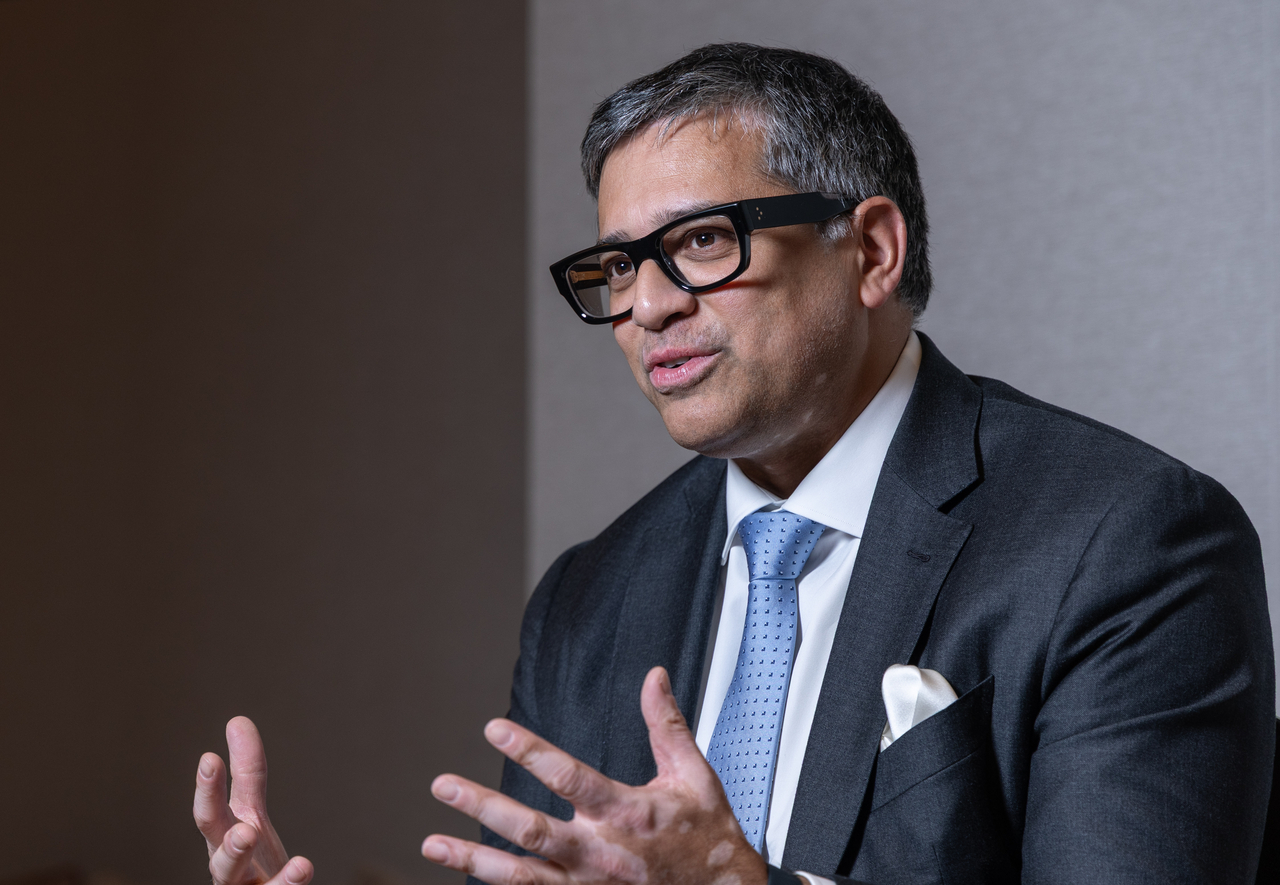
"Korea is no longer simply a market where we sell medicines. It is growing into an important country that contributes to global drug development and innovation."
Shashank Deshpande, chairman of the board of managing directors and head of Human Pharma at Boehringer Ingelheim, made the remarks in an interview on the sidelines of the 19th Asia-Pacific German Business Conference (APK 2026), held in Seoul on Friday.
Founded in Germany in 1885, Boehringer Ingelheim is a global pharmaceutical company that posted sales of about 27.8 billion euros ($31 billion) last year and employs roughly 54,300 people across 130 markets worldwide.
Deshpande praised Korea's research talent and scientific capabilities, and said the company sees strong potential for expanding technology partnerships with Korean biotech firms. "Korea has the talent, the active investment and the partnerships with global companies," he said. "It is hard to find a reason why the Korean biotech and pharmaceutical industry would not grow further."
He said collaboration with Korea has been expanding beyond drug sales into clinical trials and co-development of new drugs. "Korea regularly participates in global clinical trials, and Korean researchers are contributing to clinical trial design," he said. "We are now moving toward collaboration with Korean biotech companies for the development of innovative new drugs."
He cited the company's partnership with domestic biotech firm Aimed Bio as a prime example. Boehringer Ingelheim signed a technology transfer agreement with Aimed Bio last year for an antibody-drug conjugate (ADC) drug candidate. The ADC candidate BI 4060107 reached its first patient dosing in a Phase 1 trial last month.
"The collaboration with Aimed Bio shows that Korean companies can contribute from the earliest stages of innovative drug development," Deshpande said. "I hope this partnership leads to an actual medicine reaching the market and helping cancer patients."
'Good ideas get investment regardless of nationality' — Korean startups on the radar
Deshpande also left the door open to investing in Korean biotech startups. Boehringer Ingelheim invests in early-stage biotech and healthcare startups through its corporate venture capital arm, the Boehringer Ingelheim Venture Fund.
"The venture fund is different from a licensing deal to secure drug candidates," he said. "We look at early-stage science and innovative ideas years before they enter clinical trials."
"It is exciting to look at early-stage companies with new technologies in Korea as well," he said. "We can advise founders not only with funding but also with our clinical development experience and expertise."
"We make no distinction between a European company, an American company or a Korean company," he added. "If it fits us and makes sense, we want to invest."
Deshpande also raised the possibility of expanding collaboration with Yuhan, a domestic pharmaceutical company. The two companies have worked together for years in diabetes, cardiovascular, renal and metabolic diseases, and recently signed an MOU to broaden that cooperation.
"When I joined Boehringer Ingelheim in 2012, Yuhan was already an important partner in Korea," he said. "What makes it special is that 14 years later, we are still building on that foundation of mutual trust."
"Yuhan's deep understanding of the Korean healthcare landscape, combined with Boehringer Ingelheim's scientific expertise, has driven a successful partnership," he said, expressing confidence that the scope of collaboration would continue to grow.
AI drug development with Microsoft — and potential tie-ups with Korean firms
Deshpande also highlighted AI-driven drug development, saying he expects AI to go beyond improving operational efficiency and help raise the success rate of clinical trials.
"We are already using large language models to cut the time needed to prepare regulatory submissions," he said. "More importantly, we want to reduce the failure rate in the drug development process."
"The average success rate in Phase 3 trials is about 70 percent," he said. "If AI can identify candidates likely to fail at an early stage, that creates significant value."
Boehringer Ingelheim announced a strategic partnership with Microsoft for AI-based clinical development on Oct. 22. The two companies plan to jointly research "digital patient twin" technology that uses patient clinical data to predict disease progression and treatment outcomes, with the aim of improving the efficiency of clinical trial design.
"If we can simulate clinical trial outcomes in advance using data and modeling, we can fundamentally improve the productivity of drug development," Deshpande said.
He also left open the possibility of working with Korean AI companies. "I am well aware that Korea is quite advanced in AI," he said. "There is no specific project under way at the moment, but it would not surprise me if a collaboration with a Korean company emerged in the coming weeks or months."
"This is the moment when Korea's pharmaceutical and healthcare innovation can move beyond the Korean market and reach the rest of the world," Deshpande said. "We will see much more of Korea's innovation benefiting patients globally."
boo@heraldcorp.com