- Officials recognized for blocking burner phones, streamlining R&D administration
- Lead honoree receives 10 million won; secondary honoree receives 3.5 million won
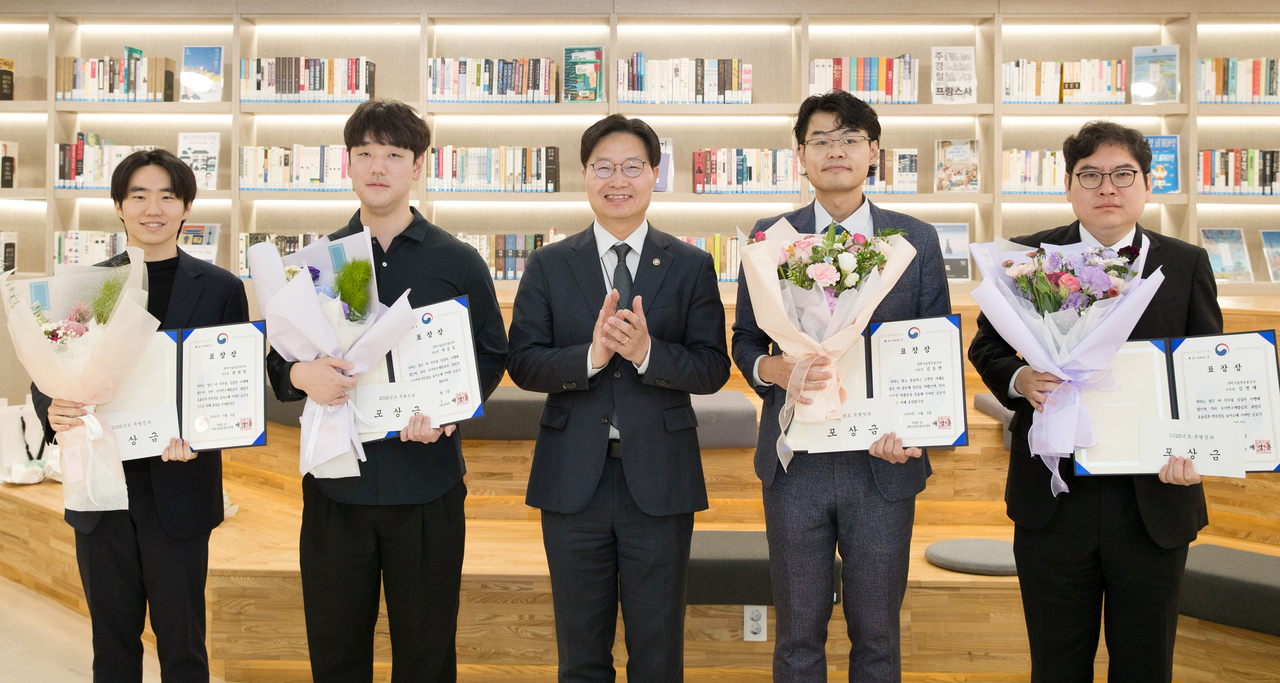
Four civil servants who developed measures to block burner phones exploited in voice phishing scams and significantly streamlined the country's complex national R&D administration procedures received government awards Tuesday.
The Ministry of Science and ICT announced Tuesday it had selected Kim Dong-hyeon, Seo Seung-ho, Kim Myeong-jae and Choi Won-young as recipients of its fourth Special Performance Award and held a ceremony to present the honors.
The Special Performance Award was established to provide exceptional recognition to civil servants who break from established practice and deliver outstanding policy results. The lead honoree receives a deputy prime minister's commendation and a cash prize of 10 million won ($7,460), while the secondary honoree receives a commendation and 3.5 million won.
Kim Dong-hyeon and Kim Myeong-jae were recognized for developing countermeasures against burner phones used in voice phishing and other crimes targeting ordinary citizens.
Losses from voice phishing last year were estimated at around 1.3 trillion won, with roughly 20,000 burner phones believed to have been used in such crimes.
The two officials drew up a comprehensive plan to prevent the illegal use of mobile phones, strengthening identity verification procedures when activating new lines and making it mandatory to notify users of the illegality of lending their phone registrations to others. Through cross-ministry joint inspections, they also pursued administrative sanctions — including business suspensions — against operators found to have activated lines illegally.
Seo Seung-ho and Choi Won-young were honored for expanding researchers' autonomy over grant spending and reducing the administrative burden on research institutions.
The two officials created a new "research innovation fund" category allowing up to 10 percent of direct research costs to be spent freely across expense categories. They also converted the rules governing indirect costs at research institutions to a negative-list system, under which funds may be used freely for any purpose not explicitly prohibited.
Particularly notable was a sweeping overhaul of national R&D administrative forms: the number of forms researchers must submit directly was cut from 2,171 to 154. The changes are expected to eliminate roughly 400,000 form submissions a year and save approximately 20,000 hours annually in research administration time.
First Vice Minister of Science and ICT Ku Hyeok-chae said the honorees represented "cases where civil servants listened to the voices of the public and the research community, reformed existing systems and delivered results that people can actually feel." He added that the ministry would "support civil servants who take initiative rather than settle for the status quo, so that they receive the recognition and rewards they deserve."
nbgkoo@heraldcorp.com