Editor's note
We tell stories through paintings — exploring the issues, the histories, and the human desires and struggles embedded in art. We begin with a single canvas and step out into the world beyond the frame.
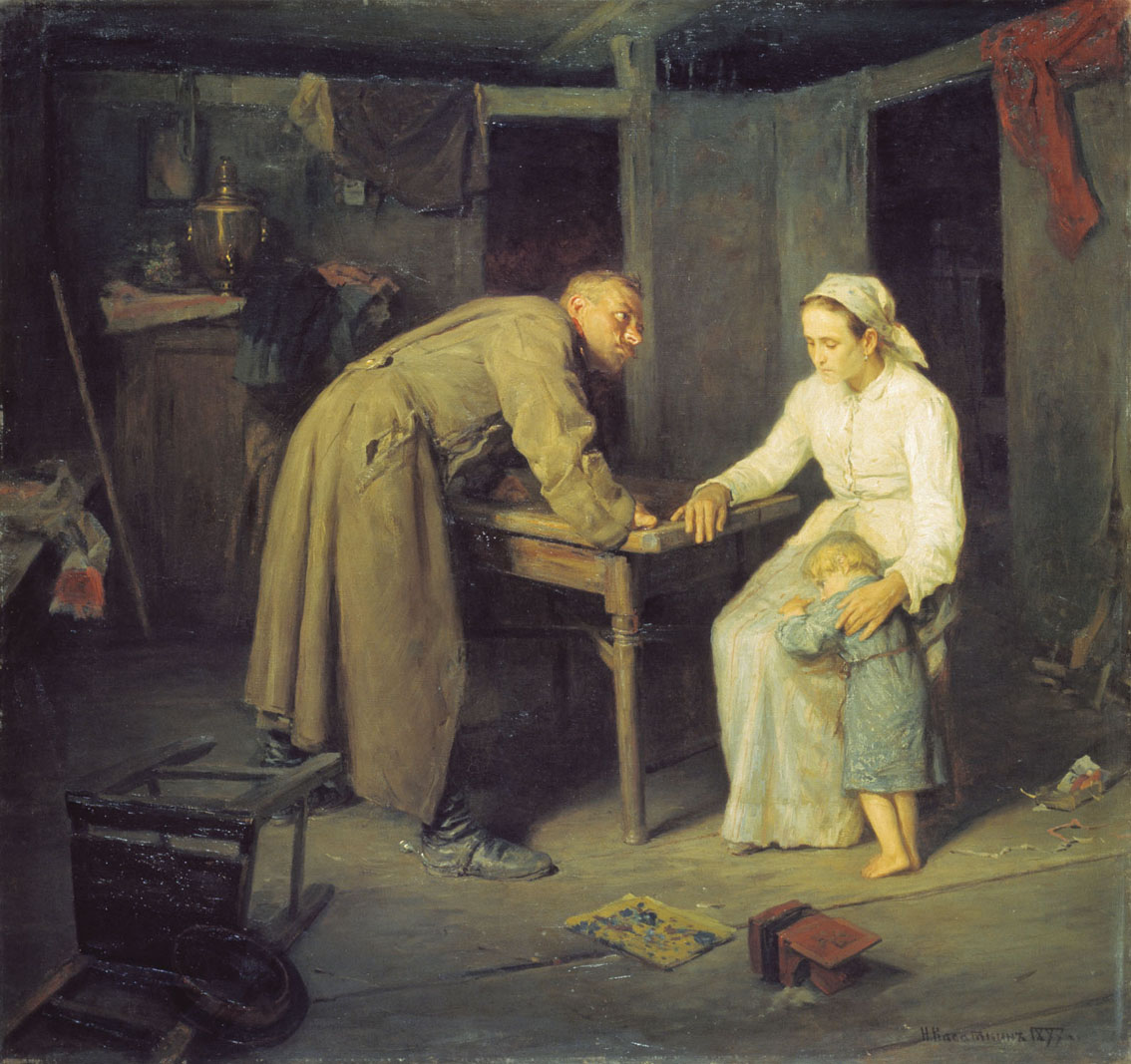
"Who?"
The husband asks. "This isn't my child. Who is this?" he presses. The setting is the Russian Empire. The husband has just returned from military service. The painting was completed in 1897, when a standard tour of duty in the empire ran roughly four to five years. He had endured the war. He had survived the battlefield. At last, he set out on the road home he had dreamed of countless times. He opened a familiar door. He came face to face with the wife he had longed to see. But beside her stood a small child he had never seen in his life — a figure that, for all the hundreds of times he had dreamed of this moment, had never once appeared in any of those dreams.
The husband's eyes harden.
A boy with his face pressed against his mother's skirt. Eyes cast downward, small hands clutching her thigh. The child does not resemble him. And no matter how he looks at the boy, the child appears to be no more than four years old. Which means — the wife says nothing, only bows her head in silence.
The couple appear to be from the lower class.
The husband's years away were surely no easy passage, but the life left behind for the wife could not have been easy either. Time moves steadily forward even through wind and rain. Life demands food, clothing and shelter with relentless hunger, even in the middle of a storm. On the cabinet in the room, a samovar — the metal tea urn that symbolizes warmth and hospitality — sits cold. It looks worn and grimy with age. In the four or five years the household was left half-empty, there was likely never a moment of true warmth within those walls.
Amid all of this, what comfortable work could the wife have found?
With no money, no possessions and now no husband, the options available to her would have been painfully obvious. If her days were spent soaked in dust and toil, her nights would have been swallowed by a bleak and uncertain future. Some cowardly men in the neighborhood may well have made her a target — preying on her fear and anxiety, and in many moments using coercion and threats to break down the defenses of her body and mind. The scene in the painting may well be the result of exactly that. Viewed through this lens, all three figures — the husband, the wife and the child — are victims. They are all casualties.
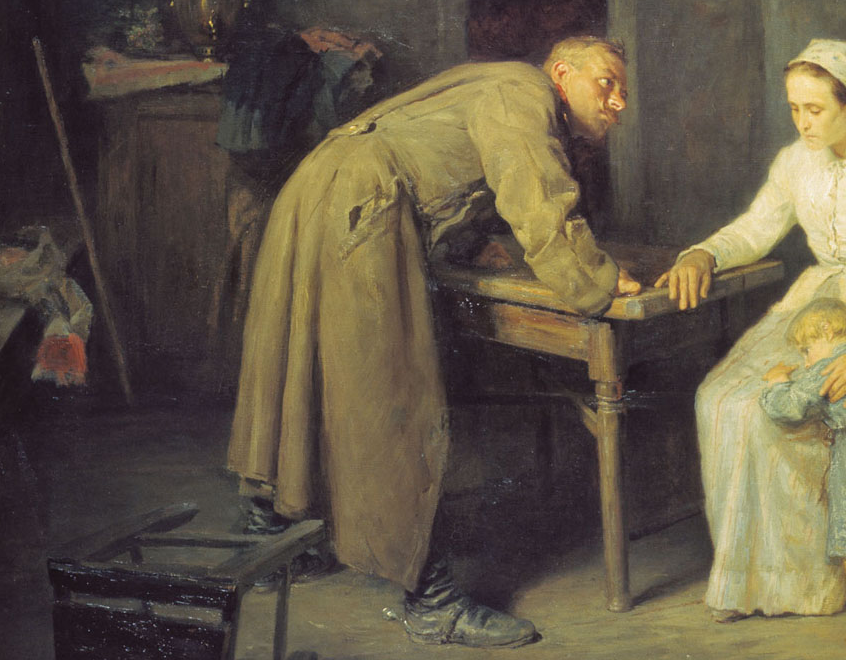
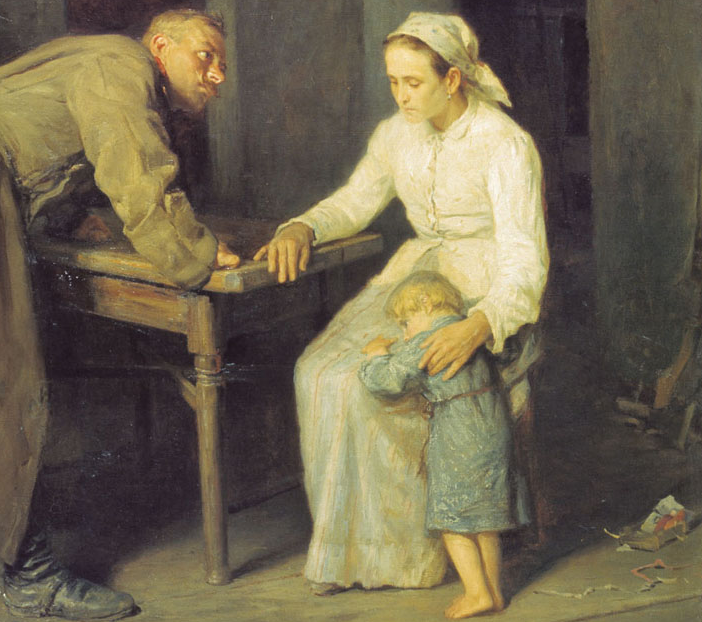
The painter, too, has scattered much to think about across the canvas.
Particularly the wife's white clothing — might it not suggest that she, too, is an innocent victim? The red cloth, crumpled and hanging as if dripping, seems to speak to the humiliation she has been forced to endure. An overturned chair and an upended container spilling what appears to be white powder — perhaps salt — convey the immediate tension of the moment, while also standing in for the inner world of a woman whose spirit has been trampled and left in ruin over the years.
In addition, consider the year the painting was made: 1897.
At that very time, the question of illegitimate children — those born outside of marriage — was becoming a matter of public debate in the Russian Empire. There were discussions and deliberations over what legal rights, if any, could be extended to such children and to those who cared for them.
Perhaps the husband already understands something of what his wife has been through. And perhaps that is precisely why he asks.
The fact that his first words are not an accusation but a question — and not "Why did you do this?" but "Who did this to you?" — has led some to interpret his words as an expression of concern rather than condemnation. His anger, on this reading, is directed not at his wife but at the cowardly man who wronged her. The question, some suggest, is his way of saying he intends to protect her now, and to hold that nameless man to account.
This narrow room is filled with three distinct tragedies. Outside, it is dark. And that only makes it all the more sorrowful.
yul@heraldcorp.com