303 works selected from 3,479 entries nationwide at the 72nd National Science Exhibition
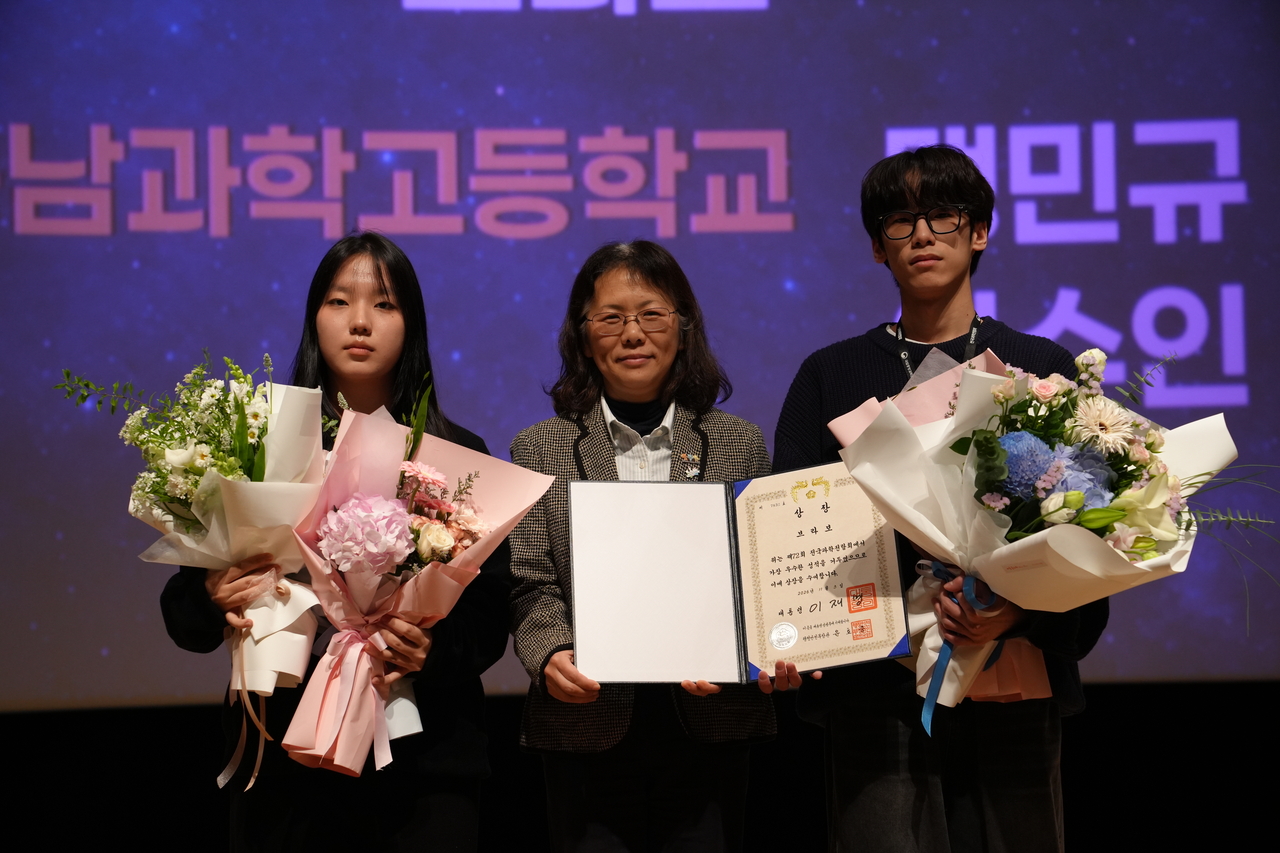
High school students who developed a technique for detecting minute structural vibrations through sound analysis took home the presidential award at a national science competition. A team of elementary school teachers who applied the mechanics of traditional Joseon-era weapons to physics education also received the top honor.
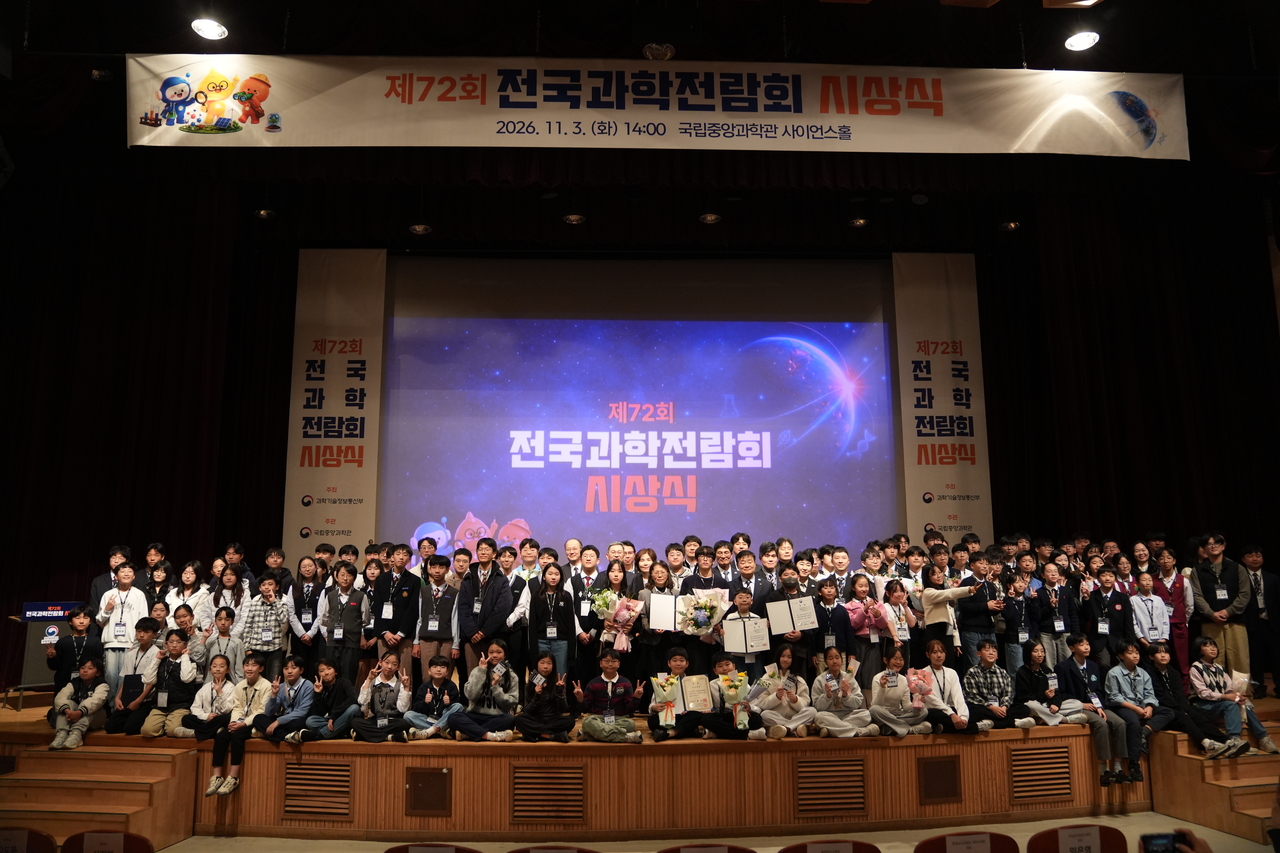
The National Science Museum, under the Ministry of Science and ICT, held the awards ceremony for the 72nd National Science Exhibition on Tuesday at the Science Hall of the National Science Museum in Daejeon.
The National Science Exhibition is South Korea's premier science competition, first held in 1949. This year, 3,479 entries were submitted from 17 cities and provinces across the country, and 303 works were selected as winners after passing through regional and national rounds.
The presidential award in the student category went to "Team Bravo," made up of Maeng Min-gyu and Lee Su-in of South Chungcheong Science High School.
The pair presented foundational technology for detecting wobble and resonance in unknown structures by analyzing changes in sound frequency and phase, through research titled "Wobble Detection Using Acoustic Doppler Phase Analysis."
Resonance occurs when an external vibration matches a structure's natural frequency, causing vibrations to amplify significantly. The research team explored a new approach to identifying a structure's vibrational characteristics through acoustic analysis.
The presidential award in the teacher and general category went to "Team Korean Weapons Research Society," comprising Kang Dae-cheol of Hwasun Elementary School, Kim Seong-sik of Docho Elementary School and Kim Hye-min of Bigeum Elementary School.
The team developed a simulator comparing the rotational motion of two Joseon-era weapons — the pyeongon and the bong — and conducted research on applying the findings to physics education at the elementary school level. A key feature of their work was using scientific analysis of traditional weapons' movements as educational content to help students grasp physics concepts.
The prime minister's award in the student category went to "Team Zero Hwanta," consisting of Kim Yeon-u, Kang Dong-u and Hwang Chan-hu of Cheonan Saesaem Elementary School.
The team researched ways to suppress Humulus japonicus — an invasive species disrupting local ecosystems — by harnessing the allelopathic properties of non-native plants found along waterways. Allelopathy refers to the phenomenon in which a plant releases certain chemical compounds that affect the growth of surrounding plants.
The prime minister's award in the teacher and general category went to "Team Gastropod Students," made up of teachers Choi Gyeong-ju, Jeon Hyeon-u and Jin Seo-yeong of Sindae Elementary School. The team analyzed behavioral changes in mud snails under salinity stress and developed the findings into ecological inquiry learning materials.
Winners of the presidential and prime minister's awards receive prize money of 10 million won ($7,460) and 5 million won, respectively. Student winners and their supervising teachers are also offered a science and culture tour to visit outstanding science facilities abroad.
The National Science Museum plans to hold a regional traveling exhibition in November and December showcasing top works from the National Science Exhibition and the National Student Science Invention Competition.
"I send a big round of applause to all participants for their passion and dedication — a full year of asking questions, running experiments and pursuing inquiry," National Science Museum Director Lee Eun-young said. "We will continue to put in place a range of support measures so that participants can keep exploring and build on their capabilities."
nbgkoo@heraldcorp.com