City seeks mid-size dome with 30,000 seats for sports and performances
6.93 trillion won earmarked for Sangdong redevelopment; ground-breaking set for 2028
More than 32,000 housing units planned across Daejang, Yeokgok and Ojeong
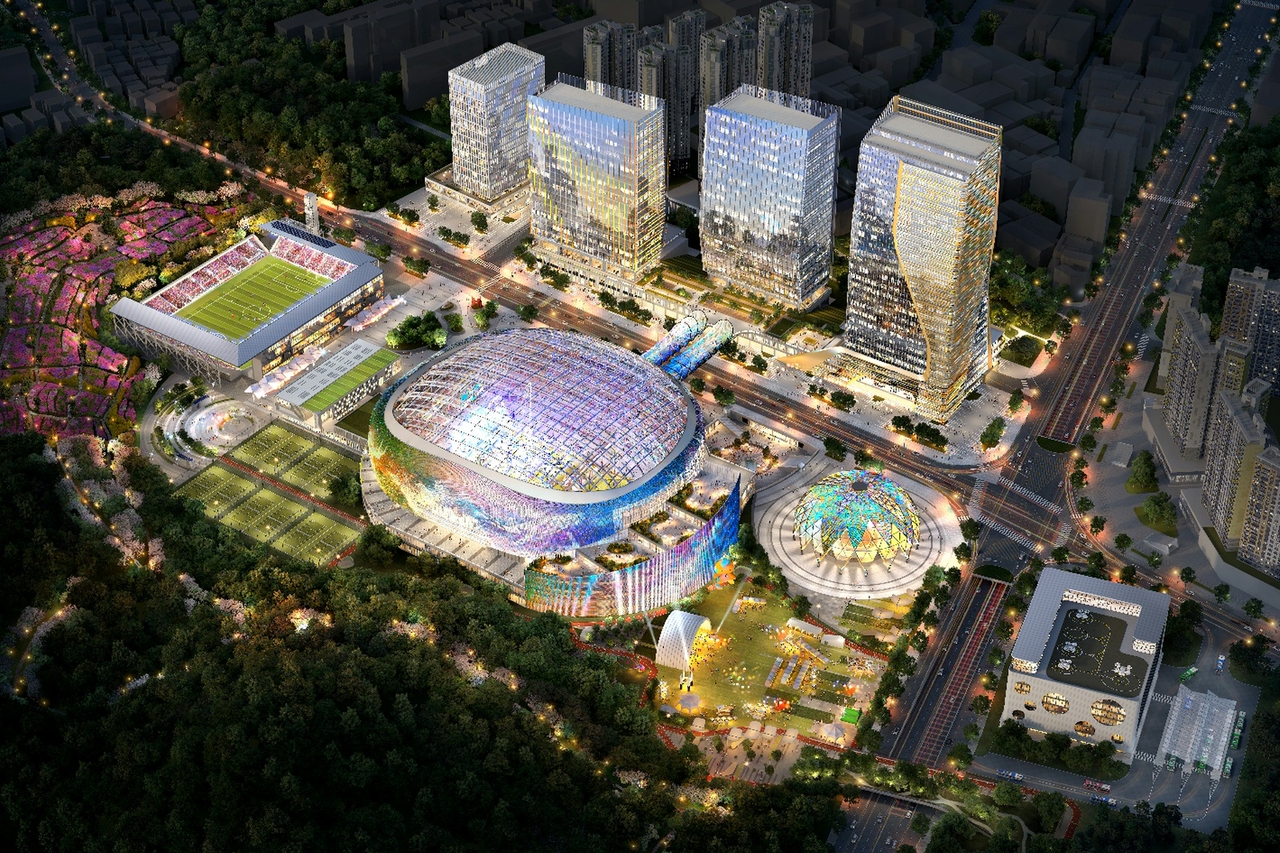
Bucheon in Gyeonggi Province is pushing to attract a dome stadium near Bucheon Stadium and redevelop the former Sangdong film and culture complex into an AI and content industry hub, as the city moves to sharpen its urban competitiveness.
The plan links those projects to large-scale public housing developments in the Daejang new town and Yeokgok district, aiming to restructure the city around a combination of residential, industrial and cultural functions. The city's core strategy is to transform Bucheon Stadium, the Sangdong Special Planning Zone and the Daejang urban high-tech industrial complex into key growth anchors — shifting the city from a predominantly residential base to a self-sustaining urban center where industry and culture converge.
Bucheon City unveiled the development plans and timelines Tuesday at a municipal policy briefing.
The area around Bucheon Stadium is to be remade into a transit-oriented mixed-use district combining sports, culture and commercial functions.
Mid-size dome stadium with 30,000 seats
The centerpiece of the project, which covers 490,823 square meters in Chunui-dong, Wonmi-gu, is the bid to attract a mid-size dome stadium with roughly 30,000 seats.
The city formed a dedicated task force in September to compete in a government call for candidate sites for a sports and entertainment dome, led by the Ministry of Culture, Sports and Tourism.
The government competition will select one site each for a large dome of 40,000 seats or more and a mid-size dome of around 30,000 seats, with a target completion date of 2034.
Bucheon plans to highlight its location at the intersection of five transit lines as a key advantage, along with its cultural credentials — including the Bucheon International Fantastic Film Festival.
The city will submit a proposal to Gyeonggi Province for site selection this month, and in 2027 will pursue consultations with the Ministry of Land, Infrastructure and Transport and a review by the Central Urban Planning Committee to amend the development plan.
The city is also considering applying for urban innovation zone designation to strengthen the feasibility of the mixed-use development tied to the dome.
An urban innovation zone — South Korea's version of a white zone — is a regulatory framework that allows diverse functions to be concentrated in one area, free from the uniform land-use categories and floor-area ratio restrictions that apply under conventional zoning.
The city intends to use the designation to create a space that integrates sports, cultural and commercial facilities.
Urban innovation zone designation targeted; full development from 2029
The city plans to pursue urban innovation zone designation in 2028 and begin full-scale development from 2029.
Residential supply will proceed in parallel. Construction is underway on 843 units in blocks A1 and A2, which broke ground in July, with move-in targeted for late 2028.
The former Sangdong film and culture complex is to be transformed into an AI-based compact city combining future industries with residential, commercial and office functions.
The large-scale mixed-use development covers 383,151 square meters in Sangdong, Wonmi-gu, with a total project cost of 6.93 trillion won ($5.17 billion).
The development plan includes a convergence center, a landmark tower, commercial and office facilities, residential space, a cultural park, roads and other urban infrastructure. Everyday public amenities and community facilities will also be expanded.
A particular emphasis is placed on attracting content industry and AI-related companies to build a new industrial ecosystem.
The city ran an expert-led project planning task force to respond to shifts in government industrial policy and improve the project's viability, and is currently in talks with a private developer on the detailed development plan.
The city plans to finalize a revised project plan and hold a public information session this month, then announce changes to the urban management plan in December.
A land sale contract is set for the first half of 2027, followed by building permit procedures, with ground-breaking targeted for the first half of 2028 and completion in the second half of 2032.
The city expects the completed Sangdong development to form a new economic hub centered on AI and content industries, with industrial and commercial spillover effects spreading to the surrounding older urban core.
Housing-jobs linked development model
The city is also accelerating the spatial restructuring of Bucheon through large-scale housing supply.
Bucheon plans to deliver more than 32,000 housing units by 2032 across five areas: the Daejang and Yeokgok public housing districts, a military base relocation site in Ojeong-dong, the Seonggol district and the Daejang Andong neighborhood.
The Daejang district will receive 20,318 units and the Yeokgok district 5,632 units, for a combined total of 25,950 units.
Rather than limiting itself to housing supply, the city intends to pursue corporate attraction, improvements to the regional transport network and expansion of everyday infrastructure simultaneously, building a development model that links residential areas to employment.
In 2027, pre-sales are planned for a combined 3,555 units — 1,522 in the Daejang district and 2,033 in the Yeokgok district — covering both public and private housing.
Move-ins in the Daejang district are set to begin in November 2027, while the Yeokgok district targets June 2029.
A 445,311-square-meter site in Ojeong-dong, currently occupied by a military base slated for relocation along with surrounding land, will be developed into a residential complex of 3,995 units.
The city plans to launch pre-sales in the second half of 2027, complete land compensation by the end of that year and finish the urban development project by 2030.
Older neighborhoods to be upgraded; Seonggol district complex due by 2028
The city is also pursuing village improvement projects to upgrade living conditions in older residential areas.
The targets are the Seonggol district in Yeowol-dong and the Daejang Andong neighborhood in Daejang-dong, both of which have been prioritized for release from the development-restricted zone. A land replotting method will be applied — under which landowners receive reorganized plots after development — to encourage original residents to remain.
The Seonggol district, which will accommodate 805 units, is currently in the demolition phase, with complex construction set for completion by May 2028.
The Daejang Andong neighborhood, planned for 1,612 units, will undergo urban development zone designation in December before construction begins in June 2029. Korea Land and Housing Corporation will serve as the project operator.
"We will concentrate our administrative capacity to ensure all development projects proceed without disruption," said Kim Woo-yong, director of Bucheon City's urban affairs bureau. "We will build a balanced development model that allows the new and old urban cores, and different generations, to thrive together — creating a city environment where residents can feel the change in their daily lives."
gilbert@heraldcorp.com