- Institute unveils 'Vision 2040' on 50th anniversary, pivoting to mission-oriented research
- Five core fields identified, including next-generation batteries, solar cells and CCU
- AI drug development platform trained on 440,000 data points goes live; robotic labs to expand
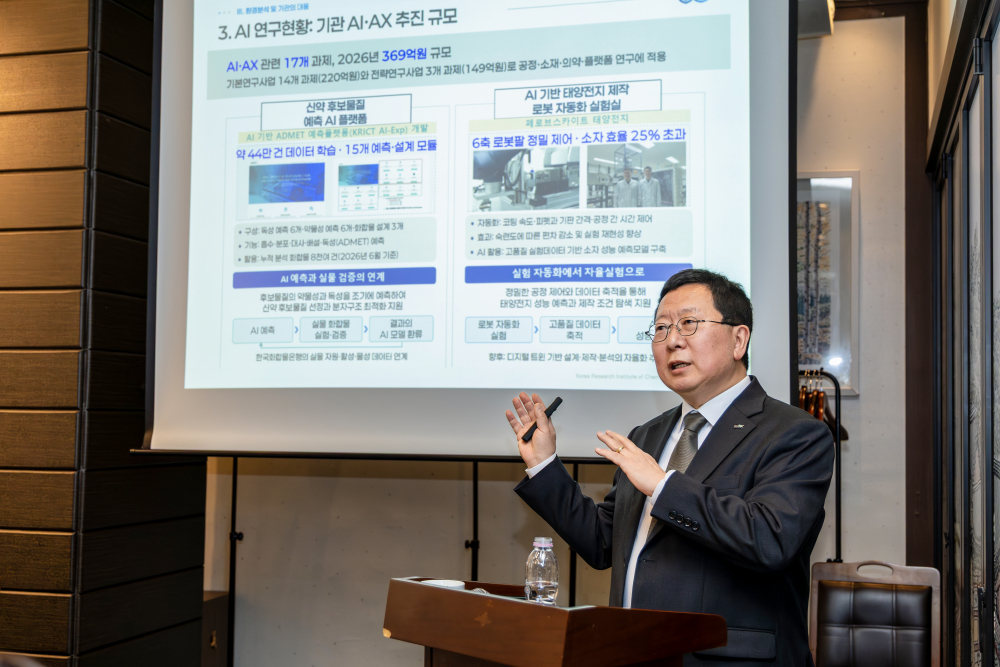
"AI is not merely a supporting tool for chemical research — it is a core technology that transforms the very way research is conducted. We will secure the chemical technologies the nation needs and ensure our research outcomes make a real contribution to industry and people's lives."
Shin Seok-min, president of the Korea Research Institute of Chemical Technology, laid out "national strategic technology" and "AI-driven research innovation" as the twin pillars of the institute's strategy for its next 50 years, speaking at a press briefing Tuesday as KRICT marked its 50th anniversary.
The plan calls for concentrating research capacity on technologies critical to national competitiveness — secondary batteries, next-generation solar cells, carbon capture and utilization, and innovative new drugs — while expanding autonomous laboratories that combine AI and robotics to reshape the paradigm of chemical R&D.
To that end, KRICT has designated five core research areas: carbon neutrality, next-generation energy, advanced biotech, response to global environmental regulation, and AI for chemical technology.
Next-generation energy is among the fields drawing the most attention. The institute plans to develop key secondary battery materials and fluorine-based materials that will determine competitiveness in the electric vehicle and ESS markets, and to accelerate research into perovskite solar cells, a leading next-generation photovoltaic technology.
In carbon neutrality, KRICT will pursue CCU technology that uses electricity to capture carbon dioxide and convert it into useful materials, alongside efforts to secure hydrogen and waste-resource recycling technologies.
In advanced biotech, the institute will push to develop innovative new drugs and treatments for antibiotic-resistant bacteria. It also plans to address tightening global environmental regulation through eco-friendly precision chemistry and biochemical technology.
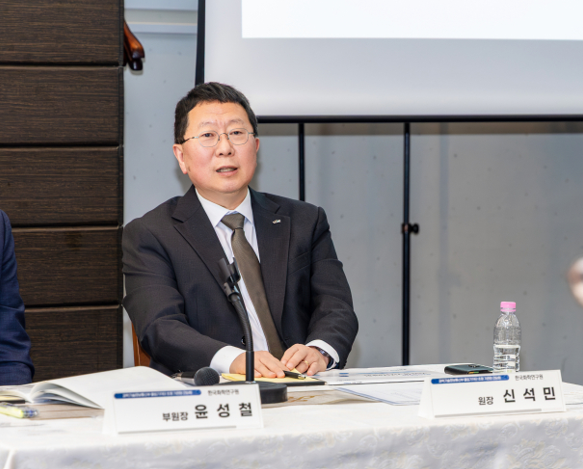
Shin said the institute is also staking its future on AI-powered research innovation.
Traditional chemical research has relied on researchers designing experimental conditions and running repeated trials to find optimal results. Combining AI with robotics, Shin said, can evolve that process into an intelligent research system in which AI analyzes vast datasets to identify promising experimental conditions and robots carry out the experiments.
To realize that vision, KRICT has launched an effort to build an "AI for Chemistry" innovation ecosystem.
A flagship product of that effort is KRICT AI-Exp, an AI drug development platform trained on approximately 440,000 data points. The platform uses 15 prediction and design modules to forecast the drug-likeness and toxicity of new drug candidates.
In solar cell research, the institute already operates an automated laboratory using a six-axis robotic arm. The robot precisely controls minute process variables to improve experimental reproducibility and generate high-quality research data.
KRICT plans to advance the system further by incorporating digital twin technology — which replicates physical laboratories in virtual space — to build a fully AI-based autonomous experimental framework.
Shin also emphasized creating an environment in which researchers can focus deeply on their work. The institute intends to use the abolition of the project-based salary system as an opportunity to move away from managing individual research projects in isolation and instead build a structure that consolidates research capacity around national missions.
"We will create an environment where researchers can challenge themselves autonomously and immerse themselves in their work, and advance as an institute that answers the problems facing the nation and society through chemistry," Shin said.
nbgkoo@heraldcorp.com