LH CEO hosts roundtable with modular housing industry
Large-scale orders aimed at achieving economies of scale, drawing private investment
Korea Land and Housing Corporation announced Wednesday it will expand large-scale orders for modular housing to accelerate supply, in line with a directive from President Lee Jae Myung to revitalize the modular construction industry. The state housing developer plans to order more than 3,000 units per year — totaling at least 18,000 units over five years — centered on third-generation new towns in the Greater Seoul area.
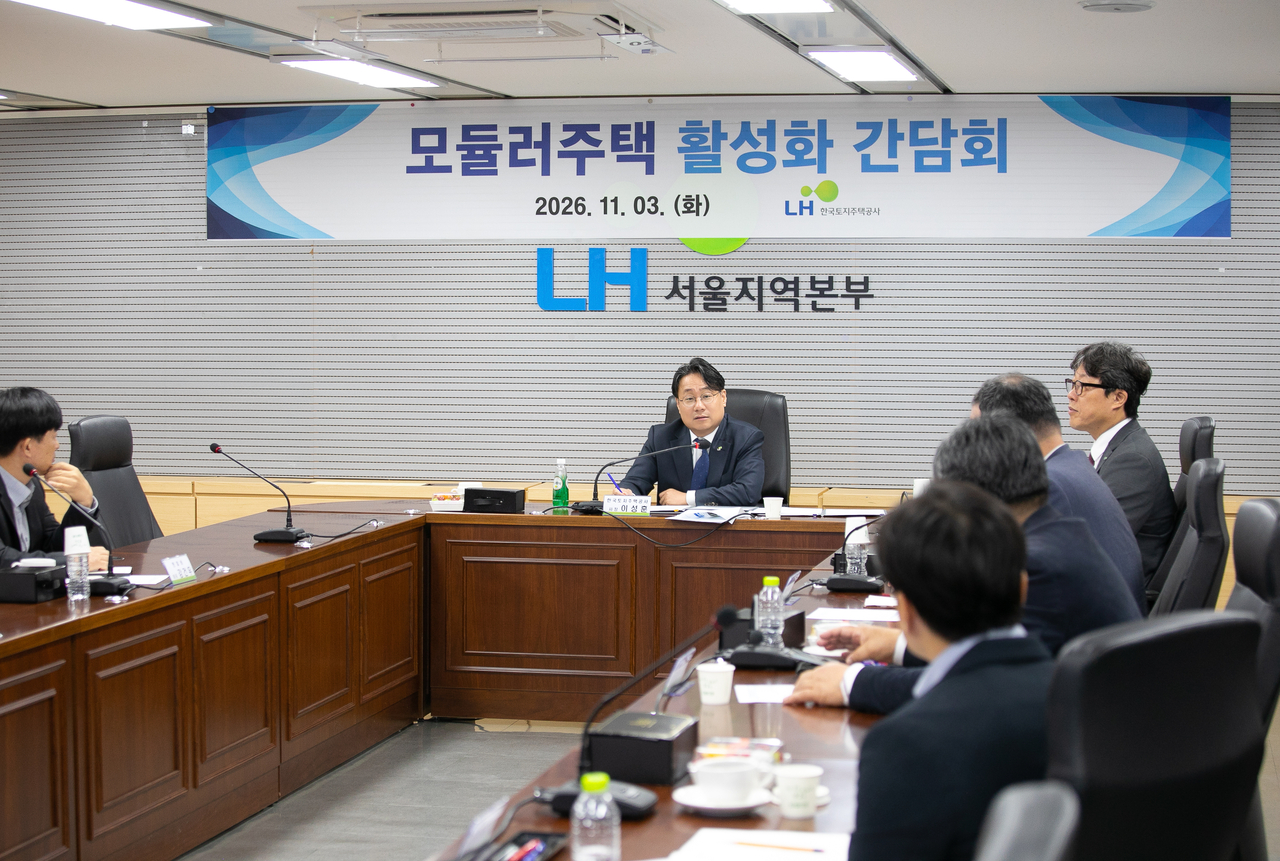
LH President Lee Seong-hun held a roundtable Tuesday with executives from six leading domestic modular housing manufacturers to discuss the expansion.
The meeting was convened to swiftly follow through on remarks President Lee made during an Oct. 20 visit to the Incheon Gyeyang third-generation new town site, where he called for building a mass-production system for modular housing and expanding orders to drive equipment investment and lower unit production costs. At the site, after hearing briefings from experts, Lee said, "Review this comprehensively from the perspective of creating a modular housing market."
At the roundtable, LH shared its modular ordering plan with industry representatives, outlining how it intends to fulfill the government's Aug. 13 rapid housing supply measures. LH said the steady volume of orders would ease manufacturers' concerns about underutilized factory capacity.
Specifically, LH said it will accelerate orders for units at Namyangju Wangsuk 2 Block A10 (555 units), Goyang Changneung Block A3 (668 units) and Pocheon Songwoo 2 Block A1 (916 units). From 2027 through 2030, it plans to place orders for at least 3,000 units annually — totaling 4.8 trillion won ($3.58 billion) worth of "18,000-plus" units over five years, centered on third-generation new towns in the metropolitan area. LH also announced it will front-load orders to push next year's volume above 3,500 units.
LH also introduced a range of institutional improvements to support the modular industry and ease liquidity pressures. The corporation will introduce a "technology-induction period" to encourage private-sector investment in research and automated production equipment. The first application will be at Pocheon Songwoo 2 Block A1, where an early order to be placed by the end of this year will give the selected contractor time for research and development and automated mass-production preparation before ground-breaking.
To ease liquidity constraints in the early market-formation stage — when large capital outlays for automated equipment are unavoidable — LH will also change how progress payments are made. Under the current system, payments are released after modular units arrive on site; the new approach will tie payments to progress at the factory.
In addition, LH will set unit-cost reduction targets by scale and year, and introduce a volume-price linkage system that allocates orders based on cost-reduction performance, encouraging manufacturers to improve their business competitiveness.
Executives from the participating manufacturers welcomed the announcement. "Sporadic, one-off orders made it very difficult to maintain factory utilization rates and commit to equipment investment," they said. "We are deeply grateful for this unprecedented large-scale commitment of 18,000-plus consecutive orders. The private sector will respond by investing in automated production lines to sharply lower unit costs and deliver high-quality housing."
The roundtable also included in-depth discussion of introducing practical ordering and quality standards tailored to modular construction, along with proposals for regulatory reform. Participants agreed to pursue innovations in the ordering framework, the creation of modular-specific standards, and the introduction of a quality certification system — leveraging modular construction's advantage of cutting build times by 20 to 30 percent compared with conventional methods.
Meanwhile, LH said it will accelerate quality system improvements, drawing on technology validated at pilot complexes including the Sejong Block 5-1 (12 stories, 450 units) and Uiwang Chopyeong Block A4 (22 stories, 381 units).
Building on modular housing units already registered on the Public Procurement Service's Narajangteo platform, LH plans to move through a "make-to-order" mass-production system based on standardized floor plans of 36, 46 and 54 square meters, and eventually evolve into a "produce-first, assemble-on-site" model as the market matures — accelerating both schedule compression and cost reduction.
"Modular housing is a core solution that can simultaneously address the aging of the construction workforce, the shortage of skilled labor, safety incidents and quality issues, while dramatically accelerating the pace of national housing supply," LH President Lee said. "Through large-scale orders as a catalyst, we will boost bold private-sector equipment investment and price competitiveness, build a K-modular residential ecosystem, and complete a great transformation of the future housing industry."
hss@heraldcorp.com