Party says Future Response Fund holds 104 trillion won in idle reserves
Vows to cut unnecessary spending, restore local allocation tax
The People Power Party warned Wednesday that the government's budget proposal for next year effectively totals 925 trillion won ($690 billion), far exceeding the officially announced figure, and pledged sweeping cuts. The party argues that the stated 820.9 trillion won does not account for 104.4 trillion won in idle reserves held in the Future Response Fund. It plans to restore local allocation tax transfers diverted into the fund and cut spending on AI and various policy funds it deems unnecessary.
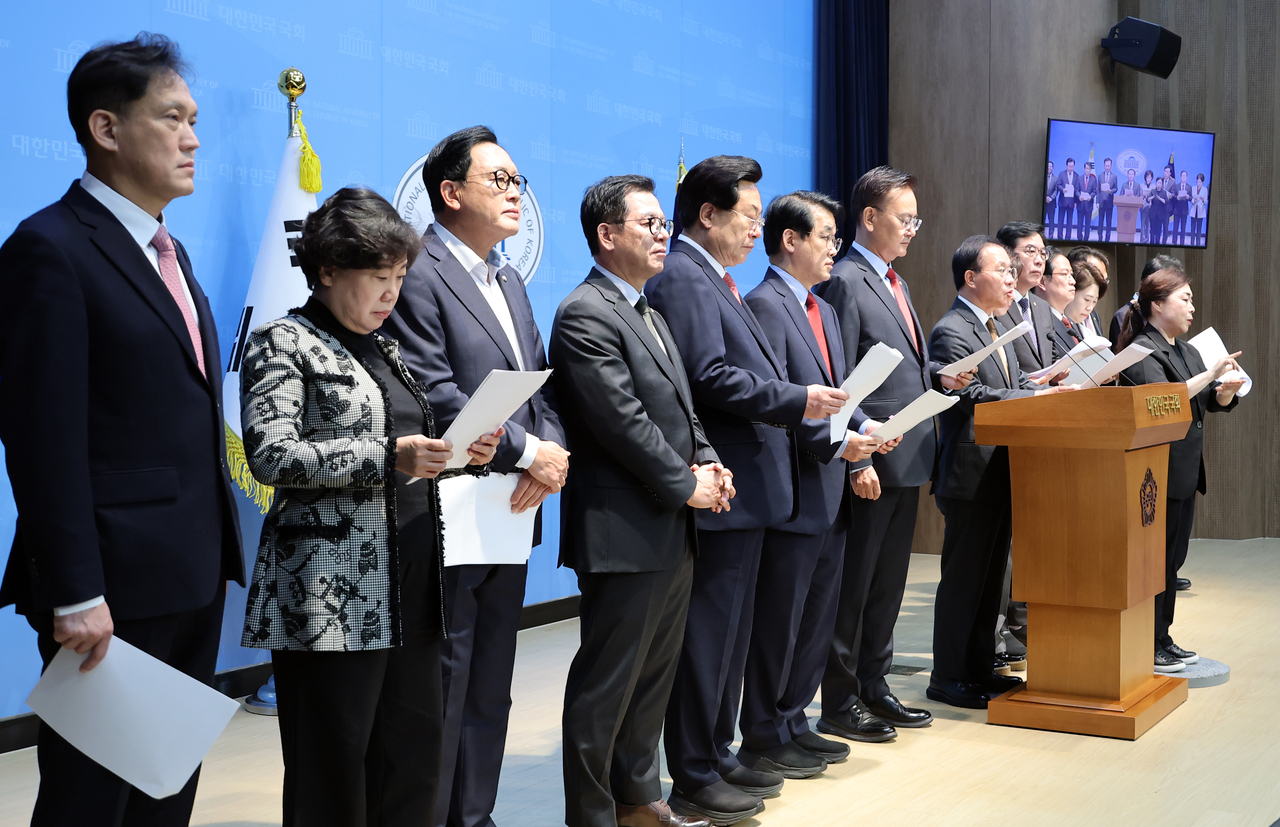
People Power Party members of the National Assembly's Budget and Accounts Committee held a press conference at the Assembly on Wednesday, calling the proposal "a grotesque budget of 925 trillion won" and demanding that the fund's "regionally discriminatory" allocations be dismantled and local allocation tax fully restored.
Yoo Sang-bum, who leads the People Power Party's side on the committee, said the government has publicly promoted next year's budget as 820.9 trillion won — a 12.8 percent increase over this year. "But hidden within it are 104.4 trillion won in Future Response Fund idle reserves that do not appear in total expenditure figures," Yoo said. "When that is factored in, next year's actual budget comes to 925.3 trillion won — a 27.1 percent increase, or 197 trillion won, over this year."
Yoo called the scale "not just enormous but grotesque — unprecedented in constitutional history." Yoo said the Lee Jae Myung administration has billed the proposal as a budget for an "irreplaceable" leap forward for South Korea, but added: "When you look inside, it is packed with largely irreplaceable — that is, irredeemable — projects."
The People Power Party took particular aim at how the Future Response Fund distributes regional finances. Committee member Yoon Jae-ok said the government had redirected 30.5 trillion won in local allocation tax into the fund as revenue, yet the fund's regional account disburses only 15.3 trillion won back to local governments — leaving 15.2 trillion won unaccounted for. Yoon added that within the regional account, local allocation tax from other cities and provinces had been cut to funnel 3.5 trillion won exclusively to Gwangju and South Jeolla Province under the banner of integration.
"The regional account is a textbook case of discrimination against other regions — their resources are being carved away to benefit Honam," Yoon said. "The full 30.5 trillion won should be cut and returned fairly to local governments."
Calls for cuts to individual project budgets followed. Lawmaker Eom Tae-young took issue with 45 billion won allocated to the Korean National Police Agency's crime prevention project. Eom said the agency plans to redeploy frontline community police officers to investigative roles following the abolition of prosecutors' investigative authority, and fill the resulting gap with 300 four-legged robots at 150 million won each — costs bundled into the crime prevention budget. Eom also flagged a separate item described as a "North Korean-style neighborhood surveillance" scheme that would shift duties currently performed by civil servants onto mutual monitoring among citizens.
Lawmakers also criticized projects where proposed budget increases far outpace actual spending records. Park Soo-young said the party would target what Park called "increase-addicted budgets" — cases where agencies cannot spend existing funds yet seek more. Park listed 5 trillion won in various policy fund budgets, 2.14 trillion won for electric vehicle distribution programs and 1.8 trillion won in renewable energy spending as candidates for cuts.
The People Power Party also designated several other items as unnecessary, including 4.7 trillion won for frontier-level AI projects, 1.7 trillion won for a youth savings program and 1.45 trillion won for an oil price stabilization support project, and said it intends to move forward with cuts across all of them.
mp1256@heraldcorp.com