Pro-Jung faction demands public apology; Choi Min-hee says she was silenced at closed meeting
Pro-Lee camp accuses rivals of fomenting division, power struggle
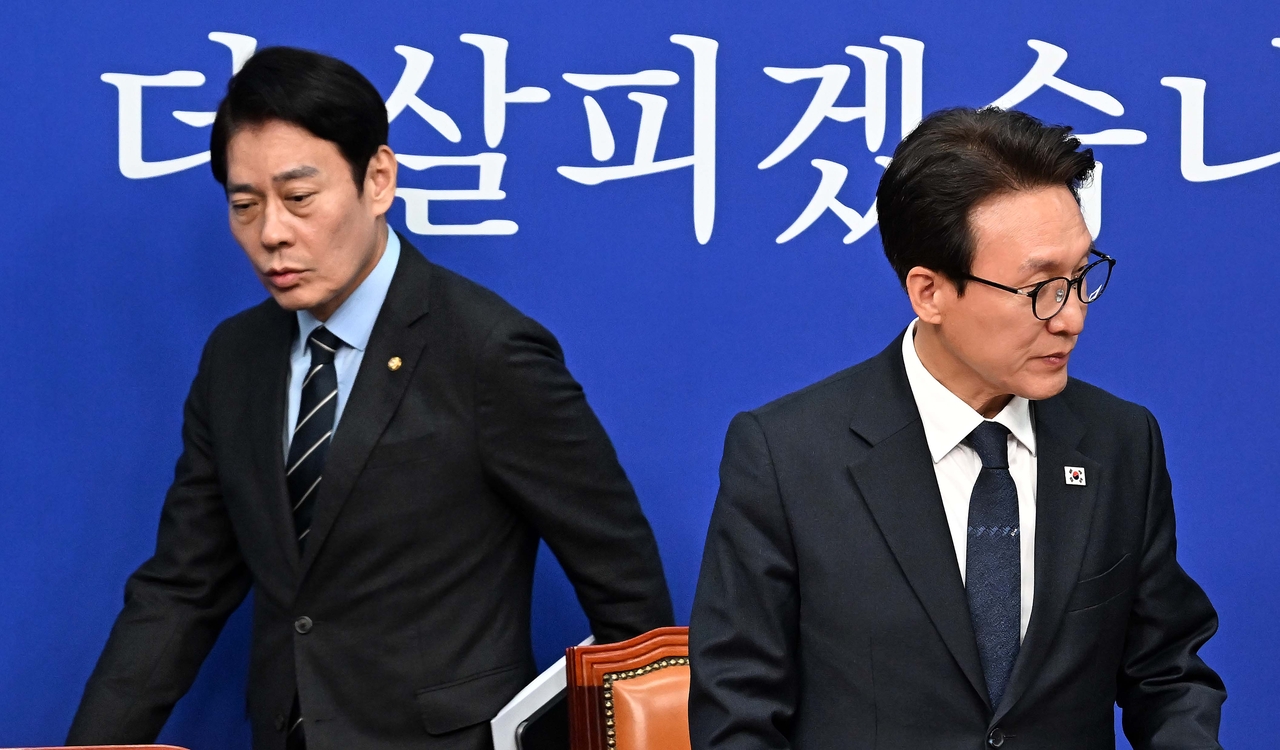
Democratic Party of Korea leader Kim Min-seok has stepped back from his claim during the party leadership race of a "three-way secret alliance" among anti-Lee, splinter and Shincheonji factions, offering an apology — but the internal feud shows no sign of abating. Lawmakers aligned with former party leader Jung Chung-rae demanded a public apology and accountability, while the pro-Lee Jae Myung camp moved to shield Kim.
Supreme council member Lee Sung-yoon, speaking at the Democratic Party's supreme council meeting at the National Assembly on Wednesday, called on Kim to go beyond a qualified apology. "To the party members and former leader Jung Chung-rae, who were stigmatized by the Shincheonji allegations and deeply wounded, please show not an 'unintentional' sorry but a sincere, public apology and a sense of responsibility," Lee said.
Lee also urged the party to investigate whether the Political Parties Act was violated and to release the findings of its internal probe. Article 52 of the Political Parties Act stipulates that anyone who publishes false information with the intent to prevent a candidate from winning a party leadership primary election or similar contest faces up to five years in prison or a fine of up to 10 million won ($7,460).
Supreme council member Han Min-su echoed the call at the same meeting. "How could the wounds of party members and supporters who have endured ridicule and humiliation be healed by a single apology delivered behind closed doors at a caucus?" Han said. "Leader Kim must publicly apologize to party members and supporters and take responsibility commensurate with his three-way secret alliance remarks."
Supreme council member Choi Min-hee, who skipped Wednesday's open session, wrote on Facebook that Kim had pressured her at a closed supreme council meeting not to raise the Shincheonji issue. "I naturally protested that my right to speak as a supreme council member should not be blocked, and Kim reacted very strongly," she wrote.
On Tuesday, ahead of a party caucus at which the results of the internal Shincheonji probe had been scheduled for release, Kim apologized, saying "there was no evidence of a secret alliance" and that he was "deeply sorry to those who were unintentionally harmed." He accepted advice that releasing the findings could trigger disputes over how the materials were obtained and further inflame tensions within the party, and opted instead to draw a line under the matter.
Kim appeared to become emotional during his remarks, and lawmakers responded with applause, according to accounts of the meeting. Floor spokesperson Kim Sung-hoe told reporters immediately after the caucus that no lawmaker had called for a criminal referral or for escalating the conflict. "He apologized sincerely, the lawmakers applauded and said he had made the right call, and it ended with the findings not being presented. There were no objections," Kim Sung-hoe said.
Kim's decision to withhold the internal probe results was made abruptly, according to those familiar with the matter. Rep. Park Seon-won, who led the party membership review TF that had prepared the presentation, told reporters: "Shincheonji is anti-Lee and infiltrated the party in an organized way. That is what I was going to report — but I was not even consulted about canceling the release."
Despite the sudden cancellation and Kim's apology, angry reactions surfaced within the party. Former leader Jung Chung-rae met reporters after Tuesday's caucus and said Kim should come forward publicly rather than apologize in secret. "I hope he comes out openly and publicly apologizes to party members, not hides in a closed caucus to say sorry," Jung said. "The result is that the party members and Jung Chung-rae are found innocent, and candidate Kim Min-seok is found guilty."
On the other side, a counter-mood was detectable, centered on pro-Lee lawmakers. Rep. Chae Hyeon-il wrote on Facebook: "I cannot help but ask whether it is truly the right path for the Democratic Party to attack the leader and stoke division the moment he makes a painful decision. Any attempt to use an issue the party leader tried to resolve by shouldering all responsibility — for the sake of the party — as a tool for internal power struggle must never be tolerated."
Kim Yong-man, the party leader's chief of civil affairs, also weighed in. "It has already been confirmed that Shincheonji members joined the party en masse, and I said that even without presenting the findings at the caucus, individual lawmakers could review the materials upon request," he said. "Responding to a decision made for party unity with 'there was nothing to it, so you apologized — now take responsibility' simply does not hold."
Despite the pro-Jung faction's pushback, voices within the party calling for a pivot away from the Shincheonji controversy and a move toward self-correction are also growing. A senior lawmaker from a Greater Seoul constituency said: "He apologized at the caucus, so he can apologize again in public. It is time to stop the division." Another party official said former leader Jung had missed an opportunity to grow politically. "If Jung had accepted the apology and moved to help resolve the situation, it could have been a chance to build up his political stature — but he reacted too hastily," the official said.
addressh@heraldcorp.com