Mayer met Hyundai Motor Group's Euisun Chung to discuss robotics
'Technology beats tariffs … AI demand overwhelms tariff impact'
'Korea will see more logistics outsourcing … supply chains must diversify'
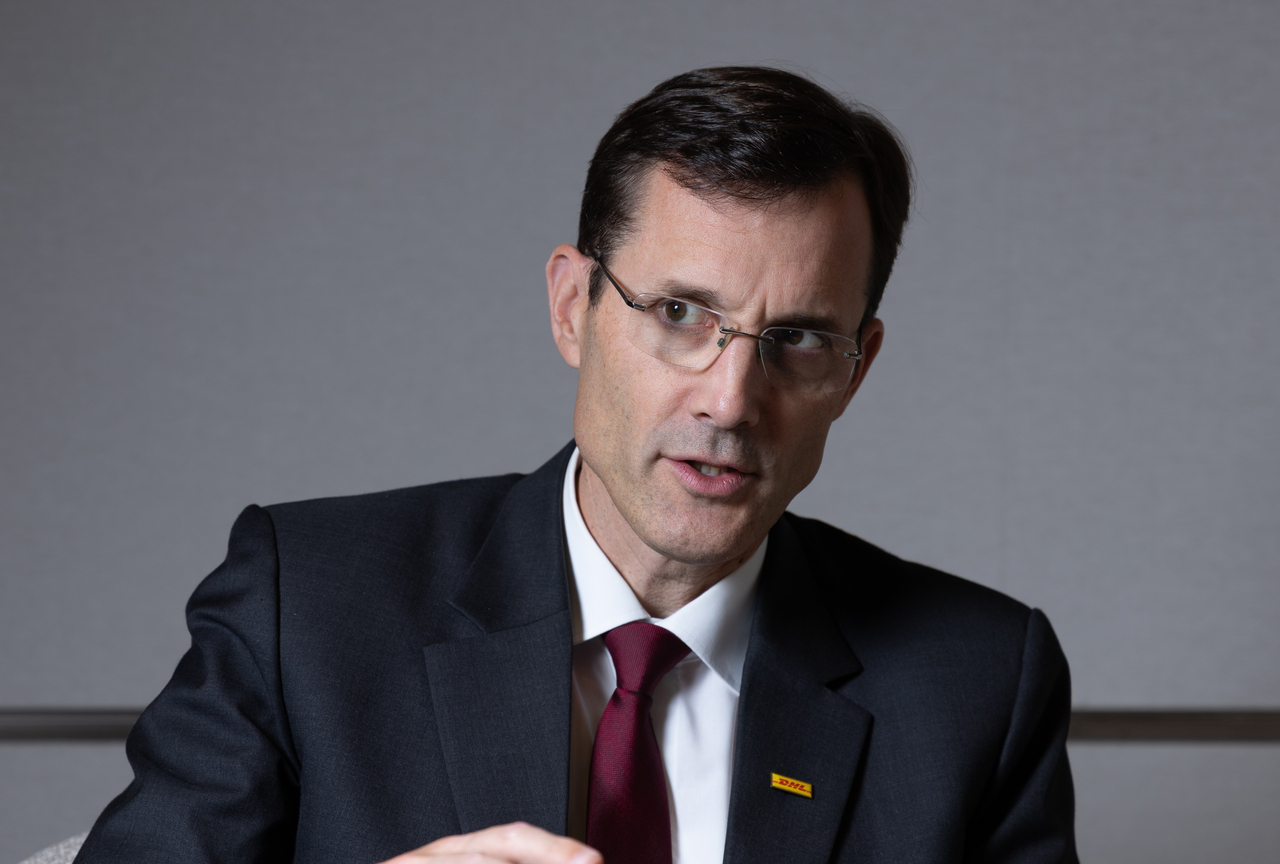
DHL Group CEO Tobias Mayer has identified South Korea as a beneficiary of the ongoing geopolitical realignment. During his visit to Seoul, Mayer met Hyundai Motor Group Chairman Euisun Chung and described Boston Dynamics — a Hyundai Motor Group subsidiary — as a "good partner," saying DHL would continue expanding its use of robots in logistics operations.
Speaking in an interview with Herald Media Group on Saturday on the sidelines of the 19th Asia-Pacific German Business Conference (APK 2026) in Seoul, Mayer said South Korea is "one of the countries we see benefiting from the current geopolitical environment," adding that DHL is placing special focus on key industries where it can add value for customers in those markets.
DHL Group is the world's largest logistics company, operating international express delivery, air and maritime freight, and contract logistics. The company has identified countries attracting trade and investment through supply chain realignment as "Geographic Tailwinds" markets, and is building up focus industries including life sciences and healthcare, new energy, and data center logistics covering semiconductors.
Mayer summed up this year's global trade flows with the phrase "technology beats tariffs." He said demand related to data centers and AI is "overwhelming the negative impact of tariffs," and noted that global trade in the first half of this year grew at its fastest pace in 15 years, excluding the post-COVID rebound period.
He cautioned, however, that even in South Korea's economy, "only some companies exposed to the AI boom are seeing major benefits — the effect is not being felt across the entire economy and society." He added that while having a semiconductor industry is better than not having one, whether it represents the right industrial mix for the broader economy is ultimately a policy question.
Mayer also met Chairman Chung again during the visit. He said the two sat next to each other at a dinner hosted by President Lee Jae Myung on Thursday to mark German Chancellor Friedrich Merz's visit to Seoul, where they discussed the direction of the automotive market and robotics technology. Mayer had also met Chung during his first visit to South Korea in January last year, when they discussed cooperation on robotics and purpose-built vehicles.
"Boston Dynamics, which Hyundai Motor owns, is a good partner for DHL," Mayer said. DHL signed a contract with Boston Dynamics in 2022 to deploy the logistics robot Stretch, and first put it into commercial use at a North American distribution center the following year. In May last year, the two companies signed an MOU to introduce an additional 1,000 Stretch units, expanding their collaboration beyond a simple supply relationship into joint development and validation. Deployment is also being extended from North America to the United Kingdom and Europe. Stretch can automatically unload up to 700 boxes per hour from trucks and containers.
"Loading, unloading and palletizing are labor-intensive and physically demanding tasks," Mayer said. "If robots can help with that, we can create better jobs and better economics." He added that proving Stretch can efficiently handle standard-sized boxes is progress, but said the technology must advance to handle harder-to-identify and harder-to-grasp items such as polybags.
DHL is also accelerating its AI adoption. The company is prioritizing AI for tasks that involve reading and comparing documents and filling out forms, such as customs clearance. Mayer said DHL is "moving beyond simple pilot deployments and scaling up real-world application."
Mayer also signaled openness to deeper cooperation with Korean companies in electric delivery vehicles. DHL Korea has signed an MOU with Kia and is introducing the electric purpose-built vehicle PV5. "We very much welcome cooperating with Korean manufacturers in the electric vehicle space," Mayer said, adding that by the early 2030s "almost all delivery vehicles will be electric." DHL currently operates about 60,000 electric delivery vehicles, and DHL Korea aims to convert its entire delivery fleet to electric vehicles by 2030.
On the Korean logistics market, Mayer expressed optimism about growing outsourcing opportunities. Because South Korea's large conglomerates have traditionally handled logistics in-house, DHL's domestic business has been concentrated in express delivery. "As economies mature, many companies focus on their core competencies and outsource logistics," he said. "This trend started in the United States, spread to Europe and Asia, and will emerge in Korea as well." He went on to say that "every morning I wake up thinking about logistics, and my colleagues at DHL Korea think only about becoming the best express operator in Korea," arguing that such specialization produces better quality.
Mayer advised Korean companies to secure options within their supply chains. "Volatility in the regulatory environment will continue," he said. "Even if it costs a little more, companies should not rely on a single supplier or factory — they need to diversify their supply chains."
He viewed the supply chain realignment as an opportunity for DHL. "When customers diversify their bases, we can quickly replicate in two or three other countries what was previously done in one," Mayer said. He also noted that "the roughly 30 years of calm that the West enjoyed from 1990 may actually have been the exception," while adding that the resilience of the global economy and trade in the face of multiple shocks is "a reason for optimism."
eyre@heraldcorp.com