Korea National Opera launches its Ring Cycle with 'Das Rheingold'
Samuel Yun and the vocal cast shine amid visual excess
Conductor Lothar Koenigs holds Wagner's architecture together
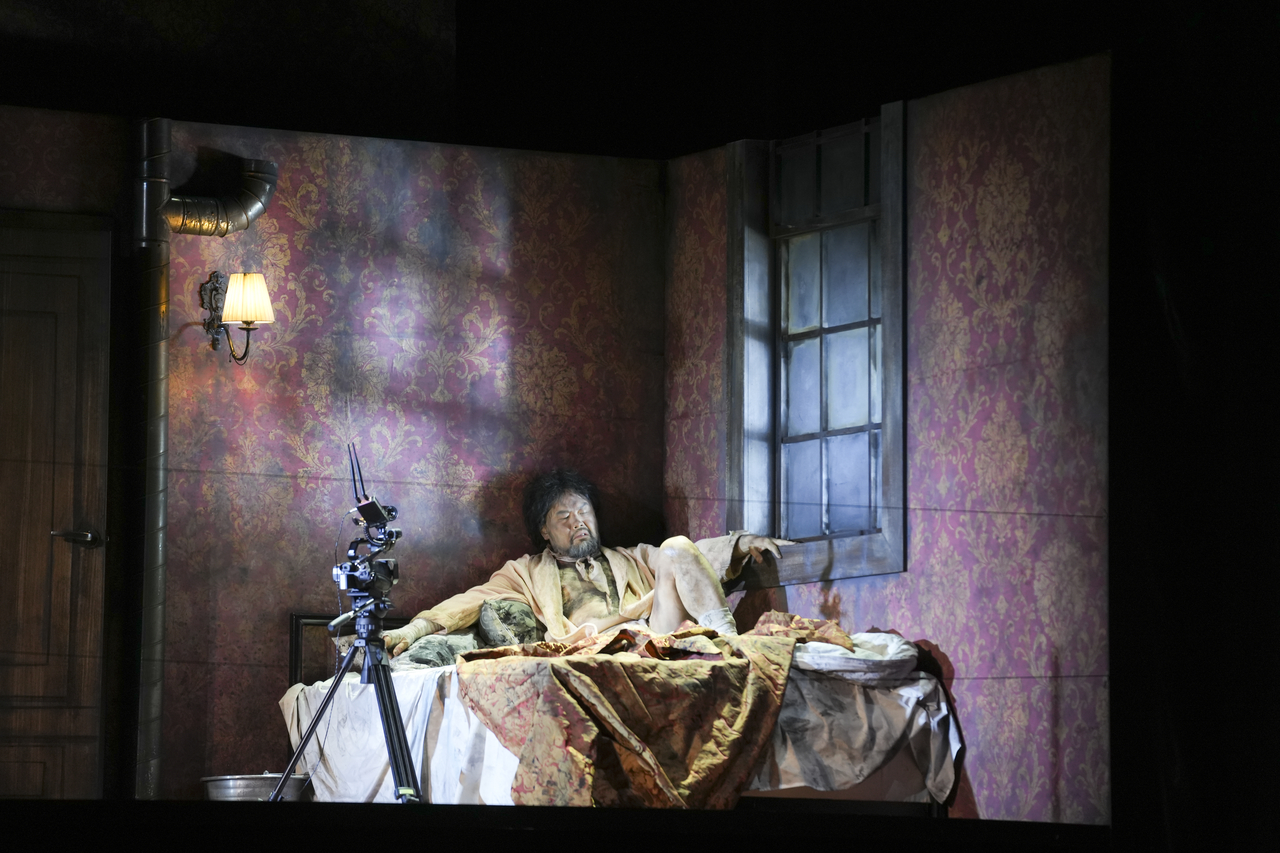
The waters of the Rhine are, as always, calm — even gentle. Richard Wagner's opening stage direction reads "Ruhig heitere Bewegung" (calm, cheerful motion), and the prelude in E-flat major, in 6/8 time, begins with a single deep E-flat from the double basses. By the fifth measure the bassoons stir; by the sixteenth, eight horns awaken one by one. As the strings surge and swell — the moment when the dim green Rhine should bloom into full life, or rather before the "primordial sound" itself takes shape — a man is already crumpled on the stage, lying in wait.
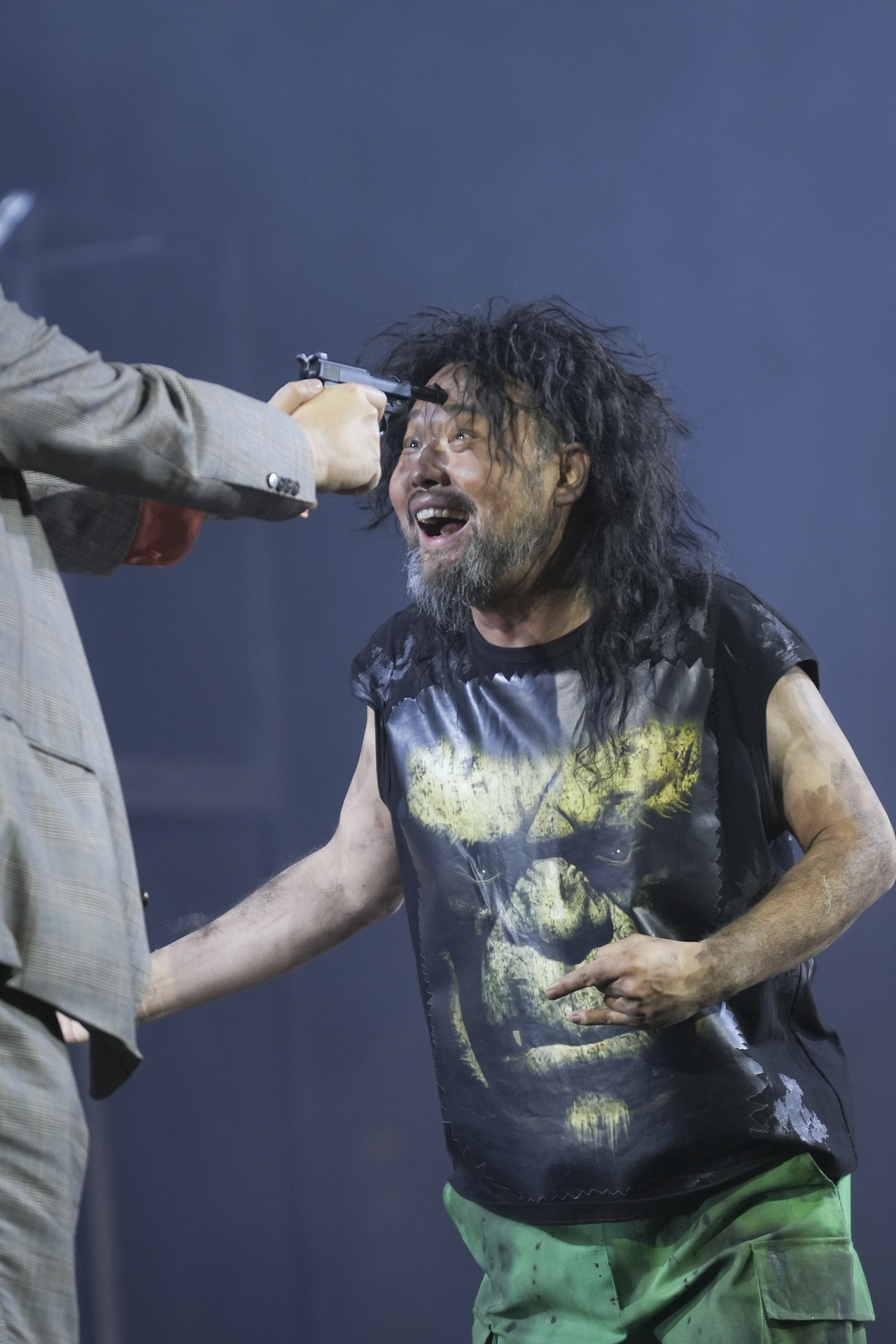
The setting is a run-down inn in some urban slum. The long-term lodger looks utterly destitute. A musty corner of a room that seems impossible in the 21st century is his cradle. His beard and hair are matted and tangled; grime is stamped across his bare body like a seal. He still makes some effort at grooming, trimming his body hair and nails with a grimy kitchen knife. There is something deeply unsettling about him — like a feral dog starved down to pure instinct, or a predator waiting for prey. Through all 136 measures of the Rhine melody, the stage refuses to yield a single glimmer of water.
His name is Alberich, a dwarf of the Nibelung race. Wagner's life work, "Der Ring des Nibelungen" — 26 years in the making — sets sail from this damp room in Seoul. This is "Das Rheingold," the historic opening chapter of the Korea National Opera's full Ring Cycle, a self-produced undertaking that will continue through 2029.
One hundred and fifty years after the complete four-part cycle premiered at the Bayreuth Festspielhaus in 1876, "Das Rheingold" tore open the Korean Ring in an uninterrupted 150-minute surge with no intermission. Director Lorenzo Fioroni, who previously collaborated with the company on "The Love for Three Oranges" last year, boldly strips the Nordic myth of its classical armor and transplants in its place the contradictions of 21st-century capitalism and the blind hunger for power. What remains once the mysticism is peeled away is a brutal ladder of exploitation.
From the top of the ladder to the bottom
"Das Rheingold" is a blood-soaked chronicle of those who claw their way up from the floor and those who, having seized a higher rung, grind others underfoot to stay there.
The work serves as the prologue to Wagner's four-part, roughly 15-hour epic "Der Ring des Nibelungen," compressing into a single act the origins and circumstances of the catastrophe that will drive the three full operas to follow — "Die Walküre," "Siegfried" and "Götterdämmerung."
At its core, the drama asks how gold — a mysterious gift of nature — is corrupted into a chain of power and greed. Alberich, the dwarf, renounces love forever and steals the Rhinemaidens' gold, forging from it the all-powerful ring that will dominate the world. Wotan, king of the gods, had promised the giants the earth itself as payment for building Valhalla; to avoid surrendering it, he resorts to deception and violence to wrest the ring from Alberich. The dwarf's blood-soaked curse as the ring is torn from him foreshadows the coming end of the world, and on that prophecy the grand prologue closes.
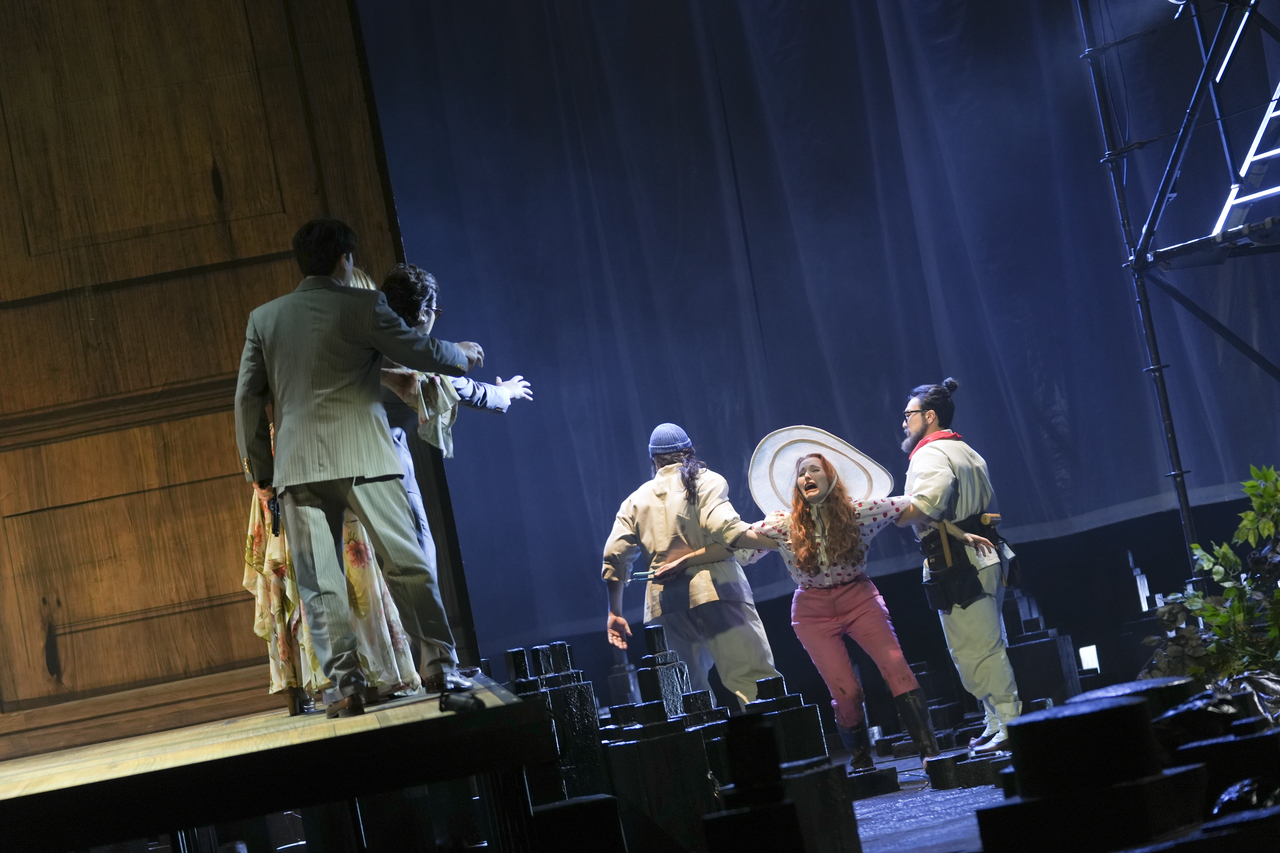
Every character in the drama violates every other. The gods exploit the labor of the giant brothers to raise their magnificent fortress, then scheme to cheat them of fair payment. The giants demand the goddess of youth, Freia, as collateral for the debt. Alberich, having utterly renounced love and seized the ring's power, reduces his own Nibelung kin to slaves. Wotan, the supreme ruler at the apex of power, ensnares Alberich through cunning and plunders the underground wealth entire. Those at the top control, exploit and humiliate those below. In the mechanics of greed, power once tasted never stops itself.
The opera is, in effect, a parade of villains. Yet the production's cold dread comes not from the wrongdoing of its obvious antagonists but from the "disguised evil" committed by those who ought to be noble or pure. Tragedy is conceived in the hypocrisy of those who believe themselves superior by virtue of their ruling-class status.
In Wagner's libretto, the Rhinemaidens, rather than guarding the sacred gold, mock Alberich's appearance. They flee when he approaches and laugh when he reaches out. The trigger that drives the dwarf to curse love and seize the gold is humiliation.
Wotan, king of the gods, is fittingly the supreme hypocrite. He governs the world through contracts — the runes of those contracts are carved into his spear — yet he is nothing but a deceiver who treats the weight of his own agreements as trivial. Not content with extorting the giant brothers, he destroys Alberich and seizes the gold. That the "king of the gods" keeps stolen goods rather than returning them to their rightful owner confirms that corruption rules even the divine realm. He even tries to slip the ring onto his own finger before Erda's warning forces him, reluctantly, to let it go. Where Alberich's evil is raw, naked greed, the gods' wickedness wears the fine garment of order and justice — and is all the more contemptible for it.
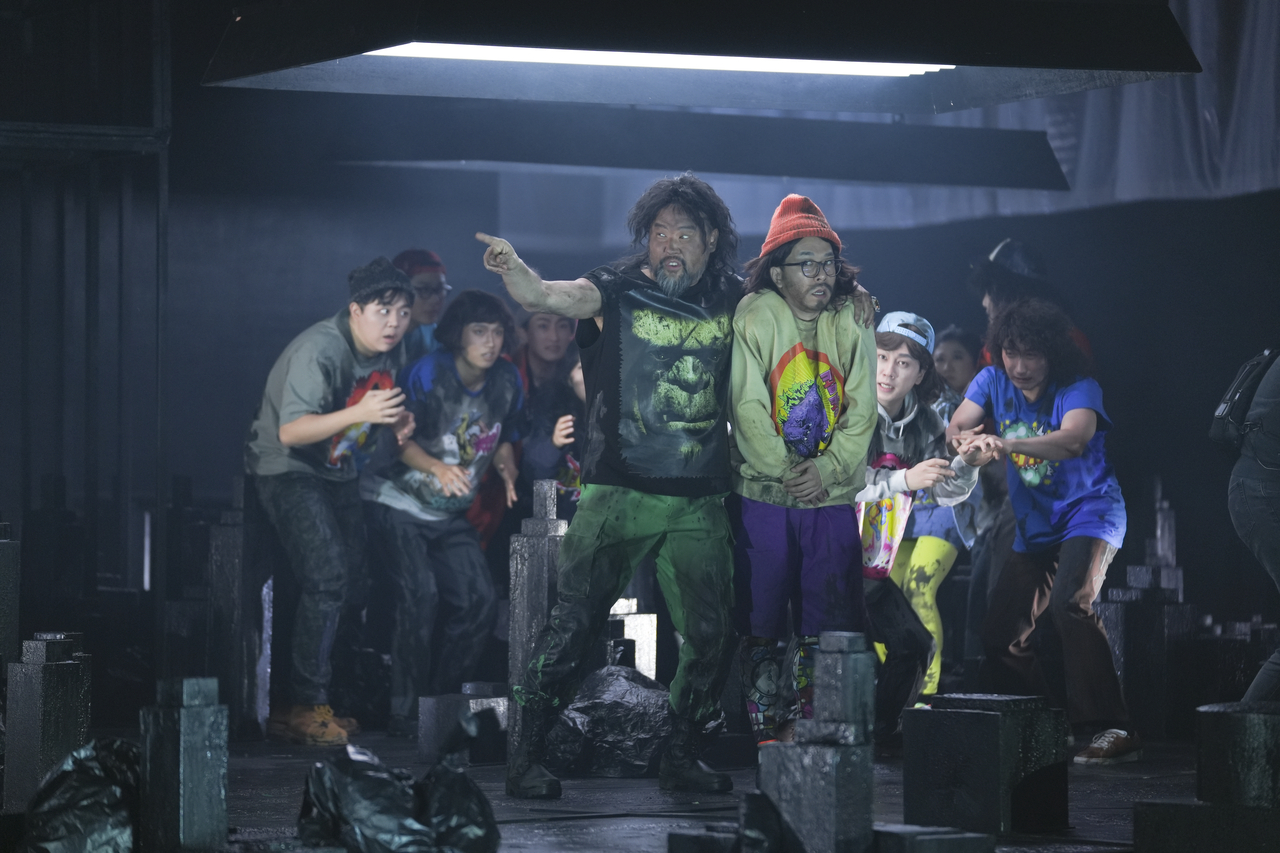
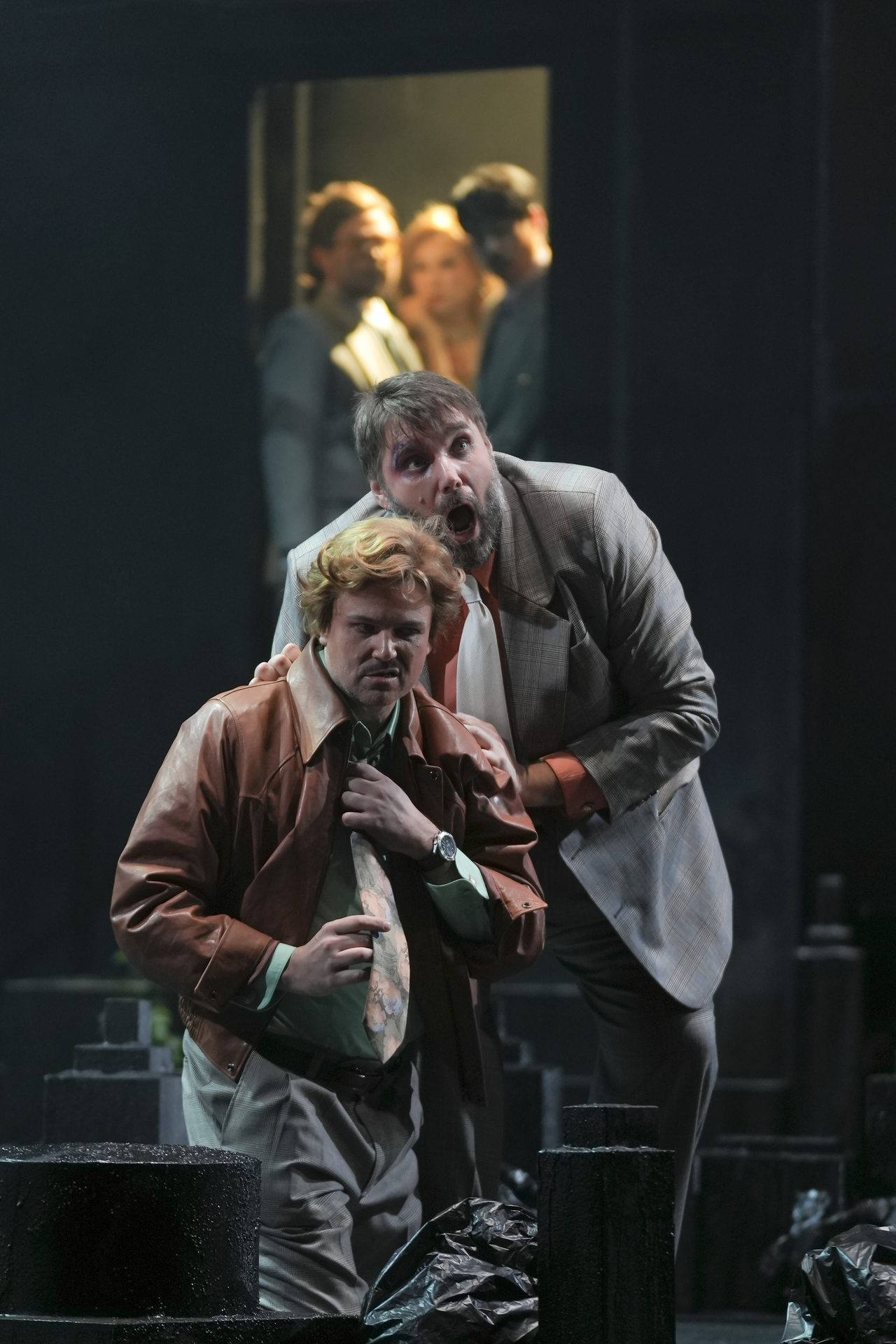
Fioroni clothes the ladder of power in contemporary dress. The mythic gold is replaced by thick wads of 50,000-won notes bearing the face of Shin Saimdang — the sacred transformed into a blunt symbol of materialism. The gods at the pinnacle of power evoke a mafia clan stepped out of a dated noir film: Wotan in a checked suit with a bruised eye, Loge the fire god in a blond wig and leather jacket playing the fixer who handles the dirty work. The giant brothers are laborers with tools dangling from their belts. At the bottom of the ladder, the Nibelungs swarm like a street gang from an urban slum. The time feels like the 20th century, or perhaps the 21st — the production refuses to pin down an era, leaving only the stark gap that capital and power have torn open.
At the end of every transaction comes the commodification of the body. In an unfinished mansion with only a chandelier hanging bare, banknotes rain down like a storm over Freia as she is handed over like a trafficking victim in lieu of construction fees — a catastrophic moment in which one being's dignity is measured by the volume of paper money. The curse does not wait. Among the giant brothers scrambling to gather the bills, Fafner strikes his brother Fasolt with a blunt weapon. It is the first fulfillment of Alberich's blood-soaked prophecy: "He who possesses it shall be consumed by care; he who does not shall be gnawed by envy." Wagner sounds the leitmotif of the curse again through the brass over this fratricidal slaughter. The ladder of greed does not merely collapse between classes — it shatters solidarity and blood ties within them as well.
Whose eye is the camera?
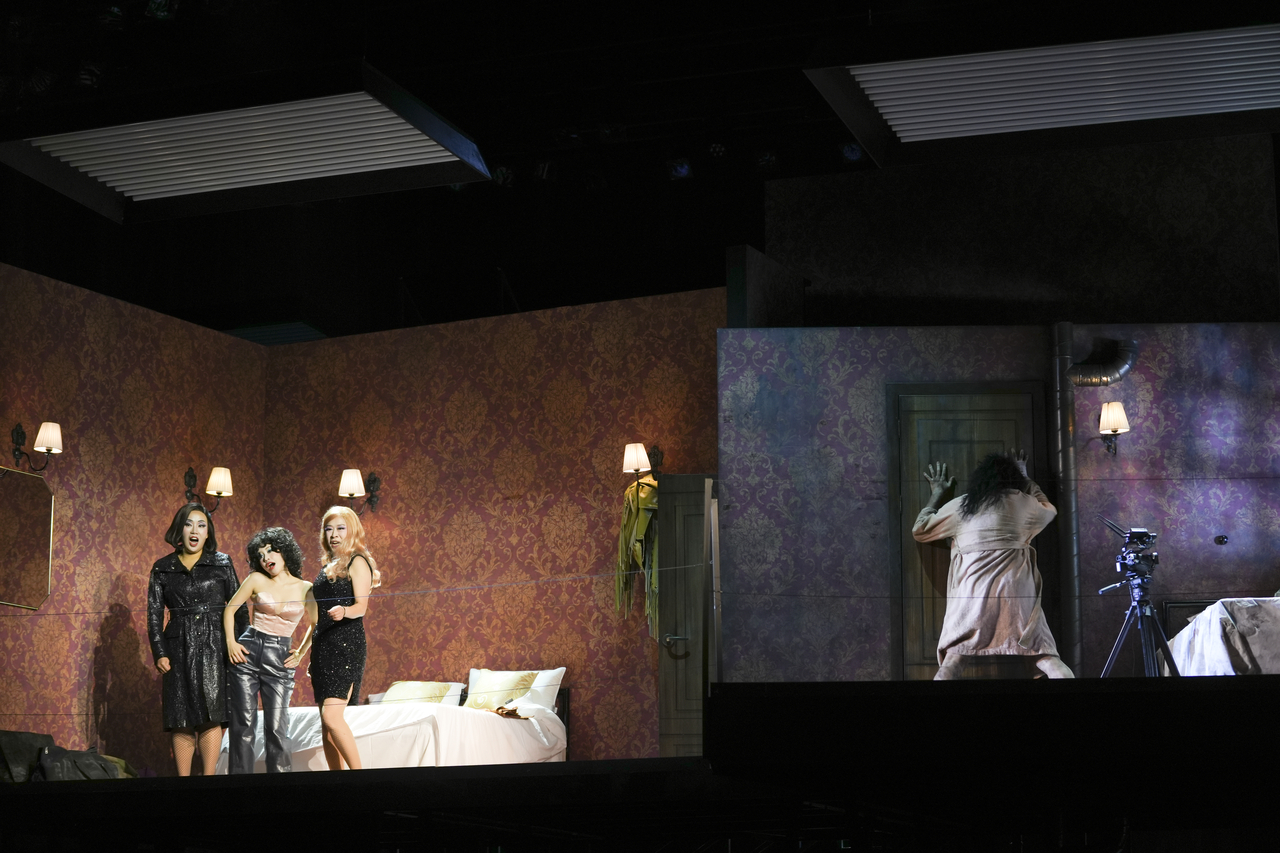
Two camera operators track the characters across the stage while two fixed cameras hold the corners. The live footage is processed through a console and reshaped in real time. Some scenes, filtered and regraded, take on the texture of old master paintings. Events behind the set, invisible from the house, are pulled onto the screen. Alberich at center stage appears simultaneously on the left screen as a giant with every pore exposed and on the right as a toy-like miniature. The expansion and contraction of power, its acquisition and loss, are translated visually through the physical scale of the subject.
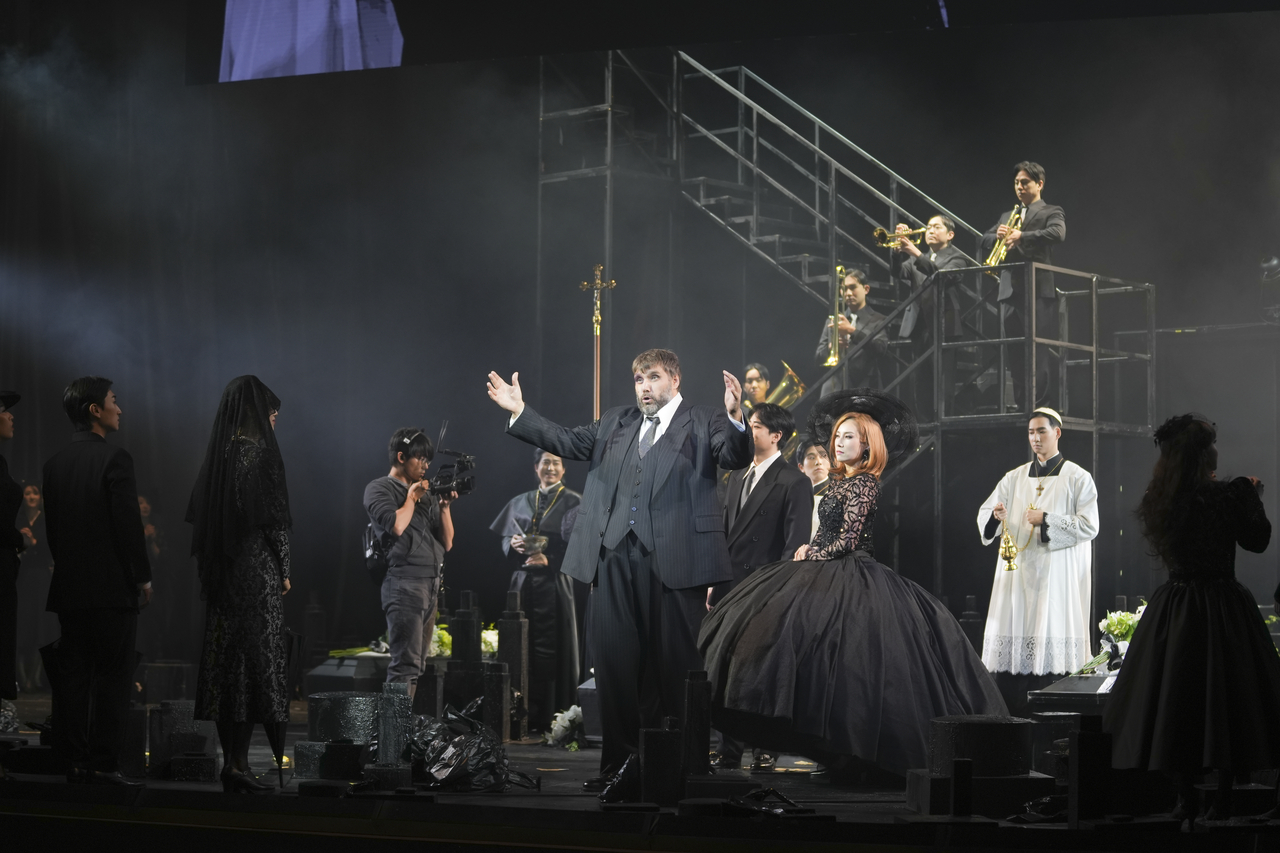
The lens mirrors the gaze of power. Just as Alberich, concealed beneath the magic helmet, surveils the Nibelungs, the camera looks down from above and peers from behind — giving the audience the uneasy sensation of voyeurs. What the lens lingers on most is the unguarded face of the powerless: eyes wide with terror, shoulders locked in fear, gestures of desire that cannot quite be suppressed. The weak, as seen through the eyes of the powerful, are this fragile. As the audience vicariously inhabits that surveilling gaze, it becomes complicit — a silent bystander who does not intervene.
The camera's eye and resolution were not consistent throughout. The live feed lost focus and shook at times, and in some moments the technique itself overwhelmed the narrative — the medium eclipsing the message. Some scenes produced a meaningless gaze in which no context could be read. Music critic Heo Myeong-hyeon said "an abundance of visual imagery does not in itself mean dramatic depth," adding that "quite a few scenes seemed to stop at the fact of using a live camera rather than using it to reveal the hidden layers or multiple textures of the work."
In Nibelheim, the underworld, the visual grammar reaches its peak. In the original, Alberich dons the magic helmet Tarnhelm and transforms into a giant serpent and then a small toad. In Fioroni's staging, the Nibelungs mass together, intertwining and contorting their bodies to form the shape of a giant reptile. The point is made visually: the absolute might of a tyrant is ultimately a house of cards built from the bodies of those he has crushed. In the interlude descending to Nibelheim, Wagner scored 18 anvils to beat out the pulse of slave labor. If that pulse is the sound of labor, then the serpent fashioned from the Nibelungs' bodies is the shape of the power that labor has built.
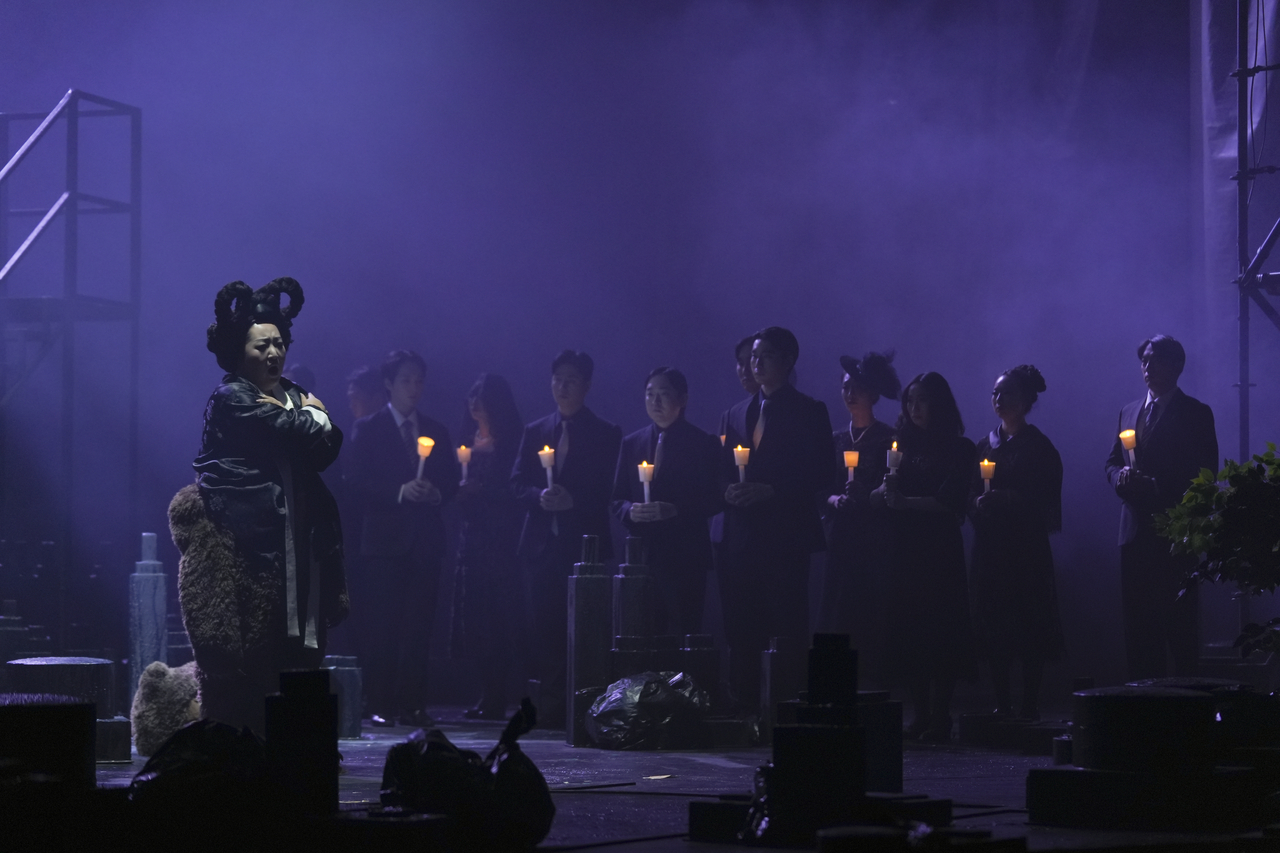
The production's directorial gestures toward contemporary Korean society were explicit. Erda, the earth goddess who carries primordial wisdom, appears as Ungnyeo — the bear-woman of Korean foundation myth — wearing a traditional hairpiece, a jeogori on top and a bear-costume bottom half. The solemn warning that foretells the doom of the gods landed in the house as a moment of bewilderment rather than awe.
Critic Heo said that "replacing Erda with Ungnyeo and hanging a protest placard reading 'enough greed' in hangul flattened the meaning Wagner was trying to convey," adding, "I found myself wondering whether this is how a foreign director sees Korea and the Korean language." The moment read as a reductive, orientalist gaze — one that failed to illuminate the mythological figure's individual significance and context. The excess of stage language ended up robbing the opera of the breathing room and resonance that belong to it.
The curse remains; Alberich disappears
Having been stripped of the all-powerful ring, Alberich delivers his agonizing curse — but his fate is left unresolved. Seen as a faithful rendering of the source material, this was actually a refreshing choice, departing from the tendency in European opera productions to depict Alberich's end with graphic violence.
Within the Ring Cycle, Alberich resurfaces in "Siegfried," hovering again around the ring, and in "Götterdämmerung" he works through his son Hagen to reclaim it. Still, the complete vanishing of the beast who had gripped the stage from the very first note left the opera's narrative tension in a vacuum. The silence — the obscured origin of the violence that ignited in that motel room — may be less a directorial misstep than the stillness before a storm, a deliberate space preparing for the catastrophe that will sweep through the next three years. That said, since the Korea National Opera plans to bring in a new director for each installment of "Der Ring des Nibelungen," it remains to be seen whether a common thematic thread will carry through after this first chapter.
What fills the void is a funeral. In the original, the gods cross the rainbow bridge and enter Valhalla. Far below, the Rhinemaidens weep, crying out for their stolen gold to be returned, and Wotan turns deaf ears to their lament. The words Wagner set to their final song read: "What is tender and true exists only in the depths; what rejoices up above is false and cowardly." Beneath the blazing fanfare of triumph, Wagner buried a frail and aching elegy.
Fioroni pulls that auditory irony into plain visual mockery. The scene is the funeral of the Rhinemaidens, slaughtered by Alberich in the first scene. The cartel of power, dressed in elegant mourning clothes, raises a toast among themselves while performing grief. Trumpet players line up on a great altar at the center of the stage as the magnificent melody of Valhalla's entry explodes. The victory fanfare rings out before a graveyard; the glory of the gods is a pavilion built upon corpses.
The music did not match the stage in clarity. Wagner scored six harps for the finale's wave of sound, but in the pit at Seoul Arts Center Opera House only two shared the burden. The horn section was also reduced, with 76 players in the orchestra overall. Critic Heo said the Korea National Symphony Orchestra "held its own, given that this is unfamiliar repertoire," but noted that "the balance between instruments was often off, leaving many leitmotifs insufficiently prominent, and whenever the music grew even slightly complex the fine-grained structure failed to emerge." What ultimately held the flow together was conductor Lothar Koenigs. The music found considerably more stability as the production moved into the third and fourth scenes. Heo agreed: "It was ultimately the conductor who kept the music moving without serious mishap."
The greatest discovery of this inaugural Korean Ring Cycle was its Korean vocal cast. Samuel Yun and Yang Jun-mo as Alberich, Ryu Ji-sang as Fasolt, Kim Dae-young as Fafner and Lee Dan-bi as Erda — all in single-cast roles — delivered outstanding work. Heo said, "It made me realize just how many fine singers Korea has," adding that "Samuel Yun led the entire production in both performance and singing, and even the giants, relatively smaller roles, were solid."
The challenges ahead for the opera world, now that "Das Rheingold" has been safely staged, are equally clear. Starting with "Die Walküre," set to take the stage next year, the dramatic arc more than doubles in length and the orchestration grows considerably more complex. Heo said the problem "cannot be solved through short-term training and rehearsal," and that "the task for the remaining Ring journey is to raise the orchestra's capacity by performing Wagner's repertoire more frequently."
shee@heraldcorp.com