- KAIST, Jeonbuk National University team identifies mechanism that inhibits clumping of dementia-linked protein
- Mouse study shows reduced brain inflammation, partial memory improvement
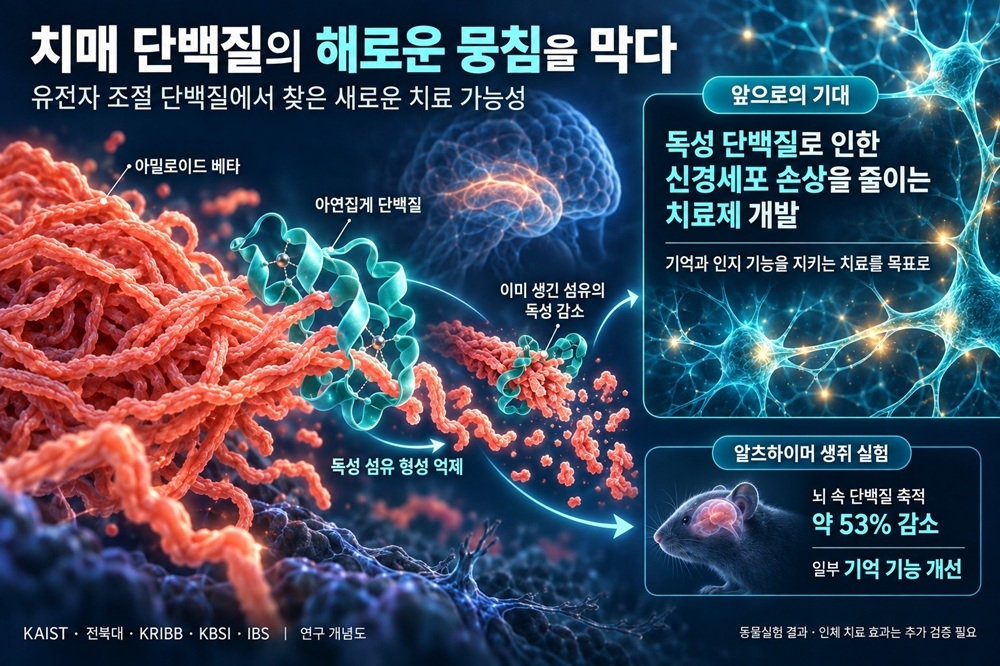
South Korean researchers have developed a new technology that prevents toxic brain proteins linked to dementia from clumping together and also reduces the toxicity of aggregates that have already formed. In mouse experiments modeling Alzheimer's disease, the team cut the accumulation of toxic proteins in the brain by about 53% and improved some memory functions — a promising sign for the development of new treatments for the hard-to-treat condition.
KAIST announced Thursday that a research team led by Professor Lim Mi-hee of its Department of Chemistry, working jointly with Professor Lee Seung-jae of Jeonbuk National University, researchers Lee Cheol-ho and Kim Kyung-shim of the Korea Research Institute of Bioscience and Biotechnology, Lee Young-ho of the Korea Basic Science Institute and Park Ji-yong of the Institute for Basic Science, had identified a new mechanism for controlling the aggregation and toxicity of proteins associated with Alzheimer's disease.
Alzheimer's disease is a degenerative brain disorder in which a protein called amyloid beta abnormally clumps and accumulates in the brain, damaging nerve cells. When the protein aggregates into long, rigid fibrous structures, it can impair neuronal function and trigger brain inflammation.
The research team focused on zinc finger proteins, which are known for their role in regulating gene activity. These proteins use zinc ions to maintain a stable three-dimensional structure and recognize DNA or RNA.
The team confirmed that a specific segment of the zinc finger protein, designated ZF2-4, binds directly to amyloid beta.
The key advance lies not in simply removing the toxic protein, but in changing the way it aggregates.
When ZF2-4 binds to amyloid beta, the growth of highly toxic long fibrous structures is suppressed. Instead, relatively less toxic non-fibrous aggregates form. When applied to already-formed toxic fibers, ZF2-4 converted the fibrous structures into shorter, thinner forms, reducing cellular toxicity.
The team also developed a method to deliver the protein directly to the brain. Because the blood-brain barrier blocks the entry of foreign substances, delivering therapeutic proteins to the brain is difficult. The researchers created a compound called ZF2-4-P9 by attaching a substance that helps cross the blood-brain barrier to ZF2-4.
When administered to Alzheimer's-model mice, ZF2-4-P9 reduced amyloid beta deposits in the cerebral cortex and hippocampus by about 53% each compared with a control group.

The activation of microglia — immune cells associated with brain inflammation — also fell by about 29% in the cerebral cortex and about 50% in the hippocampus, the region responsible for memory and learning.
Behavioral tests showed improvement in recognition memory, specifically the ability to distinguish between familiar and new objects. However, no statistically significant improvement was observed in other memory and learning assessments.
The study is significant because it presents a new therapeutic strategy that uses an existing gene-regulatory protein to directly control the structure and aggregation process of dementia-linked toxic proteins.
The research remains at the animal-testing stage, however, and further verification of long-term safety and therapeutic efficacy will be needed before the approach can be applied to human patients.
"This research demonstrated that zinc finger proteins, well known as gene-regulatory tools, can directly bind to disease-causing proteins and suppress pathological aggregation," Professor Lim said. "Applying this principle should help in designing new protein-based therapeutics that target specific disease proteins in the future."
The findings were published online Sept. 30 in the international journal Advanced Science.
nbgkoo@heraldcorp.com