Operating profit guidance raised from 13.5 billion won to 17 billion won after shedding underperforming subsidiaries; 'Uisarang AI' passes 1,300 pilot sites within a month of launch; cloud EMR due next year ahead of full monetization in 2027
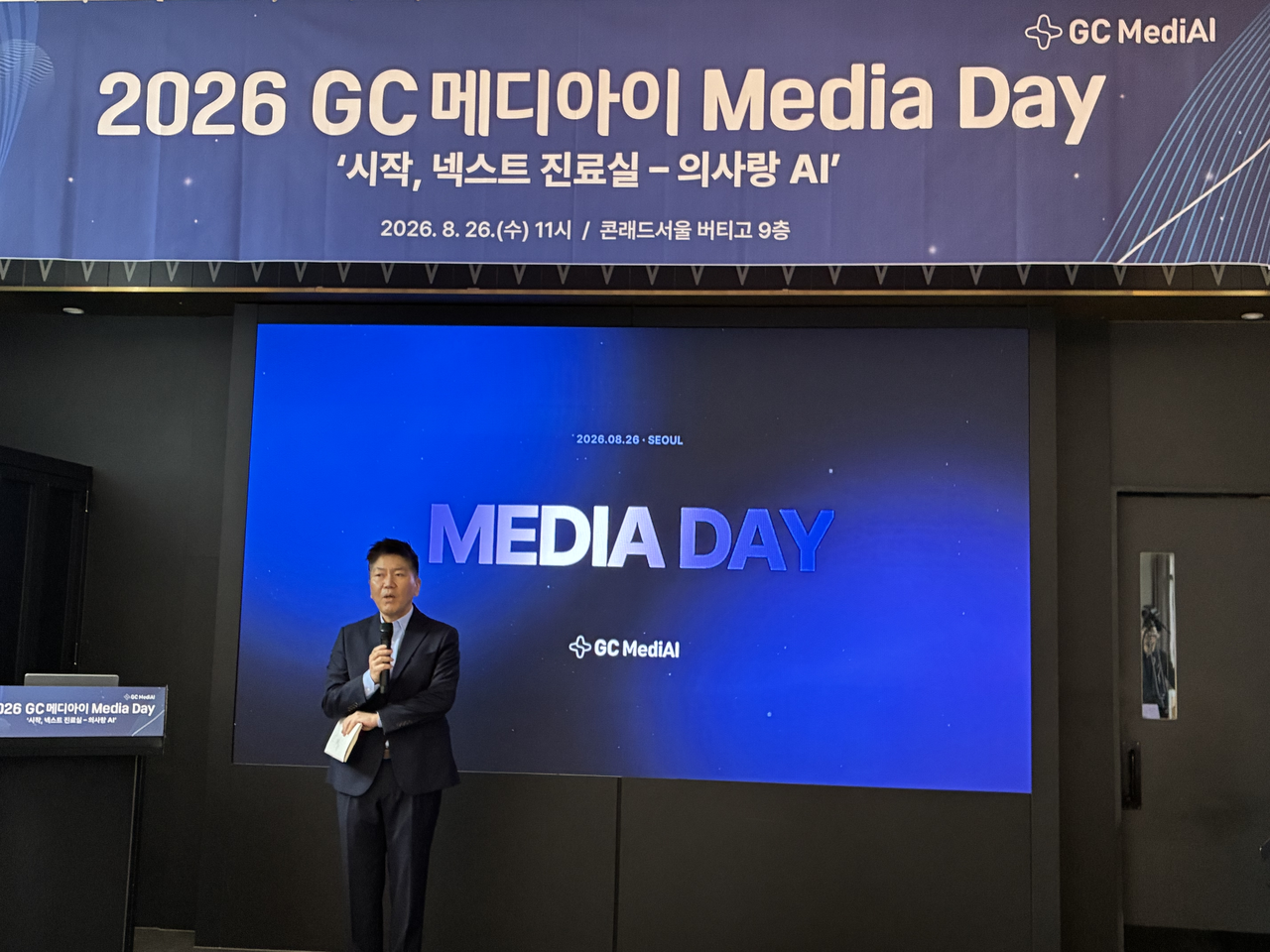
GC MediAI, the top provider of electronic medical record systems for primary care clinics in South Korea, has raised its annual operating profit guidance for this year by 26 percent.
The upward revision reflects a restructuring effort that shed loss-making subsidiaries alongside the accelerating growth of AI, data and platform businesses centered on its flagship EMR product, Uisarang.
GC MediAI recently filed a revised guidance disclosure, lifting its 2026 consolidated operating profit forecast by 25.9 percent — 3.5 billion won — from 13.5 billion won ($10.1 million) to 17 billion won. Its sales guidance was revised down over the same period, from 218.2 billion won to 174.4 billion won.
The adjustment reflects the removal of subsidiary Hecton Project — in which GC MediAI holds a 75 percent stake — from its consolidated results following a partial business transfer. Hecton Project, which operated a senior-care platform and a welfare-equipment shopping mall, had weighed on consolidated earnings, posting a net loss of 4.7 billion won in 2025.
KB Securities said in a research note that GC MediAI is strengthening its bottom line by divesting stakes in underperforming subsidiaries, including Crenner Health Comm and Hecton Project, as it upgrades its business model toward an AI-integrated Medical OS platform.
The earnings recovery was already visible in the first half of this year. GC MediAI posted consolidated sales of 101.4 billion won in the first half of 2026, up 7.9 percent from a year earlier, while operating profit surged 302.3 percent to 6.2 billion won. Growth was broad-based, driven by add-on solution sales to existing EMR customers — including CRM, Lab and VAN 2D tools — higher average revenue per user, expansion of the online medical shopping mall Misomall.com, and the consolidation of platform subsidiary Bibros, operator of the Ddocdoc app.
Alongside the structural overhaul, the company unveiled a next-generation EMR, Uisarang 2.0, at the Korea International Medical and Hospital Equipment Show in March, with enhanced clinical efficiency features. In September it began a pilot rollout of a version with built-in AI capabilities.
Uisarang AI summarizes a patient's five-year medical history in five seconds when the patient enters the consultation room, and uses real-time speech-to-text recognition to automatically generate SOAP clinical notes from the doctor-patient conversation. The company says the system cuts consultation time by 60 percent and charting time by 50 percent, while automatically generating insurance claim files and sending advance alerts on reduction risks — reducing claim processing time by 80 percent.
Within a month of its pilot launch, more than 1,300 existing customers had applied to use Uisarang AI, with about 800 sites now using it in live clinical settings. The company plans to secure adoption references at more than 6,000 sites by year-end before moving to a phased paid model in 2027.
The company's medium- to long-term strategy calls for a fundamental shift away from its traditional installed-software business toward an open platform — the Medical OS — that connects the broader healthcare ecosystem.
GC MediAI plans to officially launch a cloud-based EMR in March 2027 and open its network of roughly 25,000 clinics and pharmacies nationwide — about 16,000 clinics and hospitals and about 8,300 pharmacies — as a gateway for third-party services.
The move is designed to diversify revenue beyond monthly maintenance fees into high-margin streams: precision digital marketing for pharmaceutical companies through its LiveInfo service, API integration fees for external solutions, brokerage commissions on insurance and financial transactions such as Silson24, and data trading.
In addition, the company plans to launch a consumer-facing personal health assistant service in the second half of next year, linked to Ddocdoc — a mobile healthcare platform with 11 million verified members — to provide patients with personalized hospital recommendations, appointment booking and medication management.
CEO Kim Jin-tae, appearing on the economics YouTube channel Sampro TV, said the company expects to hit its 17 billion won operating profit target this year as its high-margin AI and data platform businesses expand, after years in which fixed costs held operating margins at just 3 to 4 percent under the traditional software distribution model. "Next year, we are also hoping to break through 20 billion won in annual operating profit," he said.
Kim said clinical prescription and treatment data are trained and processed exclusively within the company's own Nvidia server infrastructure, with no data leaving to external servers. "Based on unrivaled data optimized for South Korea's medical regulations and insurance environment, we will make the leap to become a Medical OS company connecting doctors, patients and pharmaceutical companies," Kim said.
silverpaper@heraldcorp.com