Hydrogen city diorama brings ecosystem to life for general visitors
China, Japan and EU expand policy support across full hydrogen value chain
85% of domestic hydrogen firms are small or midsize — policy backing needed
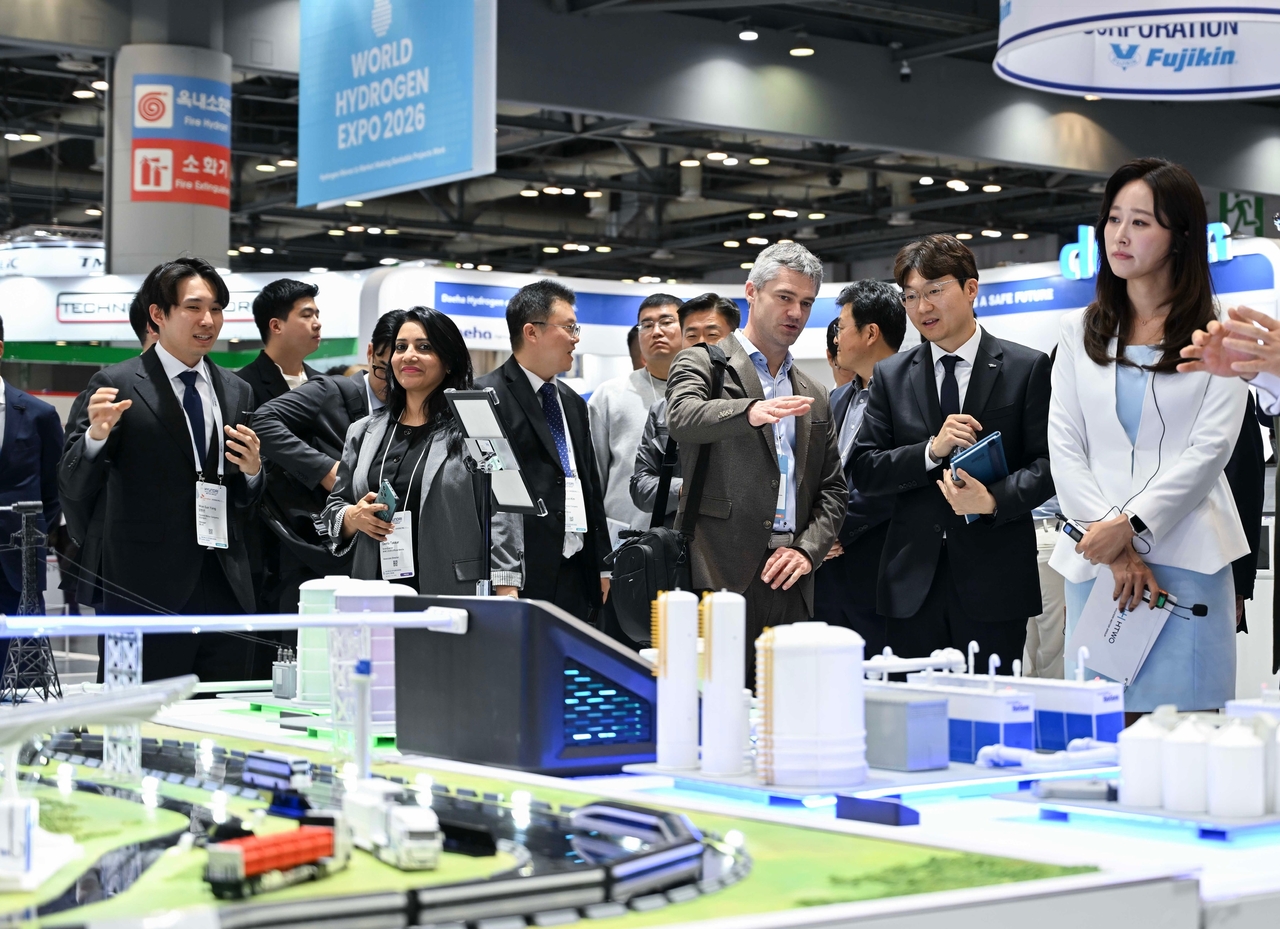
Hyundai Motor Group presented a vision of a hydrogen ecosystem spanning cities and industries at World Hydrogen Expo 2026 (WHE 2026), held at KINTEX in Goyang, Gyeonggi Province. The group aims to show that hydrogen's industrial value is realized not through individual companies or a single technology, but through an ecosystem linking production, storage, transport and end use.
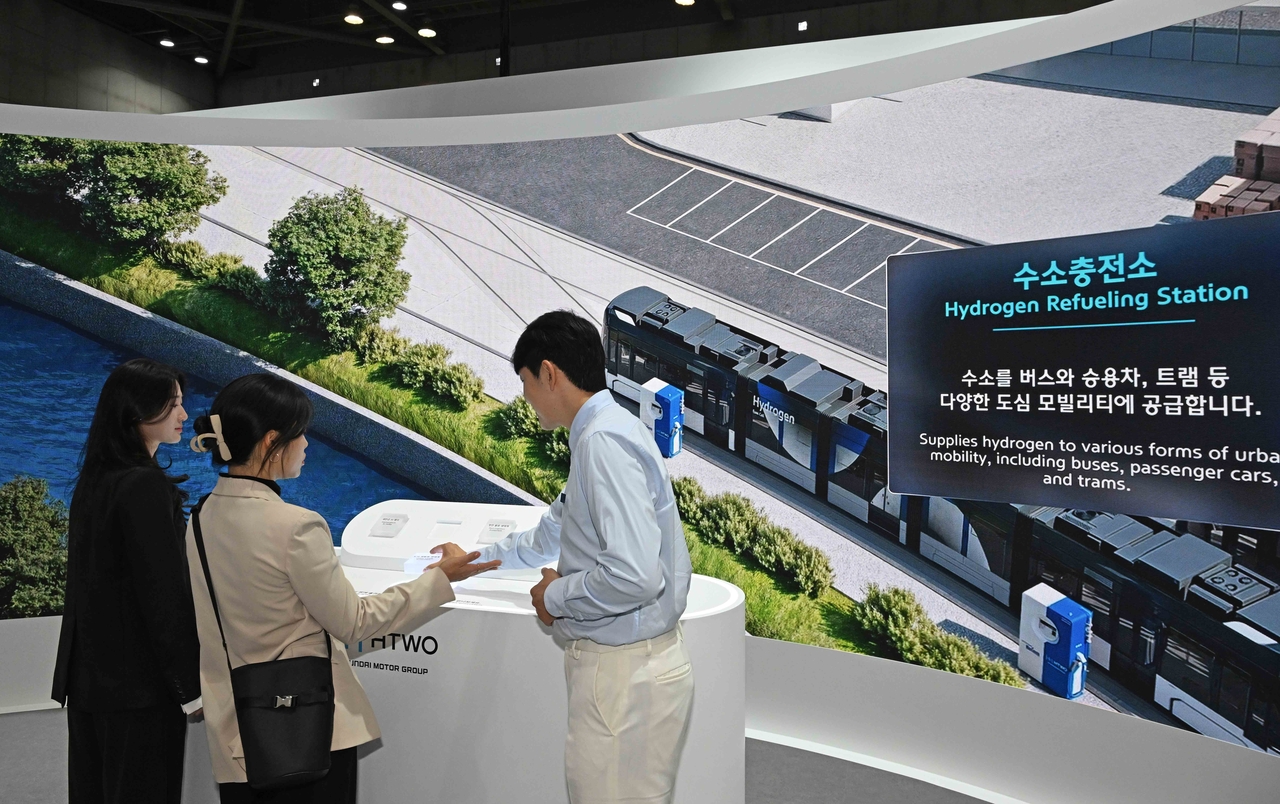
Hyundai Motor Group said Thursday it is participating in the event, which runs Wednesday through Friday at KINTEX Hall 2, showcasing implementation cases covering hydrogen production, storage, supply and utilization. The group prepared a hydrogen city diorama and scenario videos to help general visitors understand the need for a hydrogen ecosystem.
The hydrogen city diorama depicts a future city in which the entire value chain — hydrogen production infrastructure, storage and supply facilities, hydrogen fuel cell vehicles and rail cars — is connected as a single ecosystem. The display incorporates renewable energy sources, an AI data center, a robot manufacturing factory and an electrolysis plant.
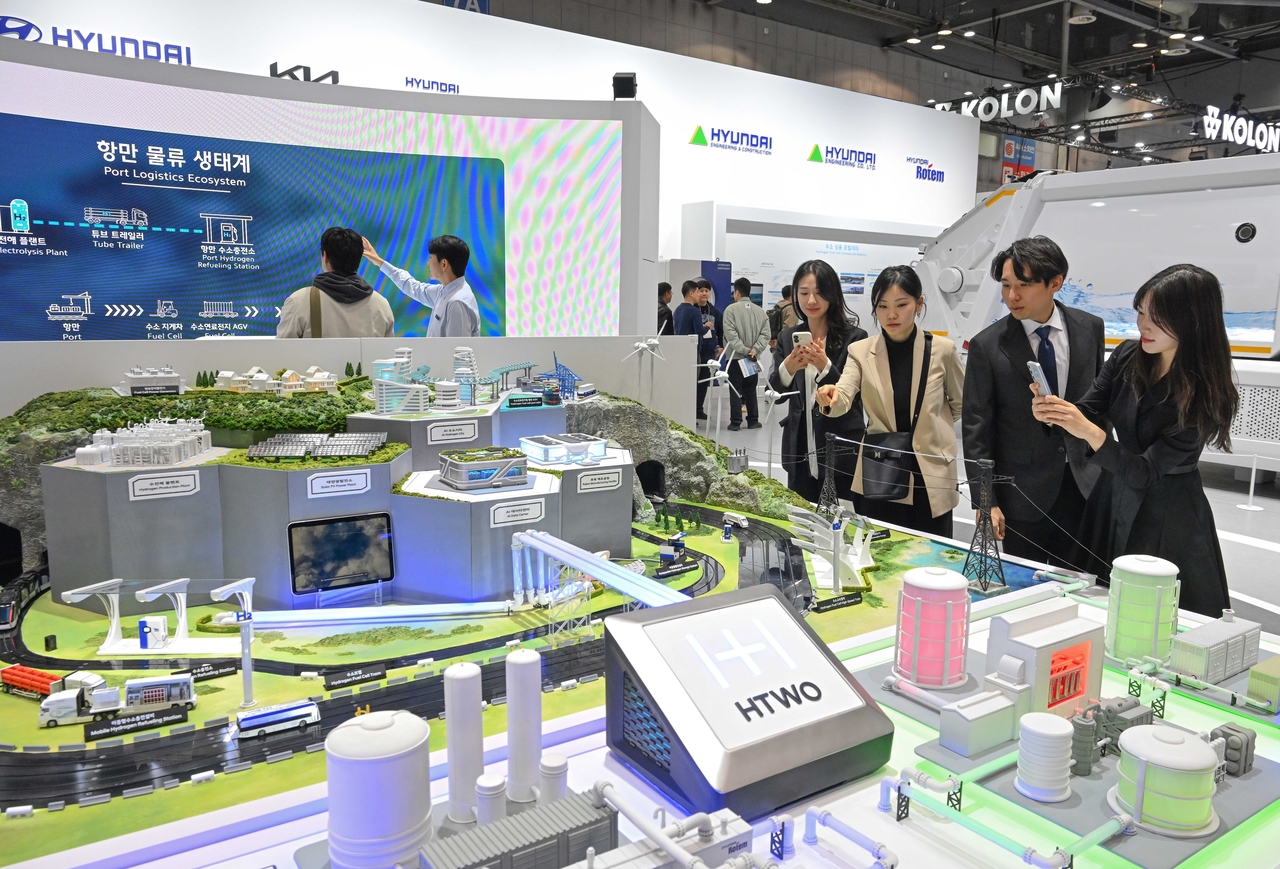
The video exhibition is built around four scenarios: the Saemangeum AI Valley, urban lifestyle, port logistics and manufacturing industry. The Saemangeum AI Valley scenario covers a locally produced and consumed ecosystem in which hydrogen generated from renewable energy is used for city power, thermal energy and mobility fuel. The urban lifestyle scenario shows a resource-circulation model in which hydrogen derived from organic waste such as food scraps powers electricity and heating in residential complexes and fuels buses, passenger cars and trams.
The port logistics scenario depicts renewable-energy-based hydrogen being supplied to port equipment such as automated guided vehicles, with hydrogen fuel cell trucks and hydrogen fuel cell locomotives linking in-port transport to overland and rail freight. The manufacturing industry scenario covers the use of hydrogen as a reducing agent and heat source for iron ore, the transport of finished steel sheets by hydrogen fuel cell truck, and the use of hydrogen fuel cell forklifts and hydrogen burners at finished-vehicle factories.
Hyundai Motor Group said hydrogen cannot easily realize its industrial value through individual companies or a single technology alone, and that the full value chain — from production and storage to transport, supply infrastructure and mobility and industrial demand — must be connected for its potential to grow.
Major economies are also broadening policy support to cover the full hydrogen value chain. China finalized its 15th Five-Year Plan in March, designating hydrogen as a new engine of economic growth. Beijing is concentrating policy resources on linking the entire life-cycle value chain — from production and storage to transport and utilization of clean, low-carbon hydrogen — and on expanding end-use demand.
Japan has been pursuing the development of clean hydrogen supply chains, demand creation in the industrial and power sectors, and the establishment of hydrogen hubs, following its 2023 revision of the Basic Hydrogen Strategy and the 2024 enactment of the Hydrogen Society Promotion Act. The EU has been using the European Hydrogen Bank, introduced in 2023, to cover the gap between clean hydrogen production costs and market prices. Hyundai Motor Group said the mechanism is expected to bring about the introduction of roughly 3 gigawatts of electrolysis capacity and the production of approximately 3.44 million metric tons of hydrogen over the next 10 years.
Most companies in South Korea's hydrogen industry are small or midsize enterprises. According to the Korea Hydrogen Alliance's 2025 Hydrogen Industry Survey, there were 2,932 domestic hydrogen industry companies and 36,264 employees as of 2024. By segment, hydrogen utilization accounted for 1,261 companies, hydrogen retail for 833, hydrogen-related services for 426 and hydrogen production for 412. Of these, 85 percent are small or midsize enterprises.
Some 82.7 percent of companies lack a dedicated research and development department. Investment in the hydrogen industry grew only 4.6 percent, from 4.15 trillion won in 2022 to 4.34 trillion won in 2024. Hyundai Motor Group said a stronger ecosystem could accelerate companies' technology commercialization and return on investment while broadening opportunities for overseas expansion. Experts say this will require expanding end-use demand into steel, manufacturing, port logistics and urban energy, as well as building out supply infrastructure and supporting early-stage commercialization.
"As the competitive axis of the hydrogen industry shifts from individual technologies and products to ecosystems, ecosystem competitiveness will determine who leads the global hydrogen industry," an industry official said. "Domestically, large, midsize and small companies need to work together to broaden the industrial base, and policy support is needed to expand demand and infrastructure."
eyre@heraldcorp.com