Housing sector up 7.8-fold to 1.7 trillion won, accounting for 60% of total; experts call for tighter management of loan balances and fiscal risks
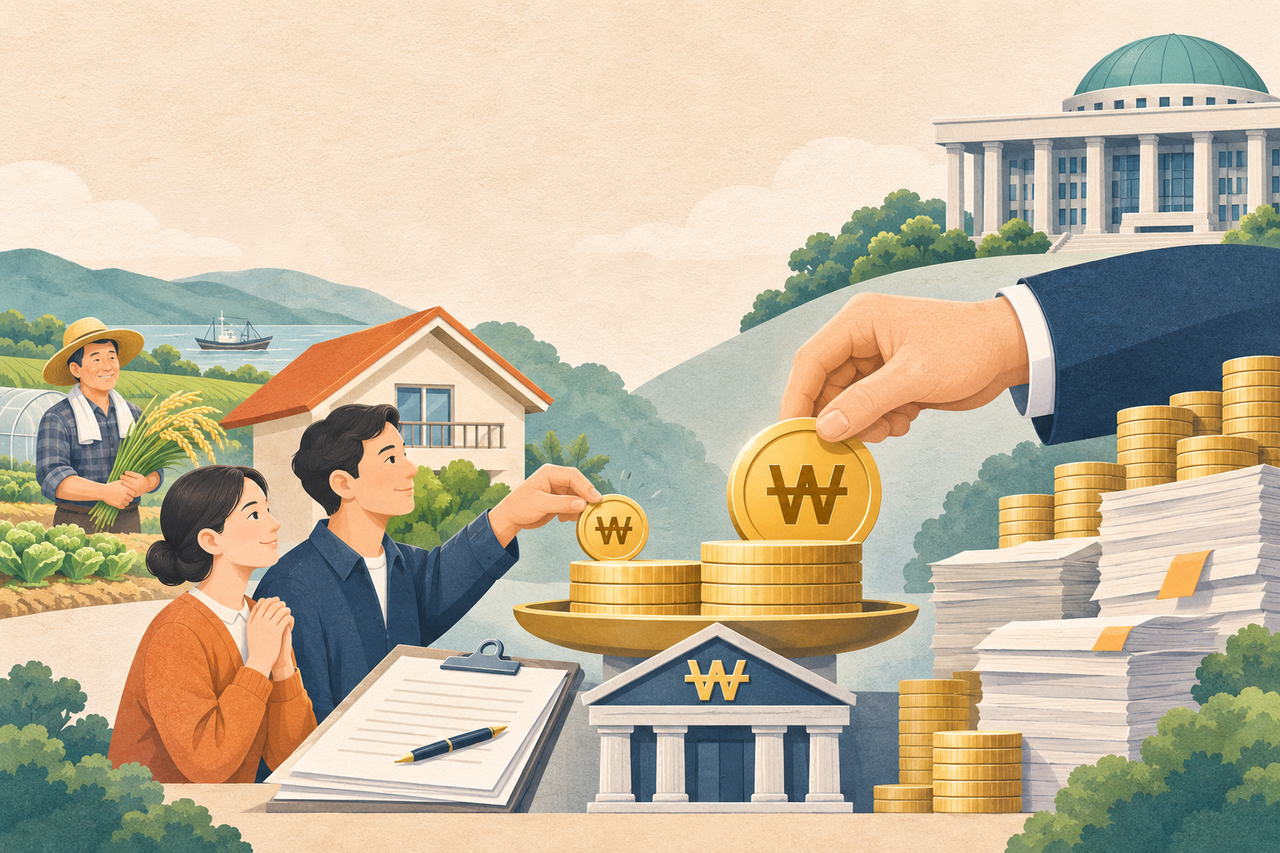
The government's interest subsidy costs for keeping policy loan rates low for ordinary borrowers and farmers surpassed 2.8 trillion won ($2.09 billion) last year — roughly four times the level of six years ago. The housing sector alone accounted for 60 percent of the total, with its subsidy costs growing nearly eightfold over the same period. Experts say the outstanding loan balances tied to these subsidies must be managed alongside the broader fiscal risks they create.
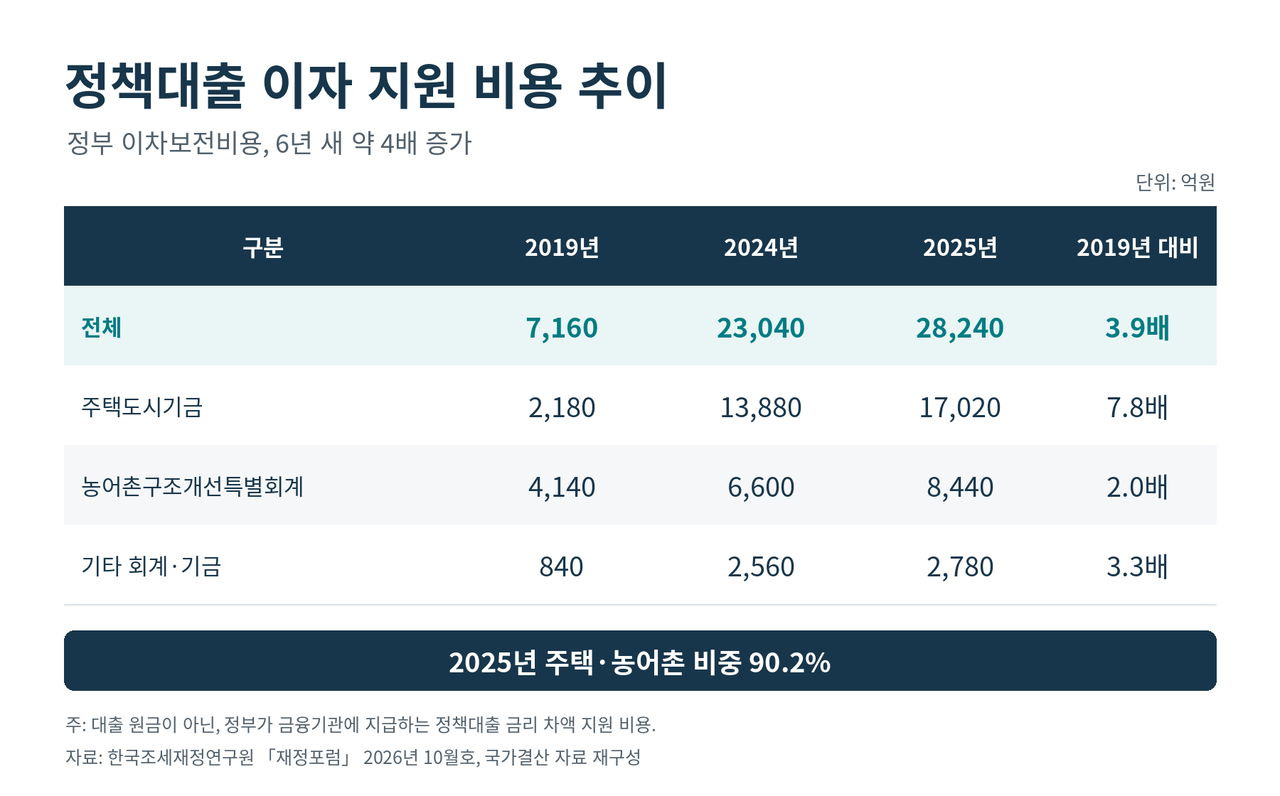
According to national settlement data compiled by the Korea Institute of Public Finance and released Friday, the government's total interest subsidy costs reached 2.82 trillion won last year, up about 3.9 times from 716 billion won in 2019. The figure also rose 520 billion won, or 22.6 percent, from 2.3 trillion won in 2024.
Interest subsidies work by having the government cover the gap between the rate charged by banks or cooperatives on policy loans and the lower rate borrowers actually pay. Rather than lending money directly, the government pays financial institutions the difference each year, generating recurring fiscal expenditure as long as the low-rate support remains in place.
The housing sector has seen the sharpest rise. Interest subsidy costs under the Housing and Urban Fund climbed from 218 billion won in 2019 to 1.39 trillion won in 2024 and then to 1.7 trillion won last year — a 7.8-fold increase over six years. The fund alone accounted for roughly 60 percent of the government's total increase in interest subsidy costs last year, adding 314 billion won in a single year.
The housing sector's share of the government's low-rate support has shifted dramatically. In 2019, the Special Account for Agricultural and Fishing Villages Structural Improvement carried interest subsidy costs of 414 billion won, nearly double the Housing and Urban Fund's 218 billion won. Housing overtook the rural sector in 2021, and the gap has widened since. Last year, the Housing and Urban Fund's share reached 60.3 percent of the total.
The Special Account for Agricultural and Fishing Villages Structural Improvement, which supports agricultural and fisheries policy financing, also more than doubled its interest subsidy costs, from 414 billion won in 2019 to 844 billion won last year, representing 29.9 percent of the total. Together, the housing and rural sectors accounted for 90.2 percent of all interest subsidy costs. The remaining accounts and funds — including the Military Welfare Fund and the Small and Medium Venture Business Promotion Fund — totaled 278 billion won.
The surge in interest subsidy costs has been driven largely by rising market interest rates. As lending rates at financial institutions climbed from 2022 onward, the rates charged to policy loan borrowers were held relatively low, widening the gap the government must cover. Because subsidy costs are determined by both the rate differential and the outstanding balance of supported loans, a rise in market rates increases the government's burden even when the loan volume stays the same.
For borrowers who need policy financing, low-rate loans serve as a buffer against the shock of rising rates. However, policy loans funded through banks are not recorded as loan assets on the government's balance sheet — unlike direct government lending — and only the annual interest subsidy payments appear as expenditure. This makes it difficult to gauge the total outstanding balance of supported loans and the full future fiscal burden from the annual subsidy figure alone, since that figure fluctuates with both the loan balance and the spread between market and policy rates.
While interest subsidy budgets are reviewed by the National Assembly each year, assessing the medium- to long-term burden requires tracking the outstanding balances, interest rate terms, and repayment schedules of the supported loans as well. Experts say a comprehensive view — covering not just annual outlays but future fiscal obligations — is essential.
"The government must make the costs and risks it bears for public purposes fully transparent, providing the evidence base needed for rational policy choices," said Yun Young-hun, a visiting research fellow at the Korea Institute of Public Finance. "Aligning financial reporting with economic reality is a task that cannot be deferred."
fact0514@heraldcorp.com