A disputed question on this year's electrical engineer practical exam has reignited calls for answer-key disclosure; 177 candidates have been sent to retakes after two separate incidents in 2026
A total of 177 candidates have been placed in retake pools this year after exam incidents at the Human Resources Development Service of Korea, the state body that administers national technical qualification tests. Fifty-seven candidates were affected by a July incident involving the general mechanical engineer practical exam, and 120 more were caught up in a Nov. 1 failure during the biological classification engineer practical exam. Between those two incidents, a dispute emerged over Question 1 — worth five points — on the electrical engineer practical exam, with some candidates alleging the question contained an error. They say the agency has refused to release a provisional answer key or its scoring criteria.
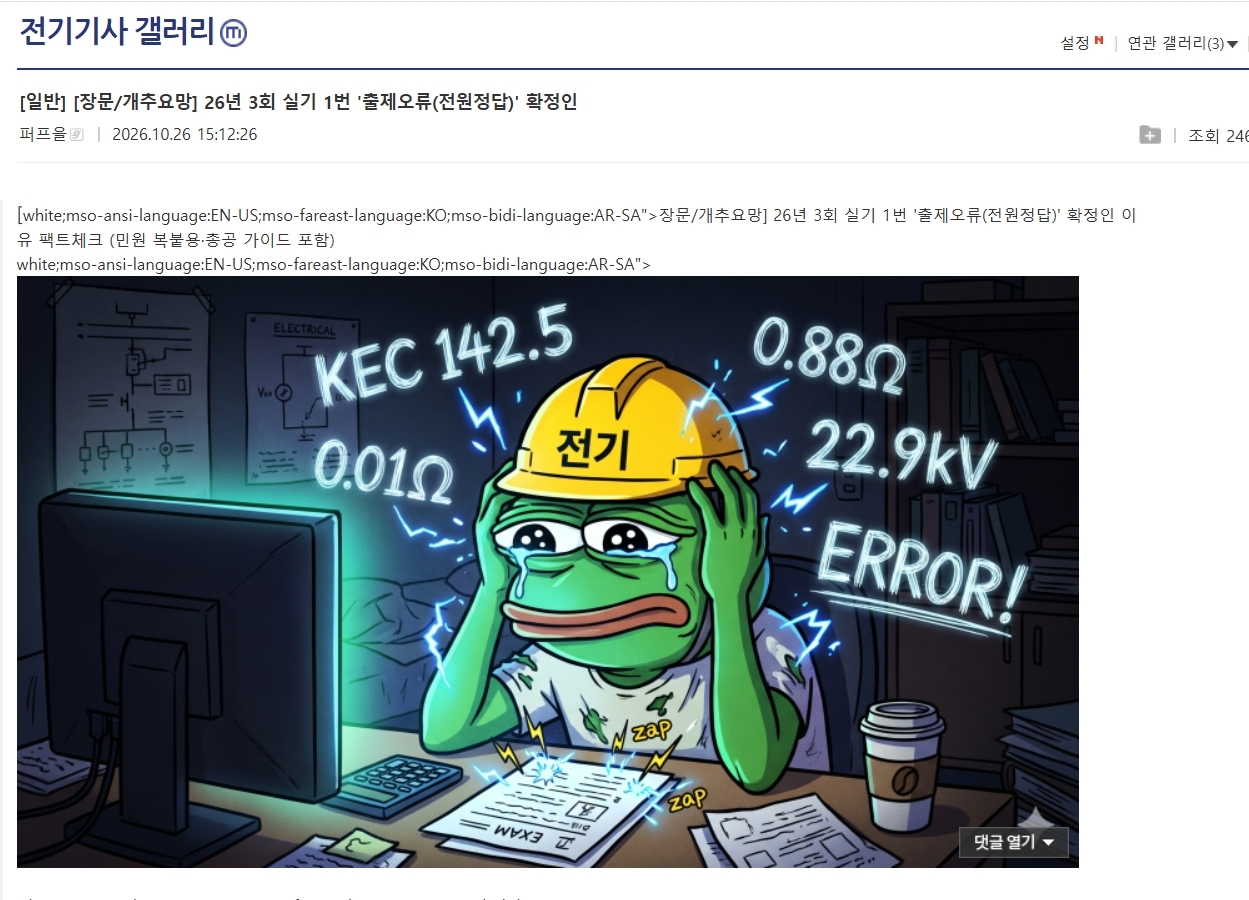
After the third regular electrical engineer practical exam concluded on Oct. 25, test-takers in online communities split over whether the answer to Question 1 was 0.01Ω or 0.88Ω, according to Kim Yeong-ju, one of the candidates. Kim filed a tip with The Herald Business the following day, Oct. 26, arguing that neither solution satisfies the question's stated conditions, and submitted a complaint to the National Sinmungo public petition system asking that the question be ruled an error and all candidates awarded full credit.
0.01Ω or 0.88Ω? Candidates demand answer key and scoring criteria
According to the tip and complaint received Saturday, Question 1 asked candidates to calculate the neutral-point grounding resistance under the Korea Electrotechnical Code for a delta-wye 154kV/22.9kV transformer when the secondary single-line short-circuit current is 15kA. Kim explained that 0.01Ω is obtained by substituting 15kA into the KEC formula 150/Ig, while 0.88Ω is derived by dividing the secondary phase voltage (22.9kV ÷ √3) by 15kA.
Kim argued that neither approach holds up. The regulation underlying the 0.01Ω solution applies to transformers that connect a high- or extra-high-voltage circuit to a low-voltage circuit, but the transformer in the question has extra-high voltage on both the primary and secondary sides, meaning no low-voltage circuit is present. Kim also noted that the current the formula requires is the primary-side ground-fault current, whereas the question provides the secondary-side short-circuit current. As for the 0.88Ω solution, Kim said it relies on a general circuit formula not found in the KEC — contradicting the question's instruction to apply the KEC — and assumes that transformer and line impedance can be ignored, an assumption the question never states.
Kim said candidates who attempted to follow the question's conditions but could not derive a formula would be unfairly penalized if only one specific numerical answer is accepted. Kim called for all candidates to receive full credit regardless of what they wrote, as is done for flawed multiple-choice questions. "The national technical qualification exam is a public certification system that countless young people and working adults prepare for because it is directly tied to their livelihoods," Kim said. "The agency should release a provisional answer key for practical exams just as it does for written exams, establish an official objection procedure, and inform candidates of the outcome of any error review." Kim added that the only response received from the National Sinmungo system was that scoring criteria are not subject to public disclosure.
Calls for the agency to disclose the basis for its electrical engineer practical exam scoring surfaced last year as well. A candidate at the time, Kim Gyeong-jo, said the agency had not provided a detailed explanation of why a particular answer was correct. Whether Question 1 this year contained an error, and how the agency intends to score it, could not be confirmed from publicly available materials.
Question paper opened a day early; exam-day video system went dark
During the second regular general mechanical engineer practical exam held July 25 and 26, a staff member and an examiner at one test site accidentally opened and used the question paper scheduled for July 26 a day early, on July 25. When the contents spread through candidate online communities, the agency determined that fairness among candidates had been compromised and designated all 57 candidates who sat the exam on July 26 for retakes. Fifty-six of them ultimately took the retake.
On Nov. 1, a video program file error struck all 14 test sites nationwide during the third regular biological classification engineer (zoology) practical exam, which had 330 candidates sitting. At nine sites, 210 candidates started the exam roughly an hour late after the error was corrected. The remaining 120 candidates at five sites completed only the written portion and were sent home. The video component accounts for 70 of the 100 points in the practical exam. The agency apologized, attributing the failure to inadequate pre-exam file checks, and scheduled a makeup video exam for Friday through Sunday. Each candidate eligible for the retake will receive 100,000 won ($75) in compensation plus travel expenses.
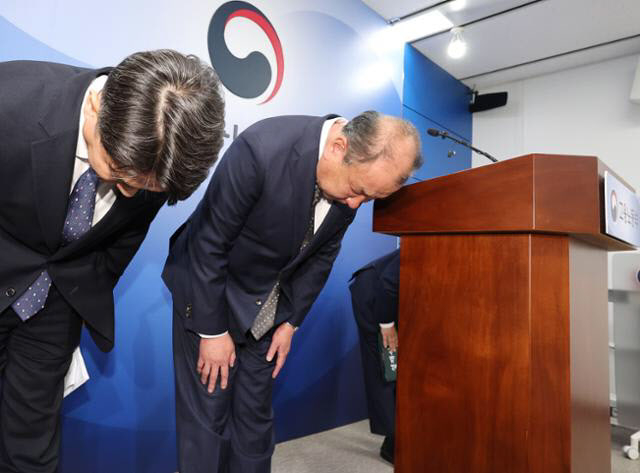
President Lee Byeong-hun took office on June 15. Following the July incident, Lee held his first press briefing on Aug. 25, saying an internal audit had confirmed negligent management and that personnel procedures would follow. He outlined "swift, preemptive and transparent" response as the agency's guiding principles and pledged to review the entire process from exam registration through question-setting, administration, scoring and results announcement. On Oct. 30, the agency announced it had concluded the activities of a national growth promotion committee that had listed "restoring trust in national qualifications" as a key agenda item. Two days later, the video system failure hit the biological classification engineer exam.
'Being told to retake the exam is itself an injustice' — two institutional warnings
During the first regular engineer and industrial engineer practical exam held April 23, 2023, under then-President Eo Su-bong, answer sheets belonging to 609 candidates were shredded before scoring, and four more answer sheets from the same test site went missing. Of the 613 affected candidates, 566 sat a retake, and some filed a class-action lawsuit against the agency.
One candidate who had sat the vocational counselor exam said that more than a month had passed since the original test and that a significant portion of what had been studied had been forgotten. "Being told to retake the exam at this point is itself an injustice," the candidate said. Eo resigned to take responsibility for the incident. The Ministry of Employment and Labor issued an institutional warning to the agency in September of that year after releasing the results of a special audit, and called for disciplinary action, formal warnings or cautions against 22 employees and others.
In June 2025, under then-President Lee Woo-young, a computer scoring error in the first-round certified labor attorney exam caused five candidates to be marked as having passed before their results were rescinded. While investigating the situation, the agency discovered the same error had occurred in the 2024 exam but did not issue a corrected pass announcement for that test. The Ministry of Employment and Labor issued a second institutional warning to the agency in October last year, saying the opaque handling of the incident had undermined the fairness and credibility of the certification body.
According to materials the agency submitted to People Power Party lawmaker Kim So-hee at the time, seven of the 11 exam mismanagement incidents recorded from 2020 through last year's national audit did not result in even a formal caution for the staff members responsible.
Disputes over scoring fairness have also reached the courts. A Ministry of Employment and Labor audit of the 2021 second-round tax accountant exam found that examiners had awarded different scores to answers with identical content. In a damages suit brought by 18 candidates, the Supreme Court last year overturned a partial ruling in favor of the plaintiffs and remanded the case to Seoul High Court, saying a determination of state liability required examination of the procedures for appointing examiners and whether the duty of care in question-setting and scoring had been breached.
The agency said it would investigate the cause of the biological classification engineer incident and draw up measures to prevent a recurrence. However, the results of the final audit and personnel actions promised after the July incident have yet to be announced. Despite two institutional warnings and a pledge to review the entire exam process, retakes have continued. Observers say the agency's remaining challenge is to explain how it has changed its pre-exam site inspection procedures since the incidents, and on what basis it evaluates objections to questions and scoring — and how it communicates those decisions to candidates.
fact0514@heraldcorp.com