Index falls below 5,000 intraday for first time since Feb. 6
Kospi market triggers circuit breaker for 11th time this year
Democratic Party landslide fuels fears of AI data center regulation
Samsung Electronics, SK hynix tumble around 10%, 12%
Kosdaq also plunges; sell-side sidecar triggered for 17th time this year
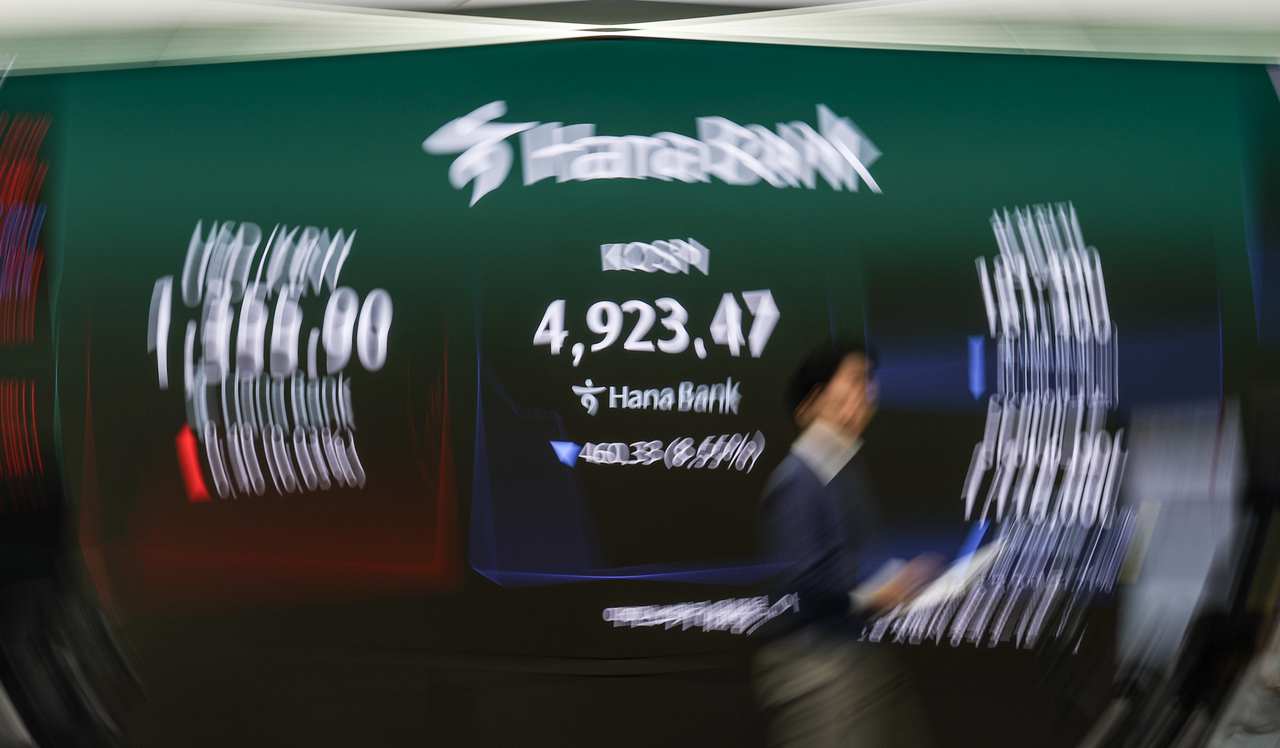
South Korea's benchmark Kospi tumbled below the 5,000 mark intraday on Friday, battered by a wave of selling in AI-related stocks that originated on Wall Street overnight.
Fears that a sweeping Democratic Party victory in US elections would bring tighter regulation of data centers hammered semiconductor shares, triggering a flood of sell orders the moment the Korean market opened. A circuit breaker halted trading just three minutes after the open — the 11th such suspension on the Kospi market this year — while Samsung Electronics and SK hynix plunged roughly 10% and 12%, respectively.
According to Korea Exchange, the Kospi opened down 120.54 points, or 2.24%, at 5,263.26, then rapidly extended its losses to fall below 5,000. The index had last traded below that level on Feb. 6, making Friday's breach a nine-month low. As of 10 a.m., the Kospi was trading at 4,934.09, down 8.35%.
With the index down more than 8% shortly after the open, a Level 1 circuit breaker was triggered at around 9:03 a.m., suspending all trading for 20 minutes. It was the 11th circuit breaker activation on the Kospi market this year and the first since Oct. 15 — a gap of 16 trading sessions.
Even after the circuit breaker was lifted, the selloff continued, prompting a sell-side sidecar on the Kospi market at around 9:34 a.m. It was the second consecutive day of sell-side sidecars, following one on Thursday.
Foreign investors led the decline, posting net selling of 133.1 billion won ($99.2 million), while retail and institutional investors were net buyers of 42.6 billion won and 86.5 billion won, respectively.
The Kospi's plunge followed a broad technology-led selloff on Wall Street overnight, where the Democratic Party's landslide election win stoked fears of stricter regulation on AI data centers.
AI-related stocks on Wall Street were hammered, with SanDisk falling 22.26%, Micron dropping 17.46% and SK hynix's American depositary receipts sliding 13.40%.
The tech-heavy NASDAQ Composite fell 5.52% — its steepest single-day drop since April last year, when US President Donald Trump's reciprocal tariff announcement sent shockwaves through Wall Street. The Philadelphia Semiconductor Index also plummeted 12.25%, its largest decline since the early days of the COVID-19 pandemic in 2020.
The CBOE Volatility Index, Wall Street's so-called fear gauge, surged as high as 28.09 intraday, hitting its highest level in eight months.
The selloff was driven by growing concern that the Democratic Party's victories — not only in Congress but also in key states such as Texas and Georgia, where data center development is concentrated — could lead to tighter restrictions on new data center construction. That, in turn, raised fears that the massive capital expenditure and semiconductor demand that had underpinned AI-related stock gains could slow more quickly than expected.
The overnight carnage on Wall Street sent shares of Samsung Electronics and SK hynix into freefall at the open. Immediately after the circuit breaker was triggered, Samsung Electronics had fallen 9.98% to 181,400 won, dropping below the 200,000-won threshold, while SK hynix tumbled 11.71% to 1,116,000 won.
Samsung Electronics touched an intraday low of 175,300 won at one point. If the stock closes in the 180,000-won range on the day, it would mark the first close below the 190,000-won level since April 7 last year — roughly seven months ago.
The Kosdaq also suffered steep losses. The index opened down 23.98 points, or 3.53%, at 654.43, then extended its decline, triggering a sell-side sidecar at around 9:06 a.m. — the 17th such activation on the Kosdaq market this year.
On the Kosdaq, foreign investors were net buyers of 48.3 billion won, while retail and institutional investors were net sellers of 48.9 billion won and 400 million won, respectively. Among the market's top-cap stocks, most were in the red, including Alteogen, Ecopro and Ecopro BM.
The government said it would mobilize all available resources to stabilize markets. Deputy Prime Minister and Finance Minister Lee Hyeong-il, presiding over a meeting of ministers on external economic affairs at Government Complex Seoul, said relevant agencies would "proactively devise and promptly implement necessary measures to prevent our stock market from overreacting relative to economic fundamentals."
Lee added that "experts forecast AI investment will continue, and the fundamentals of our economy are more solid than ever," and that the government would "closely monitor external uncertainties while also creating new opportunities for cooperation."
In practice, analysts still believe the market is overreacting to fears of an AI data center investment slowdown stemming from potential regulation. While the risk of construction delays has grown, there is insufficient evidence that existing supply contracts or semiconductor earnings have been impaired, and the likelihood of a sweeping federal-level halt to data center construction remains limited, they said.
"The Democratic Party's landslide win means we will have to contend with fears of data center construction delays and rising costs, but the likelihood of a sweeping federal-level construction halt remains limited," said Lee Gyeong-min, an analyst at Daishin Securities.

th5@heraldcorp.com