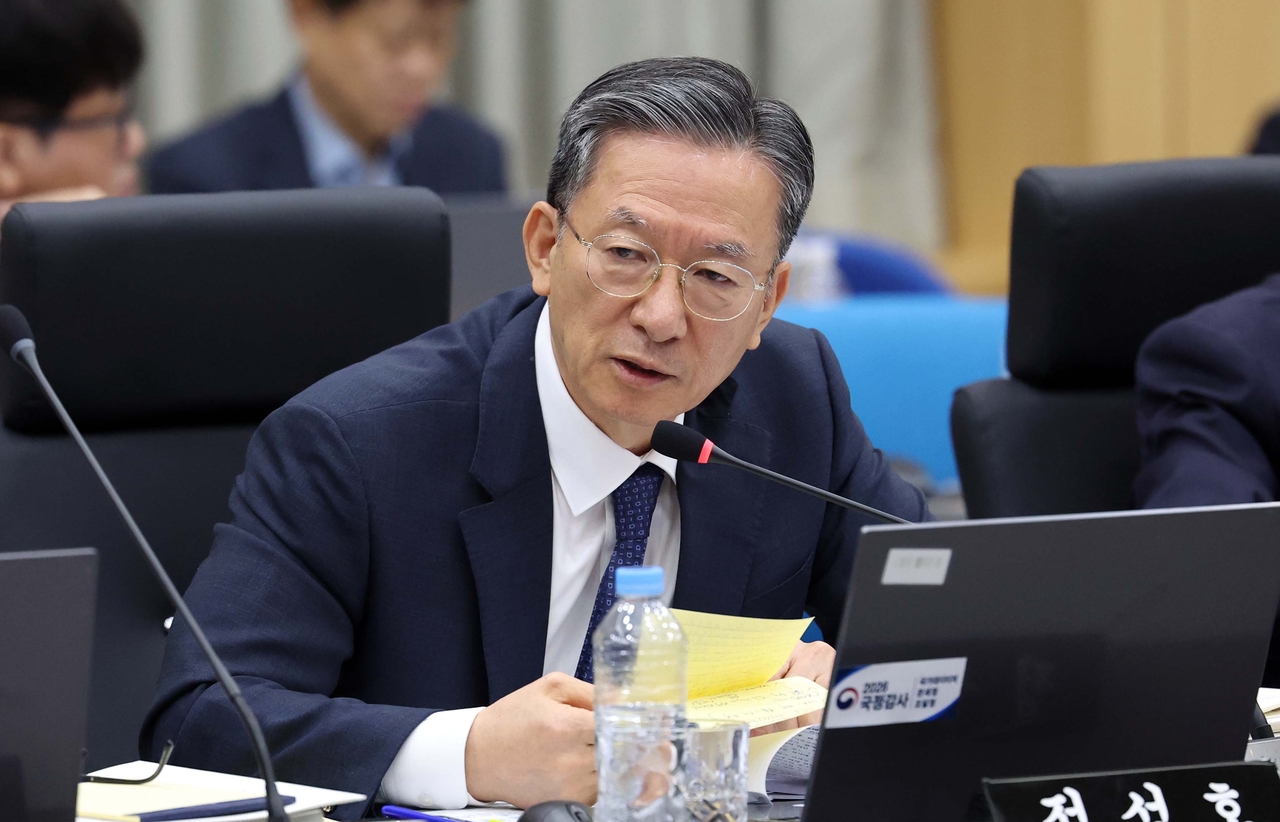
Jeong Seong-ho, a Democratic Party of Korea lawmaker and close ally of President Lee Jae Myung who served as the first justice minister under the Lee administration, said Friday he has serious reservations about the ruling party's push for the so-called fabricated indictment special prosecutor act, saying it needed more deliberation.
Appearing on MBC Radio's "Kim Jong-bae's Focus" that day, Jeong said he had "considerable doubts" about whether a special prosecutor investigation could be conducted properly, as the Democratic Party was set to pass the bill at a plenary session of the National Assembly the same day.
"Prosecutors at the prosecution office are barred from conducting investigations, and while some prosecutors are at the Serious Crimes Investigation Agency, there are not many who specialize in complex investigations," Jeong said. He added that a parliamentary investigation had already taken place and that the prosecution had formed a human rights committee to conduct its own internal probe, creating some overlap.
Jeong then questioned whether prosecutors stripped of investigative authority would even have the will to pursue the case if assigned to the special prosecutor team. "Even if they proceed with the will to do so, when results come out, won't they just be attacked again — accused of conducting a shoddy investigation?" he said.
Jeong also recalled the difficulty of securing personnel during his tenure as justice minister, when he had to dispatch prosecutors to a second comprehensive special prosecutor investigation. "I had to barely persuade capable prosecutors to go, because they didn't want to," he said, underscoring the challenge of staffing such probes.
He also raised the prospect of the effort yielding little despite a dramatic start, invoking a Korean idiom meaning much fanfare but little result. On whether the alleged fabricated indictments could actually be proven, he said, "I don't think it will be easy."
Jeong said proving fabricated indictments would require witnesses to reverse their statements or the discovery of contradictory evidence. He noted that internal prosecution reviews, a probe by the Ministry of Justice's Prosecution Human Rights and Future Committee, and an investigation by the Seoul High Prosecutors Office had all struggled to substantiate the allegations.
"It is certain that there was an overzealous investigation, but whether that can be called fabrication — whether you can directly connect the two — that has not been easy," he said.
On concerns that questions persist even after the Democratic Party dropped a provision that would have granted the special prosecutor the power to withdraw indictments, Jeong said it would not be easy for the prosecution office to withdraw charges without a final guilty verdict in place.
Regarding the People Power Party's demand that the Democratic Party give up its right to recommend special prosecutor candidates, Jeong pushed back. "We need a special prosecutor who can investigate forcefully, reflecting the will of the victims," he said. "It is actually right for the Democratic Party to make the recommendation."
Jeong also weighed in on the Democratic Party's currently suspended push for a parliamentary investigation into Chief Justice Jo Hee-dae. "If it is formed by a National Assembly vote, it will consume a considerable amount of time — is that desirable when people's livelihoods are this difficult?" he said.
bigroot@heraldcorp.com