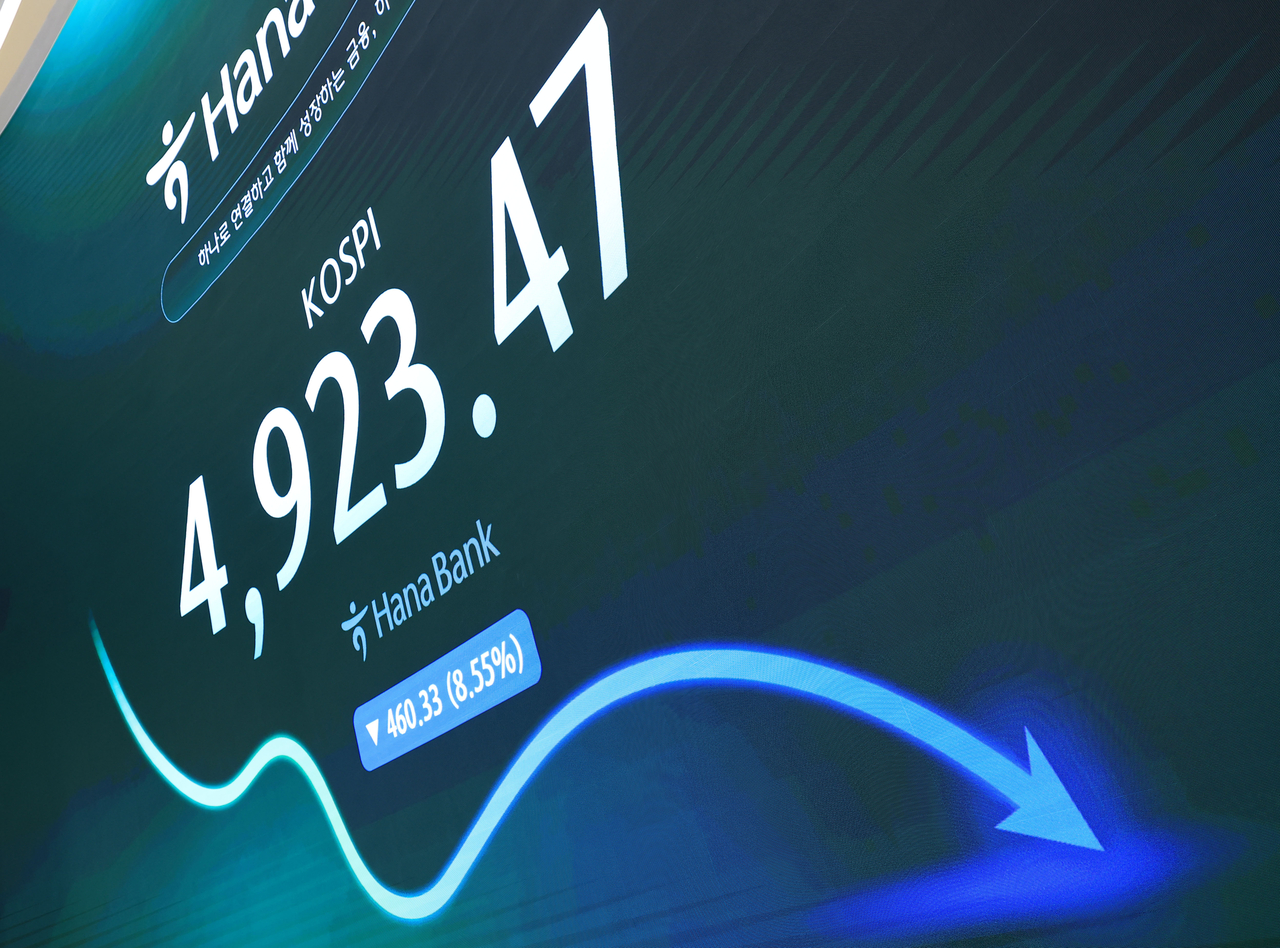
South Korea's stock market plunged into panic selling as fears over US AI investment rippled across the region. Sidecars were triggered on both the Kospi and Kosdaq on Thursday, and on Friday the Kospi shed the 5,000-point mark in early trading before a circuit breaker halted transactions. A Democratic Party sweep of both chambers of Congress in the US midterm elections — a so-called blue wave — has stoked concerns about tighter data center regulation, dealing an outsized blow to South Korea's market, which carries heavy exposure to semiconductor stocks.
According to Koscom, the Kospi fell 5.28% on Thursday, when the US midterms were held, recording the steepest decline among major indexes in South Korea, China and Japan. Taiwan's Taiex also dropped 3.20% that day, the second-largest decline after the Kospi. By contrast, major indexes in Japan, mainland China and Hong Kong finished higher.
As Asian markets opened Friday morning, the Kospi extended its losses to around 8% in early trading. Taiwan's Taiex also failed to escape the selling pressure, opening down more than 6% from the previous session after falling below 39,000 points, before widening its decline to nearly 9% in early trading.
Japan's major indexes also weakened, though by less than South Korea and Taiwan. The Nikkei 225 opened Friday above 60,000 points with a roughly 1% decline from the previous session, before widening its losses to around 6% in early trading and hovering near 57,000 as of 10 a.m.
The Kospi's pronounced underperformance within Asia reflects its heavy dependence on large-cap semiconductor stocks. Of the 3.4 trillion won ($2.53 billion) in net selling by foreign investors in the Kospi on Thursday, Samsung Electronics (1.16 trillion won) and SK hynix (1.52 trillion won) together accounted for roughly 70%. Han Ji-young, a researcher at Kiwoom Securities, said semiconductor stocks contributed about 4.6 percentage points of Thursday's 5.3% Kospi decline, with all other sectors accounting for the remaining 0.7 percentage points. "The semiconductor selloff is dampening investor sentiment across the broader market, but the intensity of the shock varies by sector," Han said.
Taiwan's market, which shares South Korea's heavy tilt toward semiconductors, also proved vulnerable to concerns about US data center regulation. Semiconductor stocks account for more than 50% of the Taiex, with TSMC alone making up over 40%. The index fell 3.20% on Thursday. Huang Yuan-ching, chief strategist at Taishin Securities Investment Advisory, forecast the index would move in the 40,000–42,000 range in the near term, but as of 10 a.m. Friday the Taiex had already fallen below 40,000.
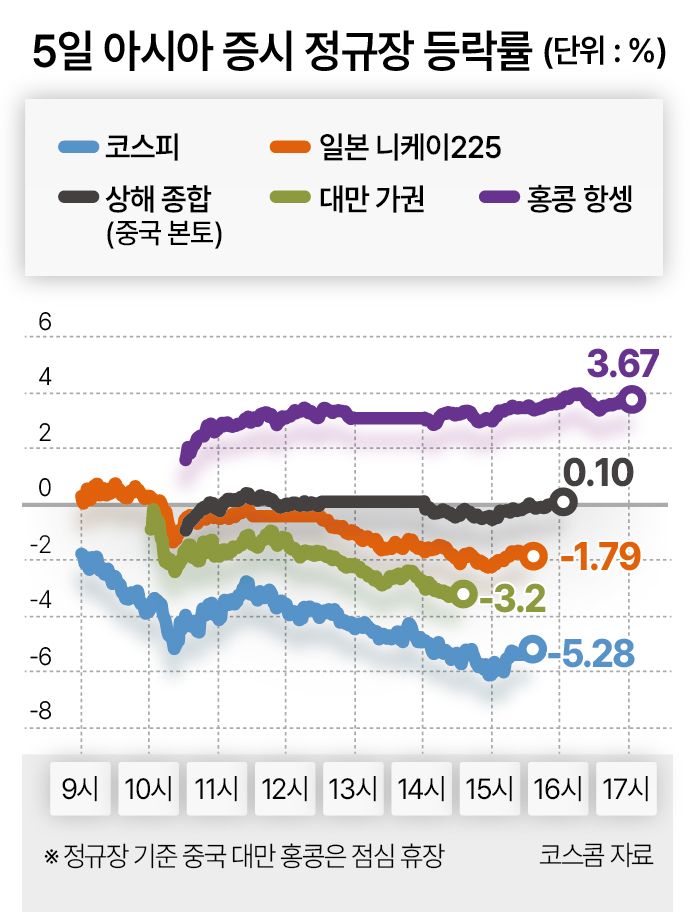
The vulnerability of South Korean and Taiwanese markets stands out even more sharply when compared with the rest of Asia on the same day. The contrast with China and Hong Kong — where some indexes actually finished higher — is particularly striking. China's Shanghai Composite rose 0.10% on Thursday, while Hong Kong's Hang Seng gained more than 3%. Both markets have relatively limited direct exposure to US big-tech data center spending, and domestic Chinese consumption and homegrown technology companies provided additional support.
Japan also fared better than South Korea or Taiwan. The Nikkei 225, which tracks 225 major listed companies, fell just 1.79% on Thursday. The Topix, a broader index covering roughly 1,600 listed companies, actually closed up 1.16%. Semiconductor inspection and manufacturing equipment stocks tumbled, but automakers such as Toyota — which raised its earnings outlook — and non-AI sectors helped prop up the market. Expectations that falling global oil prices would ease cost burdens also supported automakers, transport companies and other non-AI industries.
Market participants largely attribute the sharp selloff to fears that data center construction timelines could be pushed back. Concerns over the power and water demands of data centers, combined with local community opposition, have fueled discussions about tighter US regulation. The worry is that even if AI chip orders hold steady, delays in construction could push back delivery schedules and revenue recognition. Markets appear to be pricing in the possibility of a shift in the pace of capital deployment and when those results will show up in earnings.
Kang Jin-hyuk, a researcher at Shinhan Securities, said robust AI demand does not guarantee strong earnings or financial stability for every company in the AI supply chain. "Supply constraints do not undermine demand itself, but they can delay revenue recognition, extend the payback period on investments and increase financing burdens," Kang said.

kacew@heraldcorp.com