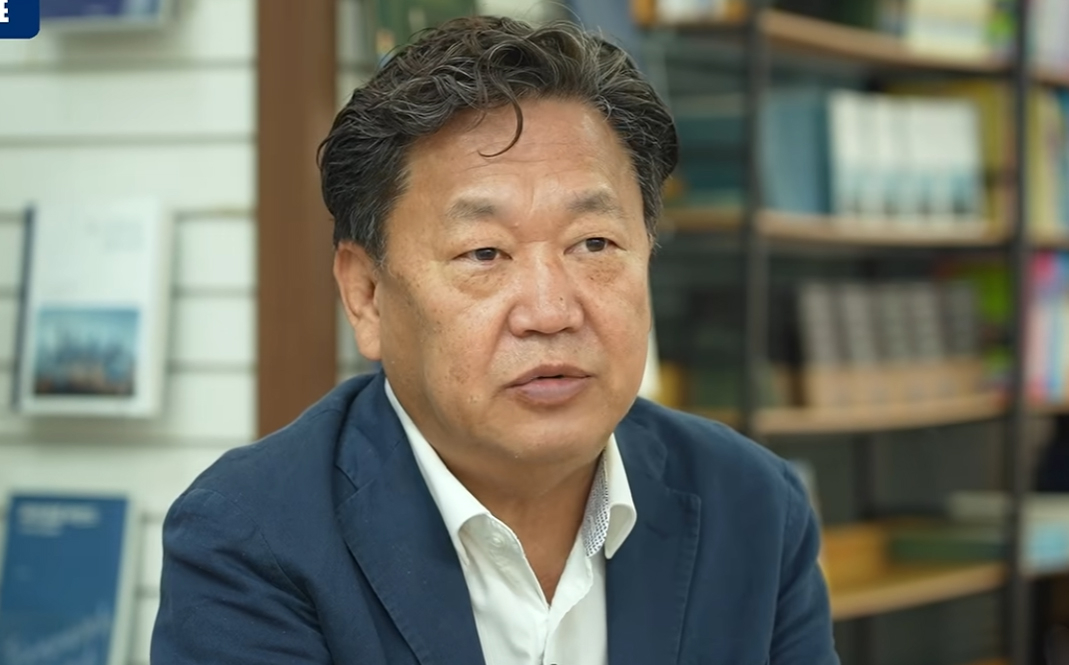
South Korean stocks plunged for a second consecutive day Friday, deepening anxiety among retail investors who had watched their holdings lose half their value in a matter of months. As investors cried out that they could no longer hold on, John Lee, head of the John Lee Rich School and a longtime advocate of long-term investing, urged them to stay invested — reminding them that stock investment exists to prepare for retirement.
Kospi fell below the 5,000-point mark during intraday trading Friday for the first time in nine months, sliding as far as 4,911.28 — a drop of 8.78 percent at its lowest point. The index closed down 324.11 points, or 6.02 percent, at 5,059.69.
Friday's decline was the steepest single-day loss since Oct. 15, when Kospi fell 7.57 percent. The closing level was the lowest since March 31, when the index finished at 5,052.46. Over two sessions, Kospi shed a total of 624.11 points, or 10.98 percent. Measured from its closing high of 9,114.55 recorded on June 22, the index has fallen 44.5 percent.
As retail investors who suffered heavy losses began questioning Lee's long-term investment principles, his response drew wide attention.
According to the YouTube channel "Y Street — The Compound Effect of Knowledge and Assets," when an investor said Thursday that their account had been "cut in half" and asked whether to keep holding, Lee shot back: "Didn't I tell you to invest for the long term?"
"The reason to invest in stocks is to prepare for retirement," Lee said. "People try to make money in the short term — that's impossible." Lee went on to say, "If you're investing for retirement, shouldn't what matters be 20 years from now? Why are you panicking over the past six months? Your money isn't melting away — it's volatility. You invest 10 million won ($7,450) and it can become 5 million won. Just keep investing consistently."
Lee particularly cautioned investors against reacting too strongly to short-term market signals such as share price charts or the trading patterns of foreign investors.
"Buying stocks means buying a company," he said. "When a share price falls, the first thing to check is whether something has gone wrong with the company — whether sales have dropped." He added, "Selling because foreign investors are selling, because you feel anxious — that's watching the market, not the company. If the company is doing well, you should be able to hold even when the share price falls."
On the broader market selloff, Lee said Kospi could fall to 4,000 and a 50 percent loss was entirely possible, but stressed that investors needed to ask whether Korean companies were truly in danger of collapse and whether there were real problems with corporate fundamentals.
"If many companies are still making money but share prices are falling, volatility can actually be a good opportunity," he said. "People buy when things are expensive and absolutely refuse to buy when things are cheap."
Lee advised retail investors to "mechanically buy a fixed amount every month." Rather than trying to time market peaks and troughs, he recommended setting aside 10 to 20 percent of monthly income as discretionary funds and investing through a regular accumulation plan.
"There will be good times and bad times, but if you have 15 to 20 years left until retirement, the fact that share prices have been cut in half right now could actually be an opportunity to buy more cheaply," he said.
He also advised against concentrating assets in individual stocks, recommending diversification through instruments such as exchange-traded funds instead. For investors nearing retirement, he suggested reducing equity exposure to around 30 to 40 percent of their portfolio and using bond ETFs or dividend-paying real estate investment trusts to hedge against volatility.
betterj@heraldcorp.com